1 .
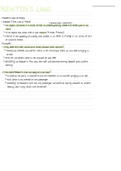
Newton 's Laws of Motion
1. 1 Newton 's First Law of Motion
( moving with constant)
↳ unless it is acted
an object continues in a state of rest or uniform a
velocity upon a net
force
↳
if an object has mass then it has inertia (M mass ,
9 inertia )
↳ inertia is the of
property of a
body that causes it to resist a change in its state rest
or uniform motio
Examples
1 .
Why does the rider continue to move forward after collision ?
↳
during the collision , the barrier exerts a net horizontal force on the bike
bringing it
to rest
↳ this net horizontal rider
force is not exerted on the
↳
according to Newton 's First Law , the rider will continue moving forward with uniform
velocity
2. How does Newton 's first cash ?
law
apply to a car
↳ a massive net to its motion )
force is exerted on the car (opposite
bringing it to rest
↳
this force is not exerted on the pass anger
↳
according to Newton 's first law , the
passanger will continue
moving forward at uniform
until strike the windshield
velocity they
, I 2 .
Graphs
divided
Directly proportional : two variables with a constant ratio When one variable is
•
.
by the other , the answer is
always a constant
i. e -
-
YT =
constant
Directly proportional graph passing through
will be a
:
straight line
•
the
origin
Inversely proportional two variables with constant product When one variable is
•
: a .
the answer is
multiplied by the other , always a constant
i. e x.
y constant
-
-
.
Inversely proportional graph : will be
hyperbole
•
a
1. 3 Newton 's Second Law of motion
↳ when a net force is applied to an object it accelerates in the direction of the net
force The acceleration
.
directly proportional
is to the net force (ax Fnet ) and inversely
mass (aim )
proportional to the
I. 4
Application of Newton 's second law to horizontal 1 vertical motion
↳ a net force is a
single force that has the same effect as the
original forces acting
together
↳
net force is
equal to the vector sum of individual forces ( Fn et Fi tf Fs )
-
t
-
Newton 's Laws of Motion
1. 1 Newton 's First Law of Motion
( moving with constant)
↳ unless it is acted
an object continues in a state of rest or uniform a
velocity upon a net
force
↳
if an object has mass then it has inertia (M mass ,
9 inertia )
↳ inertia is the of
property of a
body that causes it to resist a change in its state rest
or uniform motio
Examples
1 .
Why does the rider continue to move forward after collision ?
↳
during the collision , the barrier exerts a net horizontal force on the bike
bringing it
to rest
↳ this net horizontal rider
force is not exerted on the
↳
according to Newton 's First Law , the rider will continue moving forward with uniform
velocity
2. How does Newton 's first cash ?
law
apply to a car
↳ a massive net to its motion )
force is exerted on the car (opposite
bringing it to rest
↳
this force is not exerted on the pass anger
↳
according to Newton 's first law , the
passanger will continue
moving forward at uniform
until strike the windshield
velocity they
, I 2 .
Graphs
divided
Directly proportional : two variables with a constant ratio When one variable is
•
.
by the other , the answer is
always a constant
i. e -
-
YT =
constant
Directly proportional graph passing through
will be a
:
straight line
•
the
origin
Inversely proportional two variables with constant product When one variable is
•
: a .
the answer is
multiplied by the other , always a constant
i. e x.
y constant
-
-
.
Inversely proportional graph : will be
hyperbole
•
a
1. 3 Newton 's Second Law of motion
↳ when a net force is applied to an object it accelerates in the direction of the net
force The acceleration
.
directly proportional
is to the net force (ax Fnet ) and inversely
mass (aim )
proportional to the
I. 4
Application of Newton 's second law to horizontal 1 vertical motion
↳ a net force is a
single force that has the same effect as the
original forces acting
together
↳
net force is
equal to the vector sum of individual forces ( Fn et Fi tf Fs )
-
t
-