-
and direction
>
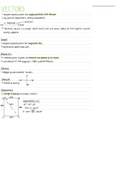
physical quantity which has magnitude (size )
>
eg position displacement velocity
,
,
,
acceleration
> direction
tail
1 magnitude
them
original
>
as the
resultant vector is a
single vector which has the same effect vectors
acting together
scalars
>
physical quantity which has magnitude only
>
eg distance , speed ,
mass
,
time
Position (X )
> reference point is where we measure the position of an object
> use positive (t ) and negative C- 1 signs to denote direction
Distance
>
length of path travelled ( scalar )
0°
Direction
270° -90°
stated as
bearing
>
1800
Displacement
>
change in
position of a body ( vector )
Atl g 40M
•
B
30M¥
displacement at C
* " "° " "
"
30M 50m at 126,87°
I =
tan -11%8-1=36,870
D•
•
40M C
, distance
speed average speed
=
time
rate of of distance ( scalar )
change
>
velocity average velocity
=
di%¥m%M ( constant velocity )
> rate of change of displacement ( vector )
>
instantaneous velocity is the
velocity at a
particular instant in time
change in velocity
Acceleration acceleration =
time
rate in
>
change of velocity
*
projectiles take the same time to reach their
greatest height from the point of
upward launch as
they take to fall back to the
point of launch
and direction
>
physical quantity which has magnitude (size )
>
eg position displacement velocity
,
,
,
acceleration
> direction
tail
1 magnitude
them
original
>
as the
resultant vector is a
single vector which has the same effect vectors
acting together
scalars
>
physical quantity which has magnitude only
>
eg distance , speed ,
mass
,
time
Position (X )
> reference point is where we measure the position of an object
> use positive (t ) and negative C- 1 signs to denote direction
Distance
>
length of path travelled ( scalar )
0°
Direction
270° -90°
stated as
bearing
>
1800
Displacement
>
change in
position of a body ( vector )
Atl g 40M
•
B
30M¥
displacement at C
* " "° " "
"
30M 50m at 126,87°
I =
tan -11%8-1=36,870
D•
•
40M C
, distance
speed average speed
=
time
rate of of distance ( scalar )
change
>
velocity average velocity
=
di%¥m%M ( constant velocity )
> rate of change of displacement ( vector )
>
instantaneous velocity is the
velocity at a
particular instant in time
change in velocity
Acceleration acceleration =
time
rate in
>
change of velocity
*
projectiles take the same time to reach their
greatest height from the point of
upward launch as
they take to fall back to the
point of launch