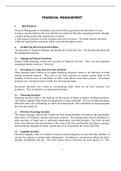
FINANCIAL MANAGEMENT
1. DEFINITION
Financial Management is a discipline concerned with the generation and allocation of scarce
resources (usually funds) to the most efficient use within the firm (the competing projects) through
a market pricing system (the required rate of return).
A firm requires resources in form of funds raised from investors. The funds must be allocated
within the organization to projects which will yield the highest return.
2. SCOPE OF FINANCE FUNCTIONS
The functions of Financial Manager can broadly be divided into two: The Routine functions and
the Managerial Functions.
2.1 Managerial Finance Functions
Require skilful planning, control and execution of financial activities. There are four important
managerial finance functions. These are:
(a) Investment or Long-term asset-mix decisions
These decisions (also referred to as capital budgeting decisions) relates to the allocation of funds
among investment projects. They refer to the firm's decision to commit current funds to the
purchase of fixed assets in expectation of future cash inflows from these projects. Investment
proposals are evaluated in terms of both risk and expected return.
Investment decisions also relates to recommitting funds when an old asset becomes less
productive. This is referred to as replacement decision.
(b) Financing decisions
Financing decision refers to the decision on the sources of funds to finance investment projects.
The finance manager must decide the proportion of equity and debt. The mix of debt and equity
affects the firm's cost of financing as well as the financial risk. This will further be discussed under
the risk return trade-off.
(c) Division of earnings decision
The finance manager must decide whether the firm should distribute all profits to the shareholder,
retain them, or distribute a portion and retain a portion. The earnings must also be distributed to
other providers of funds such as preference shareholder, and debt providers. The firm's divided
policy may influence the determination of the value of the firm and therefore the finance manager
must decide the optimum dividend - payout ratio so as to maximize the value of the firm.
(d) Liquidity decision
The firm's liquidity refers to its ability to meet its current obligations as and when they fall due. It
can also be referred as current assets management. Investment in current assets affects the firm's
liquidity, profitability and risk. The more current assets a firm has, the more liquid it is. This
1
,implies that the firm has a lower risk of becoming insolvent but since current assets are non-
earning assets the profitability of the firm will be low. The converse will hold true.
The finance manager should develop sound techniques of managing current assets to ensure that
neither insufficient nor unnecessary funds are invested in current assets.
2.2 Routine functions
For the effective execution of the managerial finance functions, routine functions have to be
performed. These decisions concern procedures and systems and involve a lot of paper work and
time. In most cases these decisions are delegated to junior staff in the organization. Some of the
important routine functions are:
(a) Supervision of cash receipts and payments
(b) Safeguarding of cash balance
(c) Custody and safeguarding of important documents
(d) Record keeping and reporting
The finance manager will be involved with the managerial functions while the routine functions
will be carried out by junior staff in the firm. He must however, supervise the activities of these
junior staff.
2
, 3. OBJECTIVES OF A BUSINESS ENTITY
Any business firm would have certain objectives which it aims at achieving. The major goals of a
firm are:
Profit maximization
Shareholders' wealth maximization
Social responsibility
Business Ethics
Growth
(a) Profit maximization
Traditionally, this was considered to be the major goal of the firm. Profit maximization refers to
achieving the highest possible profits during the year. This could be achieved by either increasing
sales revenue or by reducing expenses. Note that:
Profit = Revenue – Expenses
The sales revenue can be increased by either increasing the sales volume or the selling price. It
should be noted however, that maximizing sales revenue may at the same time result to increasing
the firm's expenses.
The pricing mechanism will however, help the firm to determine which goods and services to
provide so as to maximize profits of the firm.
The profit maximization goal has been criticized because of the following:
(a) It ignores time value of money
(b) It ignores risk and uncertainties
(c) it is vague
(d) it ignores other participants in the firm rather than the shareholders
(b) Shareholders' wealth maximization
Shareholders' wealth maximization refers to maximization of the net present value of every
decision made in the firm. Net present value is equal to the difference between the present value of
benefits received from a decision and the present value of the cost of the decision. (Note this will
be discussed further in Lesson 2).
A financial action with a positive net present value will maximize the wealth of the shareholders,
while a decision with a negative net present value will reduce the wealth of the shareholders.
Under this goal, a firm will only take those decisions that result in a positive net present value.
Shareholder wealth maximization helps to solve the problems with profit maximization. This is
because, the goal:
3
1. DEFINITION
Financial Management is a discipline concerned with the generation and allocation of scarce
resources (usually funds) to the most efficient use within the firm (the competing projects) through
a market pricing system (the required rate of return).
A firm requires resources in form of funds raised from investors. The funds must be allocated
within the organization to projects which will yield the highest return.
2. SCOPE OF FINANCE FUNCTIONS
The functions of Financial Manager can broadly be divided into two: The Routine functions and
the Managerial Functions.
2.1 Managerial Finance Functions
Require skilful planning, control and execution of financial activities. There are four important
managerial finance functions. These are:
(a) Investment or Long-term asset-mix decisions
These decisions (also referred to as capital budgeting decisions) relates to the allocation of funds
among investment projects. They refer to the firm's decision to commit current funds to the
purchase of fixed assets in expectation of future cash inflows from these projects. Investment
proposals are evaluated in terms of both risk and expected return.
Investment decisions also relates to recommitting funds when an old asset becomes less
productive. This is referred to as replacement decision.
(b) Financing decisions
Financing decision refers to the decision on the sources of funds to finance investment projects.
The finance manager must decide the proportion of equity and debt. The mix of debt and equity
affects the firm's cost of financing as well as the financial risk. This will further be discussed under
the risk return trade-off.
(c) Division of earnings decision
The finance manager must decide whether the firm should distribute all profits to the shareholder,
retain them, or distribute a portion and retain a portion. The earnings must also be distributed to
other providers of funds such as preference shareholder, and debt providers. The firm's divided
policy may influence the determination of the value of the firm and therefore the finance manager
must decide the optimum dividend - payout ratio so as to maximize the value of the firm.
(d) Liquidity decision
The firm's liquidity refers to its ability to meet its current obligations as and when they fall due. It
can also be referred as current assets management. Investment in current assets affects the firm's
liquidity, profitability and risk. The more current assets a firm has, the more liquid it is. This
1
,implies that the firm has a lower risk of becoming insolvent but since current assets are non-
earning assets the profitability of the firm will be low. The converse will hold true.
The finance manager should develop sound techniques of managing current assets to ensure that
neither insufficient nor unnecessary funds are invested in current assets.
2.2 Routine functions
For the effective execution of the managerial finance functions, routine functions have to be
performed. These decisions concern procedures and systems and involve a lot of paper work and
time. In most cases these decisions are delegated to junior staff in the organization. Some of the
important routine functions are:
(a) Supervision of cash receipts and payments
(b) Safeguarding of cash balance
(c) Custody and safeguarding of important documents
(d) Record keeping and reporting
The finance manager will be involved with the managerial functions while the routine functions
will be carried out by junior staff in the firm. He must however, supervise the activities of these
junior staff.
2
, 3. OBJECTIVES OF A BUSINESS ENTITY
Any business firm would have certain objectives which it aims at achieving. The major goals of a
firm are:
Profit maximization
Shareholders' wealth maximization
Social responsibility
Business Ethics
Growth
(a) Profit maximization
Traditionally, this was considered to be the major goal of the firm. Profit maximization refers to
achieving the highest possible profits during the year. This could be achieved by either increasing
sales revenue or by reducing expenses. Note that:
Profit = Revenue – Expenses
The sales revenue can be increased by either increasing the sales volume or the selling price. It
should be noted however, that maximizing sales revenue may at the same time result to increasing
the firm's expenses.
The pricing mechanism will however, help the firm to determine which goods and services to
provide so as to maximize profits of the firm.
The profit maximization goal has been criticized because of the following:
(a) It ignores time value of money
(b) It ignores risk and uncertainties
(c) it is vague
(d) it ignores other participants in the firm rather than the shareholders
(b) Shareholders' wealth maximization
Shareholders' wealth maximization refers to maximization of the net present value of every
decision made in the firm. Net present value is equal to the difference between the present value of
benefits received from a decision and the present value of the cost of the decision. (Note this will
be discussed further in Lesson 2).
A financial action with a positive net present value will maximize the wealth of the shareholders,
while a decision with a negative net present value will reduce the wealth of the shareholders.
Under this goal, a firm will only take those decisions that result in a positive net present value.
Shareholder wealth maximization helps to solve the problems with profit maximization. This is
because, the goal:
3