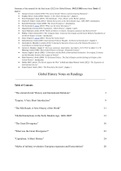
Summary of the material for the final exam (2022) for Global History. INCLUDES notes from (Total: 62
pages):
● George Lawson’s article (2010) “The eternal divide? History and International Relations”.
● Stephen Howe’s book (2002) “Empire: A Very Short Introduction”, chapter 1.
● Peter Frankopan’s book (2015) “The Silk Roads: A New History of the World”, preface.
● Charles H. Parker’s book (2012) “Global Interactions in the Early Modern Age, 1400-1800”, introduction.
● Kenneth Pomeranz’s book (2000) “The Great Divergence”, introduction.
● The Economist’s article (2013) “What was the Great Divergence?”.
● Jürgen Kocka’s book (2016) “Capitalism: A Short History”, chapter 1 and 3.
● Jason Sharman’s article (2018) “Myths of military revolution: European expansion and Eurocentrism”.
● Phillip J. Stern’s book (2011) “The Company-State: Corporate Sovereignty and the Early Modern Foundations of
the British Empire in India”, introduction.
● Claire Vergerio’s article (2021) “Beyond the Nation-State”.
● Edward Keene’s book (2005) “International Political Thought: An Historical Introduction”, chapter 6.
● Gurminder K. Bhambra’s article (2016) “Undoing the Epistemic Disavowal of the Haitian Revolution: A
Contribution to Global Social Thought”.
● Antony G. Hopkins’ chapter 6 “Overseas expansion, imperialism, and empire, 1815-1914” in editor T. C. W.
Blanning’s book (2000) “Short Oxford History of Europe: Nineteenth Century”.
● Antony Anghie’s article (2002) “Colonialism and the Birth of International Institutions: Sovereignty, Economy,
and the Mandate System of the League of Nations”.
● Mark Mazower’s book (2009) “No Enchanted Palace: The End of Empire and the Ideological Origins of the
United Nations”, introduction.
● Hedley Bull’s article “The Revolt Against the West” in Bull and Adam Watson’s book (2022) “The Expansion of
International Society”.
● Frantz Fanon’s book (1961) “The Wretched of the Earth”, chapter 1.
Global History Notes on Readings
Table of Contents
“The eternal divide? History and International Relations” 3
“Empire: A Very Short Introduction” 9
“The Silk Roads: A New History of the World” 11
“Global Interactions in the Early Modern Age, 1400-1800” 13
“The Great Divergence” 16
“What was the Great Divergence?” 23
“Capitalism: A Short History” 24
“Myths of military revolution: European expansion and Eurocentrism” 28
, 2
“The Company-State: Corporate Sovereignty and the Early Modern Foundations of the
British Empire in India” 32
“Beyond the Nation-State” 35
“International Political Thought: A Historical Introduction” 38
“Undoing the Epistemic Disavowal of the Haitian Revolution: A Contribution to Global
Social Thought” 43
“Overseas expansion, imperialism, and empire, 1815-1914” 47
“Colonialism and the Birth of International Institutions: Sovereignty, Economy, and the
Mandate System of the League of Nations” 52
“No Enchanted Palace: The End of Empire and the Ideological Origins of the United
Nations” 54
“The Revolt Against the West” 57
“The Wretched of the Earth” 61
, 3
“The eternal divide? History and International Relations”
Introduction
History has always been a core feature of research throughout International Relations (IR).
➔ HOWEVER, there exists a clear division of labour between theory-building political
scientists and chronicling historians (e.g. secondary sources vs. primary sources).
➔ This results in the formation of differences where one discipline (IR/political science) acts as
a binary opposite for/coloniser of the other (history).
Despite the closeness between IR and history, much IR scholarship is based on a view of history in
which it is seen as a:
1. Scripture; history becomes a predetermined site for the empirical verification of abstract
claims.
➔ Serving as ‘scripture’ removed from their context and applied to ill-fitting situations.
➔ Promoting a selection bias and the continuation of ahistoricism by other means.
➔ Mostly adopted by mainstream approaches.
2. Butterfly; history is seen as the ‘if only’ realm of uncertainty.
➔ A ‘butterfly’ of contingent hiccups upon which IR theorists provide ill-fitting maps,
while failing to see how historical events are part of broader processes, sequences and
plots that provide shape within historical development itself.
➔ Mostly adopted by post-positivist approaches (e.g. post-structuralism).
Scripture and Butterfly: History and International Relations
History has often served as a passive backdrop for theorists’ experiments and it is often assumed to
be removed from the menu of mainstream IR.
➔ Commonly held assumption of the ahistoricism of neo-neo approaches.
➔ The idea that historical sensitivity is something that, only recently, has become a core feature
of IR scholarship.
The return of classical liberalism, the rise of neoclassical realism and constructivism, and the
reconvening of the English School mark less the emergence of a historical turn in IR, and more an
acceleration and deepening of historical trends already present.
➔ History has always served as a tool for testing the validity of theoretical positions.
➔ Mainstream scholarship continues to use history as a barometer or litmus test for
adjudicating between rival schemas.
Although mainstream approaches do employ historical research, it is more in the form of ‘history’ as a
point of data collection, rather than historicism.
➔ Historicism: An understanding of the contingent, disruptive, constitutive impact of local
events, particularities and discontinuities.
Therefore, these approaches illustrate the ahistoricism of seeing ‘history as scripture’ and history is
NOT considered on its own terms, but is stripped to explain the present, forming a general
abstraction.
➔ Thus, leading to a type of motivated bias within research (i.e. the inability to recognize
historical anomalies and discrepancies, leading to an unbridgeable gap between theoretical
assertions and historical analysis).
, 4
An alternative is to favour a historical epistemology which seeks NOT to ‘resolve history’ but to see
it as an ‘open problem’, remaining ‘out of reach’ (Nick Vaughan-Williams, 2005).
➔ History becomes an ‘undecidable infinity of possible truths’; a ‘butterfly’ of contingent
hiccups without shape, form or reason.
➔ History is inherently unstable and disruptive, as argued by scholars Rob Walker (1988),
David Campbell (1998) and Richard Ashley (1989).
➔ Benefits of this approach include:
◆ In terms of nuance, detail and sensitivity, historical research of this type is
unrivalled.
◆ Several techniques employed by scholars (e.g. genealogy, multi-perspectivism) are
powerful tools for questioning taken-for-granted assumptions about both past and
present
➔ HOWEVER, difficulties include:
◆ The risk of ‘overdetermination’ based on post-structuralist understandings.
◆ A possibility of omitting bigger, more important commonalities.
◆ Problems building durable links between history and IR.
● Mainstream approaches make history a singular realm of certainty and
regularity (based on general abstractions).
● Post-structuralist approaches assume history to be a singular realm of
difference and instability (focusing on the particular).
‘Middle-way’ approaches (e.g. the English school) to IR theory claim the closest association with
historical research, playing an active role in bridging the theory-history divide. HOWEVER, even the
English School tends to replicate core features of this divide, with NO consistent philosophy of
history or historical method:
● Several English School theorists see history as ‘useful knowledge’, serving as a means of
illuminating concrete puzzles in world politics.
● At the same time, these theorists remain suspicious to generate accounts of ‘final causes’ (i.e.
understanding of history as a necessarily limited realm).
Regarding constructivist approaches, it is equally difficult to establish a distinct mode of historical
enquiry:
● Constructivists tend to adopt an interpretivist approach to historical research, giving special
attention to processes of social change.
● HOWEVER, there is little distinctiveness about the theory-history relationship, making it
impossible to pick out a discrete association between the two.
Nevertheless, several approaches beyond the standard paradigms (e.g. historical sociology,
conceptual history and intellectual history) have sought to combine historical insights with major
theoretical statements.
Key points:
1. From mainstream approaches comes a sense of history as ‘scripture’. This is deeply
flawed, creating a basic history by which to confirm or tweak theoretical claims.
➔ Overemphasis on continuity and incompatible analogies.
2. From the radical historiography of post-positivism comes a sense of history as ‘butterfly’;
a realm of ifs and maybes which reveals NOT truth but the ideological disposition of the
pages):
● George Lawson’s article (2010) “The eternal divide? History and International Relations”.
● Stephen Howe’s book (2002) “Empire: A Very Short Introduction”, chapter 1.
● Peter Frankopan’s book (2015) “The Silk Roads: A New History of the World”, preface.
● Charles H. Parker’s book (2012) “Global Interactions in the Early Modern Age, 1400-1800”, introduction.
● Kenneth Pomeranz’s book (2000) “The Great Divergence”, introduction.
● The Economist’s article (2013) “What was the Great Divergence?”.
● Jürgen Kocka’s book (2016) “Capitalism: A Short History”, chapter 1 and 3.
● Jason Sharman’s article (2018) “Myths of military revolution: European expansion and Eurocentrism”.
● Phillip J. Stern’s book (2011) “The Company-State: Corporate Sovereignty and the Early Modern Foundations of
the British Empire in India”, introduction.
● Claire Vergerio’s article (2021) “Beyond the Nation-State”.
● Edward Keene’s book (2005) “International Political Thought: An Historical Introduction”, chapter 6.
● Gurminder K. Bhambra’s article (2016) “Undoing the Epistemic Disavowal of the Haitian Revolution: A
Contribution to Global Social Thought”.
● Antony G. Hopkins’ chapter 6 “Overseas expansion, imperialism, and empire, 1815-1914” in editor T. C. W.
Blanning’s book (2000) “Short Oxford History of Europe: Nineteenth Century”.
● Antony Anghie’s article (2002) “Colonialism and the Birth of International Institutions: Sovereignty, Economy,
and the Mandate System of the League of Nations”.
● Mark Mazower’s book (2009) “No Enchanted Palace: The End of Empire and the Ideological Origins of the
United Nations”, introduction.
● Hedley Bull’s article “The Revolt Against the West” in Bull and Adam Watson’s book (2022) “The Expansion of
International Society”.
● Frantz Fanon’s book (1961) “The Wretched of the Earth”, chapter 1.
Global History Notes on Readings
Table of Contents
“The eternal divide? History and International Relations” 3
“Empire: A Very Short Introduction” 9
“The Silk Roads: A New History of the World” 11
“Global Interactions in the Early Modern Age, 1400-1800” 13
“The Great Divergence” 16
“What was the Great Divergence?” 23
“Capitalism: A Short History” 24
“Myths of military revolution: European expansion and Eurocentrism” 28
, 2
“The Company-State: Corporate Sovereignty and the Early Modern Foundations of the
British Empire in India” 32
“Beyond the Nation-State” 35
“International Political Thought: A Historical Introduction” 38
“Undoing the Epistemic Disavowal of the Haitian Revolution: A Contribution to Global
Social Thought” 43
“Overseas expansion, imperialism, and empire, 1815-1914” 47
“Colonialism and the Birth of International Institutions: Sovereignty, Economy, and the
Mandate System of the League of Nations” 52
“No Enchanted Palace: The End of Empire and the Ideological Origins of the United
Nations” 54
“The Revolt Against the West” 57
“The Wretched of the Earth” 61
, 3
“The eternal divide? History and International Relations”
Introduction
History has always been a core feature of research throughout International Relations (IR).
➔ HOWEVER, there exists a clear division of labour between theory-building political
scientists and chronicling historians (e.g. secondary sources vs. primary sources).
➔ This results in the formation of differences where one discipline (IR/political science) acts as
a binary opposite for/coloniser of the other (history).
Despite the closeness between IR and history, much IR scholarship is based on a view of history in
which it is seen as a:
1. Scripture; history becomes a predetermined site for the empirical verification of abstract
claims.
➔ Serving as ‘scripture’ removed from their context and applied to ill-fitting situations.
➔ Promoting a selection bias and the continuation of ahistoricism by other means.
➔ Mostly adopted by mainstream approaches.
2. Butterfly; history is seen as the ‘if only’ realm of uncertainty.
➔ A ‘butterfly’ of contingent hiccups upon which IR theorists provide ill-fitting maps,
while failing to see how historical events are part of broader processes, sequences and
plots that provide shape within historical development itself.
➔ Mostly adopted by post-positivist approaches (e.g. post-structuralism).
Scripture and Butterfly: History and International Relations
History has often served as a passive backdrop for theorists’ experiments and it is often assumed to
be removed from the menu of mainstream IR.
➔ Commonly held assumption of the ahistoricism of neo-neo approaches.
➔ The idea that historical sensitivity is something that, only recently, has become a core feature
of IR scholarship.
The return of classical liberalism, the rise of neoclassical realism and constructivism, and the
reconvening of the English School mark less the emergence of a historical turn in IR, and more an
acceleration and deepening of historical trends already present.
➔ History has always served as a tool for testing the validity of theoretical positions.
➔ Mainstream scholarship continues to use history as a barometer or litmus test for
adjudicating between rival schemas.
Although mainstream approaches do employ historical research, it is more in the form of ‘history’ as a
point of data collection, rather than historicism.
➔ Historicism: An understanding of the contingent, disruptive, constitutive impact of local
events, particularities and discontinuities.
Therefore, these approaches illustrate the ahistoricism of seeing ‘history as scripture’ and history is
NOT considered on its own terms, but is stripped to explain the present, forming a general
abstraction.
➔ Thus, leading to a type of motivated bias within research (i.e. the inability to recognize
historical anomalies and discrepancies, leading to an unbridgeable gap between theoretical
assertions and historical analysis).
, 4
An alternative is to favour a historical epistemology which seeks NOT to ‘resolve history’ but to see
it as an ‘open problem’, remaining ‘out of reach’ (Nick Vaughan-Williams, 2005).
➔ History becomes an ‘undecidable infinity of possible truths’; a ‘butterfly’ of contingent
hiccups without shape, form or reason.
➔ History is inherently unstable and disruptive, as argued by scholars Rob Walker (1988),
David Campbell (1998) and Richard Ashley (1989).
➔ Benefits of this approach include:
◆ In terms of nuance, detail and sensitivity, historical research of this type is
unrivalled.
◆ Several techniques employed by scholars (e.g. genealogy, multi-perspectivism) are
powerful tools for questioning taken-for-granted assumptions about both past and
present
➔ HOWEVER, difficulties include:
◆ The risk of ‘overdetermination’ based on post-structuralist understandings.
◆ A possibility of omitting bigger, more important commonalities.
◆ Problems building durable links between history and IR.
● Mainstream approaches make history a singular realm of certainty and
regularity (based on general abstractions).
● Post-structuralist approaches assume history to be a singular realm of
difference and instability (focusing on the particular).
‘Middle-way’ approaches (e.g. the English school) to IR theory claim the closest association with
historical research, playing an active role in bridging the theory-history divide. HOWEVER, even the
English School tends to replicate core features of this divide, with NO consistent philosophy of
history or historical method:
● Several English School theorists see history as ‘useful knowledge’, serving as a means of
illuminating concrete puzzles in world politics.
● At the same time, these theorists remain suspicious to generate accounts of ‘final causes’ (i.e.
understanding of history as a necessarily limited realm).
Regarding constructivist approaches, it is equally difficult to establish a distinct mode of historical
enquiry:
● Constructivists tend to adopt an interpretivist approach to historical research, giving special
attention to processes of social change.
● HOWEVER, there is little distinctiveness about the theory-history relationship, making it
impossible to pick out a discrete association between the two.
Nevertheless, several approaches beyond the standard paradigms (e.g. historical sociology,
conceptual history and intellectual history) have sought to combine historical insights with major
theoretical statements.
Key points:
1. From mainstream approaches comes a sense of history as ‘scripture’. This is deeply
flawed, creating a basic history by which to confirm or tweak theoretical claims.
➔ Overemphasis on continuity and incompatible analogies.
2. From the radical historiography of post-positivism comes a sense of history as ‘butterfly’;
a realm of ifs and maybes which reveals NOT truth but the ideological disposition of the