ADMIN LAW REVISION
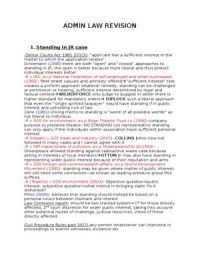
1. Standing in JR case
-Senior Courts Act 1981 S31(3)- “applicant has a sufficient interest in the
matter to which the application relates”
Schiemann (1990)-there are both “open” and “closed” approaches to
standing in JR, the open is better because more liberal and thus protect
individual interests better
-R v IRC, ex p National Federation of self-employed and small businesses
(1982)- fleet street casuals and amnesty offered”sufficient interest” test
creates a uniform approach whatever remedy, standing can be challenged
at permission or hearing, sufficient interest determined by legal and
factual contextWILBERFORCE only judge to suggest in obiter there is
higher standard for mandatory orders DIPLOCK such a liberal approach
that even the “single spirited taxpayer” would have standing if in public
interest and upholding rule of law
Cane (1981)-linking merits to standing is “worst of all possible worlds” as
not liberal to individual
-R v SOS for environment, ex p Rose Theatre Trust co (1990)-company
purpose to preserve theatre- NO STANDING coz representative standing
can only apply if the individuals within association have sufficient personal
interest
-R (Hasan) v SOS trade and industry (2007)- COLLINS J-this view not
followed in many cases and I cannot agree with it
-R v HM inspectorate of pollution, ex p Greenpeace(No.2)(1994)-
Greenpeace allowed standing against radioactive waste case because
acting in interests of local membersOTTON J- may also have standing in
representing wider public interest because of their reputation and aims
-R v SOS foreign and commonwealth affairs, ex p World Development
Movement (1995)- standing may be given where matter of public interest-
still will need some connection—as known as leading pressure group this
suffices
-R (Teakins) v SOS environment (2003)- Objective question=public
interest, subjective question=what motive in bringing claim ?is it
dishonest?
Miles (2000)- believes that standing should instead be based on a
personal nexus between claimant and interest
Law Comission report- should be two tracked system=1st for those directly
affected, 2nd court discretion for wider public interest, taking into account
other potential routes of challenge, judicial resources, views of those
directly affected
Civil Procedure Rules part 54(7)-any person whatsoever can intervene in
proceedings to submit witnesses, evidence etc
, HRA 1998 S7- claimant can only argue in convention rights cases if can
establish they are direct “victim”
Fordham (2000)-this is not an issue in practice because common law can
bring claims in JR without having to rely on HRA so wont be massive
difference
2. Jurisdiction
Point of Law= means a question of interpreting meaning of words
Question of fact=”assertion that a phenomenon exists, has existed, or will
exist”
Gordon- believes courts should always be confined to nature of facts and
not truth of them, to respect SOP
i) Errors of Law
-Anismimic ltd v Foreign compensation commission (1969)- case of seizure
of Egyptian land and nullity provisionHOL take broad view of jurisdiction
to include all errors of law included precedent facts within this area so
as answer to the question about construing the scheme determined the
compensation commissions jurisdiction in the matter, they could not make
the final decision
-Pearlman v Keepers & Governors Harrow School (1979)- tribunal do not
give tenent benefits because not “structural alteration” confusing
decision but affirms anismimic decision!--> as the tribunals jurisdiction
depends upon it, it is PRECEDENT FACT and so court have final
sayDENNING accepts this but says courts use it to manipulate cases
unfairly
-O’Reilly v Mackman (1983)DIPLOCK OBITERsuggested all errors of law
could be regarded jurisdictional
-R v Privy Council, ex p Page (1993)HOL- all errors of law are jurisdictional!
So interpretation of statutory provisions is for courts
Sunstein (2006)- prefers the US approach that rejected this in Chevron
USA v NRDC (1984) because over there agencies are specialised and
politically accountable
UK has 3 limited exceptions to the rule outlined in Page, so that courts will
not intervene even when question of error of law
* Special system of rules
-Page (1993)-lecturer contract not dismissed before 67 without “good
cause” released on redundancy no JR here because university have
special system of rules long standing ruledecision focuses on policy and
efficiency
- R v Registrar of Companies, ex parte Central Bank of India (1986)- this is not an
unqualified and iniveitable rule
* nature of decision-making body
- AXA General Insurance Ltd and others v HM Advocate (2011)- if because of
courts constitutional position it is not justiciable then it wont be amenable to JR
includes acts of parliament, acts in parliament, and all the appeal court from
High court upwards...
1. Standing in JR case
-Senior Courts Act 1981 S31(3)- “applicant has a sufficient interest in the
matter to which the application relates”
Schiemann (1990)-there are both “open” and “closed” approaches to
standing in JR, the open is better because more liberal and thus protect
individual interests better
-R v IRC, ex p National Federation of self-employed and small businesses
(1982)- fleet street casuals and amnesty offered”sufficient interest” test
creates a uniform approach whatever remedy, standing can be challenged
at permission or hearing, sufficient interest determined by legal and
factual contextWILBERFORCE only judge to suggest in obiter there is
higher standard for mandatory orders DIPLOCK such a liberal approach
that even the “single spirited taxpayer” would have standing if in public
interest and upholding rule of law
Cane (1981)-linking merits to standing is “worst of all possible worlds” as
not liberal to individual
-R v SOS for environment, ex p Rose Theatre Trust co (1990)-company
purpose to preserve theatre- NO STANDING coz representative standing
can only apply if the individuals within association have sufficient personal
interest
-R (Hasan) v SOS trade and industry (2007)- COLLINS J-this view not
followed in many cases and I cannot agree with it
-R v HM inspectorate of pollution, ex p Greenpeace(No.2)(1994)-
Greenpeace allowed standing against radioactive waste case because
acting in interests of local membersOTTON J- may also have standing in
representing wider public interest because of their reputation and aims
-R v SOS foreign and commonwealth affairs, ex p World Development
Movement (1995)- standing may be given where matter of public interest-
still will need some connection—as known as leading pressure group this
suffices
-R (Teakins) v SOS environment (2003)- Objective question=public
interest, subjective question=what motive in bringing claim ?is it
dishonest?
Miles (2000)- believes that standing should instead be based on a
personal nexus between claimant and interest
Law Comission report- should be two tracked system=1st for those directly
affected, 2nd court discretion for wider public interest, taking into account
other potential routes of challenge, judicial resources, views of those
directly affected
Civil Procedure Rules part 54(7)-any person whatsoever can intervene in
proceedings to submit witnesses, evidence etc
, HRA 1998 S7- claimant can only argue in convention rights cases if can
establish they are direct “victim”
Fordham (2000)-this is not an issue in practice because common law can
bring claims in JR without having to rely on HRA so wont be massive
difference
2. Jurisdiction
Point of Law= means a question of interpreting meaning of words
Question of fact=”assertion that a phenomenon exists, has existed, or will
exist”
Gordon- believes courts should always be confined to nature of facts and
not truth of them, to respect SOP
i) Errors of Law
-Anismimic ltd v Foreign compensation commission (1969)- case of seizure
of Egyptian land and nullity provisionHOL take broad view of jurisdiction
to include all errors of law included precedent facts within this area so
as answer to the question about construing the scheme determined the
compensation commissions jurisdiction in the matter, they could not make
the final decision
-Pearlman v Keepers & Governors Harrow School (1979)- tribunal do not
give tenent benefits because not “structural alteration” confusing
decision but affirms anismimic decision!--> as the tribunals jurisdiction
depends upon it, it is PRECEDENT FACT and so court have final
sayDENNING accepts this but says courts use it to manipulate cases
unfairly
-O’Reilly v Mackman (1983)DIPLOCK OBITERsuggested all errors of law
could be regarded jurisdictional
-R v Privy Council, ex p Page (1993)HOL- all errors of law are jurisdictional!
So interpretation of statutory provisions is for courts
Sunstein (2006)- prefers the US approach that rejected this in Chevron
USA v NRDC (1984) because over there agencies are specialised and
politically accountable
UK has 3 limited exceptions to the rule outlined in Page, so that courts will
not intervene even when question of error of law
* Special system of rules
-Page (1993)-lecturer contract not dismissed before 67 without “good
cause” released on redundancy no JR here because university have
special system of rules long standing ruledecision focuses on policy and
efficiency
- R v Registrar of Companies, ex parte Central Bank of India (1986)- this is not an
unqualified and iniveitable rule
* nature of decision-making body
- AXA General Insurance Ltd and others v HM Advocate (2011)- if because of
courts constitutional position it is not justiciable then it wont be amenable to JR
includes acts of parliament, acts in parliament, and all the appeal court from
High court upwards...