TRIG Summary lectures + notes
Transitions, Innovations and Governance
Summary of lectures and Notes
MSc Industrial Ecology, Y1Q2, 2022
Lecture 1 tm 12
Lecture 1: course introduction & What is Sustainable Innovation
(Jaco Quist)
Course goals
Understand main theories and frameworks about socio-technical
transitions and the governance strategies to bring about changes
Are to apply these theories and frameworks to practical cases in the
context of Industrial Ecology
Can reflect on the limitations and conditions of these theories and
how to apply them
What is an innovation?
Process of turning opportunity into new ideas and of putting
these into widely used practice (Tidd, Bessant and Pavitt, 2001)
o Different ways of disruptiveness and at various scales, ranging
from product to systems
Create commercial and social value from knowledge and ideas
Definitions of innovation either focus on the ‘change’ dimensions
(connecting organizational, institutional or behavioural changes to a
(technological) innovation), or on the creation of a technical
novelty (often a product).
A sustaining innovation is in an existing market and is aimed to
improve performance/lower cost/incremental changes. The customer is
believable and the market is predictable. Disruptive innovations tackle
a not well understood problem for a new market, and is dramatic and
game-changing. The market is thus unpredictable and traditional business
models thus fail.
- Two metrics:
o Disrupt vs sustain existing linkages on user practices, markets
or institutions
o Incremental or radical change in technology (knowledge,
competence and skills)
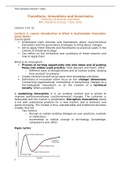
Hype cycles:
1
,TRIG Summary lectures + notes
Kondriatev described changes of the techno-economic paradigms through
Kondriatev cycles: long economic waves which link wealth and
technological innovation:
Hargroves and Smith (2005) describe waves of innovation based on
Kondriatev, instead of a long wave they make little ‘jumps’:
Sustainable innovation: innovation improving sustainability
performance, where sustainability considerations are integrated into
company systems
Eco-innovation: any form of innovation aiming at a significant and
demonstrable progress towards the goal of sustainable development,
through reducing impacts on the environment and efficiency of resources
and energy.
- Typology (Carrillo-Hermosilla et al (2010)):
o Component addition (e.g. end of pipe)
o Sub-system change (e.g. eco-efficient solutions, efficiency
and optimization)
o System change (e.g. transitions, IE, etc)
2
, TRIG Summary lectures + notes
Eco-innovation and sustainable innovation go beyond regular
product and process innovations and are more future-oriented
- Sustainable innovation goes beyond eco-innovation: it includes
social objectives and is more clearly linked to the holistic and
long-term processes of sustainable development or the related long-
term objective of sustainability.
System innovations are complex because there are many actors with
conflicting interests, ambiguity and values, and there are often sets of
innovations. The impact only comes in the implementation phase.
Lecture 2: Introduction to governance (Thomas Hoppe)
How to manage complex society create or maintain ‘public value’
Governance…:
Includes all processes of governing (wow really)
Coordination of collective action
A way to describe and explain changes in our world
Role of the State in society goes beyond government
Definition governance (by Bevir): “All processes of governing, whether
undertaken by a government, market, or network, whether over a family,
tribe, informal or formal organization or territory, and whether through
laws, norms, power or language.”
Governance acts in different spheres of society: State, Community (civil
society), and Market.
- For research you can looks at the actors/agents, their behavior and
interactions, the institutions (formal ‘rules of the game’), decision
making, or solving real world problems that require collective action
Williamson made a 4-layer model of Institutions, where governance is
seen as ‘play of the game’ in which societal actors interact and
governance structures their transactions (e.g. through contracts)
3
Transitions, Innovations and Governance
Summary of lectures and Notes
MSc Industrial Ecology, Y1Q2, 2022
Lecture 1 tm 12
Lecture 1: course introduction & What is Sustainable Innovation
(Jaco Quist)
Course goals
Understand main theories and frameworks about socio-technical
transitions and the governance strategies to bring about changes
Are to apply these theories and frameworks to practical cases in the
context of Industrial Ecology
Can reflect on the limitations and conditions of these theories and
how to apply them
What is an innovation?
Process of turning opportunity into new ideas and of putting
these into widely used practice (Tidd, Bessant and Pavitt, 2001)
o Different ways of disruptiveness and at various scales, ranging
from product to systems
Create commercial and social value from knowledge and ideas
Definitions of innovation either focus on the ‘change’ dimensions
(connecting organizational, institutional or behavioural changes to a
(technological) innovation), or on the creation of a technical
novelty (often a product).
A sustaining innovation is in an existing market and is aimed to
improve performance/lower cost/incremental changes. The customer is
believable and the market is predictable. Disruptive innovations tackle
a not well understood problem for a new market, and is dramatic and
game-changing. The market is thus unpredictable and traditional business
models thus fail.
- Two metrics:
o Disrupt vs sustain existing linkages on user practices, markets
or institutions
o Incremental or radical change in technology (knowledge,
competence and skills)
Hype cycles:
1
,TRIG Summary lectures + notes
Kondriatev described changes of the techno-economic paradigms through
Kondriatev cycles: long economic waves which link wealth and
technological innovation:
Hargroves and Smith (2005) describe waves of innovation based on
Kondriatev, instead of a long wave they make little ‘jumps’:
Sustainable innovation: innovation improving sustainability
performance, where sustainability considerations are integrated into
company systems
Eco-innovation: any form of innovation aiming at a significant and
demonstrable progress towards the goal of sustainable development,
through reducing impacts on the environment and efficiency of resources
and energy.
- Typology (Carrillo-Hermosilla et al (2010)):
o Component addition (e.g. end of pipe)
o Sub-system change (e.g. eco-efficient solutions, efficiency
and optimization)
o System change (e.g. transitions, IE, etc)
2
, TRIG Summary lectures + notes
Eco-innovation and sustainable innovation go beyond regular
product and process innovations and are more future-oriented
- Sustainable innovation goes beyond eco-innovation: it includes
social objectives and is more clearly linked to the holistic and
long-term processes of sustainable development or the related long-
term objective of sustainability.
System innovations are complex because there are many actors with
conflicting interests, ambiguity and values, and there are often sets of
innovations. The impact only comes in the implementation phase.
Lecture 2: Introduction to governance (Thomas Hoppe)
How to manage complex society create or maintain ‘public value’
Governance…:
Includes all processes of governing (wow really)
Coordination of collective action
A way to describe and explain changes in our world
Role of the State in society goes beyond government
Definition governance (by Bevir): “All processes of governing, whether
undertaken by a government, market, or network, whether over a family,
tribe, informal or formal organization or territory, and whether through
laws, norms, power or language.”
Governance acts in different spheres of society: State, Community (civil
society), and Market.
- For research you can looks at the actors/agents, their behavior and
interactions, the institutions (formal ‘rules of the game’), decision
making, or solving real world problems that require collective action
Williamson made a 4-layer model of Institutions, where governance is
seen as ‘play of the game’ in which societal actors interact and
governance structures their transactions (e.g. through contracts)
3