2.4C Perception- 2022 - Lecture 1 – Rene Zoeienberg – Brain & Cognition – Jan
2022
Practical week 1: test yourself online.
Read the practical reader and follow APA guidelines
Core disciplines in this block biological, cognitive psychology and clinical
neuropsychology.
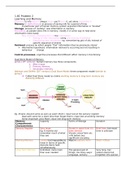
Perception statements: 1. our senses enable a complete and truthful
perception of the world around us. But is this true? Some images show
straight lines that are perceived curved. Our perception can be tricked
e.g. the moon illusion (optical illusion which causes the Moon to appear
larger near the horizon than it does higher up in the sky) or seeing black
dots, but when we try to focus on the black dots, they’re white:
2. Perception is a passive registration of the world around us. However, is the
brain really passive? E.g. the brain can interpret the cube in two ways, one
where the blue is at the back of the cube and another where it is as the left front
side of the cube. Your brain has to work to see the distinction. Our perception is
not only input through our senses but also of the knowledge that we have. Perception is
the result of
1. Stimulus input (bottom-up information) and
2. Knowledge and expectations (top down information)
Illusory conjunction; psychological effects in which participants
combine features of two objects into one object. Contains of:
1. Visual: If the triangle, oval and circle are shown quickly or in
large amounts, the mind would conjunct and illusory image.
However if you would remember the triangle as an orange pyramid, the oval as a blue
lake and the grey as a silver ring, illusory conjunction lessens due to the prior
knowledge. Our knowledge of the world changes what we see.
2. Segmentation: when we read or write a sentence, we use
spaces, commas, periods etc. Spoken language is a more
continuous stream of sound, if we hear another language
different than ours, than we would not know where the spaces,
commas or periods are located.
3. Phoneme restoration effect: if we hear a sentence where part
of it is replaced with white noise, we will automatically add to the
sentence depending on the context e.g. it was time to #ave my
friend goodbye and it was time to #ave my beard (due to the
context you would add wave and shave).
3. Perception is innate, you do not have to learn it. However, the
nervous system develops as the child gets older, you need
connections of the nervous system that are essential that you
need to learn, understand, move and perceive.
But also when you’re older e.g. it takes a lot of time to learn to
write and read Chinese characters if you have not grown up with it. Or e.g. it would be
hard for a layperson to read a mammogram.
2022
Practical week 1: test yourself online.
Read the practical reader and follow APA guidelines
Core disciplines in this block biological, cognitive psychology and clinical
neuropsychology.
Perception statements: 1. our senses enable a complete and truthful
perception of the world around us. But is this true? Some images show
straight lines that are perceived curved. Our perception can be tricked
e.g. the moon illusion (optical illusion which causes the Moon to appear
larger near the horizon than it does higher up in the sky) or seeing black
dots, but when we try to focus on the black dots, they’re white:
2. Perception is a passive registration of the world around us. However, is the
brain really passive? E.g. the brain can interpret the cube in two ways, one
where the blue is at the back of the cube and another where it is as the left front
side of the cube. Your brain has to work to see the distinction. Our perception is
not only input through our senses but also of the knowledge that we have. Perception is
the result of
1. Stimulus input (bottom-up information) and
2. Knowledge and expectations (top down information)
Illusory conjunction; psychological effects in which participants
combine features of two objects into one object. Contains of:
1. Visual: If the triangle, oval and circle are shown quickly or in
large amounts, the mind would conjunct and illusory image.
However if you would remember the triangle as an orange pyramid, the oval as a blue
lake and the grey as a silver ring, illusory conjunction lessens due to the prior
knowledge. Our knowledge of the world changes what we see.
2. Segmentation: when we read or write a sentence, we use
spaces, commas, periods etc. Spoken language is a more
continuous stream of sound, if we hear another language
different than ours, than we would not know where the spaces,
commas or periods are located.
3. Phoneme restoration effect: if we hear a sentence where part
of it is replaced with white noise, we will automatically add to the
sentence depending on the context e.g. it was time to #ave my
friend goodbye and it was time to #ave my beard (due to the
context you would add wave and shave).
3. Perception is innate, you do not have to learn it. However, the
nervous system develops as the child gets older, you need
connections of the nervous system that are essential that you
need to learn, understand, move and perceive.
But also when you’re older e.g. it takes a lot of time to learn to
write and read Chinese characters if you have not grown up with it. Or e.g. it would be
hard for a layperson to read a mammogram.