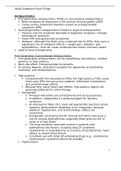
Study Questions Psych Drugs
Antipsychotics
First-generation antipsychotics (FGAs) or conventional antipsychotics
Block receptors for dopamine in the central nervous system (CNS)
Cause serious movement disorders known as extrapyramidal
symptoms (EPS)
Second-generation antipsychotics (SGAs) or atypical antipsychotics
Produce only the moderate blockade of dopamine receptors; stronger
blockade for serotonin
Fewer EPS (extrapyramidal symptoms)
However, although the SGAs carry a reduced risk for EPSs, they carry a
significant risk of metabolic effects— weight gain, diabetes, and
dyslipidemia— that can cause cardiovascular events and early death.
Used to treat schizophrenia
First-Generation (Conventional) Antipsychotics
First-generation antipsychotics can be classified as low potency, medium
potency, or high potency
Main side effect: Extrapyramidal movements
To varying degrees, they block receptors for dopamine, acetylcholine,
histamine, and norepinephrine.
High potency:
Compared with the low-potency FGAs, the high-potency FGAs cause
more early EPSs but cause less sedation, orthostatic hypotension,
and anticholinergic effects.
Because they cause fewer side effects, high-potency agents are
generally preferred for initial therapy.
Haloperidol
o Principal indications are schizophrenia and acute psychosis.
o In addition, haloperidol is a preferred agent for Tourette
syndrome.
o As indicated in Table 24.2, early extrapyramidal reactions (acute
dystonia, parkinsonism, akathisia) occur frequently, whereas
sedation, hypotension, and anticholinergic effects are
uncommon.
o Haloperidol can prolong the QT interval and hence may pose a
risk for serious dysrhythmias, especially when given by the IV
route or in high doses.
o The drug should be used with caution in patients with
dysrhythmia risk factors, including long QT syndrome,
hypokalemia or hyperkalemia, or a history of dysrhythmias, heart
attack, or severe heart failure.
o Combined use with other QT-prolonging drugs (e.g., amiodarone,
erythromycin, quinidine) should be avoided.
Fluphenazine
1
,Study Questions Psych Drugs
o Fluphenazine is a high-potency agent indicated for schizophrenia
and other psychotic disorders.
o The drug belongs to the piperazine subclass of phenothiazines.
o As with other high-potency agents, the most common adverse
effects are early EPSs: acute dystonia, parkinsonism, and
akathisia.
o The risk for TD equals that of other FGAs.
o Effects seen occasionally include sedation, orthostatic
hypotension, anticholinergic effects, gynecomastia, galactorrhea,
and menstrual irregularities.
o NMS, convulsions, and agranulocytosis are rare.
Low Potency:
Chlorpromazine
o Chlorpromazine is a low-potency FGA and belongs to the
phenothiazine family.
o Principal indications are schizophrenia and other psychotic
disorders.
o Additional psychiatric indications are schizoaffective disorder and
the manic phase of bipolar disorder.
o Other uses include suppression of emesis, relief of intractable
hiccups, and control of severe behavior problems in children.
o The most common adverse effects are sedation, orthostatic
hypotension, and anticholinergic effects (dry mouth, blurred
vision, urinary retention, photophobia, constipation, tachycardia).
o Neuroendocrine effects (galactorrhea, gynecomastia, menstrual
irregularities) are seen on occasion.
o Photosensitivity reactions are possible, and patients should be
advised to minimize unprotected exposure to sunlight.
o Because chlorpromazine is a low-potency neuroleptic, the risk for
early extrapyramidal reactions (dystonia, akathisia,
parkinsonism) is relatively low.
o However, the risk for TD is the same as with all other FGAs.
Chlorpromazine lowers seizure threshold.
o Accordingly, patients with seizure disorders should be especially
diligent about taking antiseizure medication.
o Like haloperidol, chlorpromazine can prolong the QT interval, and
hence may pose a risk for fatal dysrhythmias, especially in
patients with dysrhythmia risk factors (e.g., long QT syndrome,
hypokalemia, hyperkalemia, history of cardiac dysrhythmias).
o Agranulocytosis and NMS occur rarely.
o Chlorpromazine can intensify responses to CNS depressants
(e.g., antihistamines, benzodiazepines, barbiturates) and
anticholinergic drugs (e.g., antihistamines, tricyclic
antidepressants, atropine-like drugs).
2
, Study Questions Psych Drugs
Thioridazine
o Thioridazine is a low-potency FGA that prolongs the QT interval
and hence can cause fatal cardiac dysrhythmias.
o Because of this danger, the drug should be reserved for treating
schizophrenia in patients who have not responded to safer
agents.
o The most common adverse effects are sedation, orthostatic
hypotension, anticholinergic effects, weight gain, and inhibition
of ejaculation.
o Effects seen occasionally include extrapyramidal reactions
(dystonia, parkinsonism, akathisia, TD), neuroendocrine effects
(galactorrhea, gynecomastia, menstrual irregularities), and
photosensitivity reactions.
o NMS, convulsions, agranulocytosis, and pigmentary retinopathy
occur rarely.
o Principal interactions are with anticholinergic drugs and CNS
depressants.
o Thioridazine causes dose-related prolongation of QTc interval that
may cause torsades de pointes − type arrhythmias and sudden
death. Restrict use to schizophrenia resistant to standard
antipsychotic drugs.
Atypical Antipsychotic Agents
As for major side effects, the SGAs are less likely to cause EPSs, including
TD.
However, the SGAs carry an even greater risk of their own, namely,
serious metabolic effects— weight gain, diabetes, and dyslipidemia— that
can lead to cardiovascular events and premature death.
Furthermore, like the FGAs, the SGAs can cause sedation and orthostatic
hypotension and can increase the risk for death when used to treat
dementia-related psychosis in older adults.
In addition to their use in schizophrenia, all of the SGAs are approved for
bipolar disorder
Clozapine (first SGA)
Mechanism of action
o Blocks dopamine and serotonin
Therapeutic use
o Schizophrenia
o Levodopa-induced psychosis
Pharmacokinetics:
o taken orally.
o Metabolized by CYP450 and has 12 hour ½ life.
Black Box Warning
3
Antipsychotics
First-generation antipsychotics (FGAs) or conventional antipsychotics
Block receptors for dopamine in the central nervous system (CNS)
Cause serious movement disorders known as extrapyramidal
symptoms (EPS)
Second-generation antipsychotics (SGAs) or atypical antipsychotics
Produce only the moderate blockade of dopamine receptors; stronger
blockade for serotonin
Fewer EPS (extrapyramidal symptoms)
However, although the SGAs carry a reduced risk for EPSs, they carry a
significant risk of metabolic effects— weight gain, diabetes, and
dyslipidemia— that can cause cardiovascular events and early death.
Used to treat schizophrenia
First-Generation (Conventional) Antipsychotics
First-generation antipsychotics can be classified as low potency, medium
potency, or high potency
Main side effect: Extrapyramidal movements
To varying degrees, they block receptors for dopamine, acetylcholine,
histamine, and norepinephrine.
High potency:
Compared with the low-potency FGAs, the high-potency FGAs cause
more early EPSs but cause less sedation, orthostatic hypotension,
and anticholinergic effects.
Because they cause fewer side effects, high-potency agents are
generally preferred for initial therapy.
Haloperidol
o Principal indications are schizophrenia and acute psychosis.
o In addition, haloperidol is a preferred agent for Tourette
syndrome.
o As indicated in Table 24.2, early extrapyramidal reactions (acute
dystonia, parkinsonism, akathisia) occur frequently, whereas
sedation, hypotension, and anticholinergic effects are
uncommon.
o Haloperidol can prolong the QT interval and hence may pose a
risk for serious dysrhythmias, especially when given by the IV
route or in high doses.
o The drug should be used with caution in patients with
dysrhythmia risk factors, including long QT syndrome,
hypokalemia or hyperkalemia, or a history of dysrhythmias, heart
attack, or severe heart failure.
o Combined use with other QT-prolonging drugs (e.g., amiodarone,
erythromycin, quinidine) should be avoided.
Fluphenazine
1
,Study Questions Psych Drugs
o Fluphenazine is a high-potency agent indicated for schizophrenia
and other psychotic disorders.
o The drug belongs to the piperazine subclass of phenothiazines.
o As with other high-potency agents, the most common adverse
effects are early EPSs: acute dystonia, parkinsonism, and
akathisia.
o The risk for TD equals that of other FGAs.
o Effects seen occasionally include sedation, orthostatic
hypotension, anticholinergic effects, gynecomastia, galactorrhea,
and menstrual irregularities.
o NMS, convulsions, and agranulocytosis are rare.
Low Potency:
Chlorpromazine
o Chlorpromazine is a low-potency FGA and belongs to the
phenothiazine family.
o Principal indications are schizophrenia and other psychotic
disorders.
o Additional psychiatric indications are schizoaffective disorder and
the manic phase of bipolar disorder.
o Other uses include suppression of emesis, relief of intractable
hiccups, and control of severe behavior problems in children.
o The most common adverse effects are sedation, orthostatic
hypotension, and anticholinergic effects (dry mouth, blurred
vision, urinary retention, photophobia, constipation, tachycardia).
o Neuroendocrine effects (galactorrhea, gynecomastia, menstrual
irregularities) are seen on occasion.
o Photosensitivity reactions are possible, and patients should be
advised to minimize unprotected exposure to sunlight.
o Because chlorpromazine is a low-potency neuroleptic, the risk for
early extrapyramidal reactions (dystonia, akathisia,
parkinsonism) is relatively low.
o However, the risk for TD is the same as with all other FGAs.
Chlorpromazine lowers seizure threshold.
o Accordingly, patients with seizure disorders should be especially
diligent about taking antiseizure medication.
o Like haloperidol, chlorpromazine can prolong the QT interval, and
hence may pose a risk for fatal dysrhythmias, especially in
patients with dysrhythmia risk factors (e.g., long QT syndrome,
hypokalemia, hyperkalemia, history of cardiac dysrhythmias).
o Agranulocytosis and NMS occur rarely.
o Chlorpromazine can intensify responses to CNS depressants
(e.g., antihistamines, benzodiazepines, barbiturates) and
anticholinergic drugs (e.g., antihistamines, tricyclic
antidepressants, atropine-like drugs).
2
, Study Questions Psych Drugs
Thioridazine
o Thioridazine is a low-potency FGA that prolongs the QT interval
and hence can cause fatal cardiac dysrhythmias.
o Because of this danger, the drug should be reserved for treating
schizophrenia in patients who have not responded to safer
agents.
o The most common adverse effects are sedation, orthostatic
hypotension, anticholinergic effects, weight gain, and inhibition
of ejaculation.
o Effects seen occasionally include extrapyramidal reactions
(dystonia, parkinsonism, akathisia, TD), neuroendocrine effects
(galactorrhea, gynecomastia, menstrual irregularities), and
photosensitivity reactions.
o NMS, convulsions, agranulocytosis, and pigmentary retinopathy
occur rarely.
o Principal interactions are with anticholinergic drugs and CNS
depressants.
o Thioridazine causes dose-related prolongation of QTc interval that
may cause torsades de pointes − type arrhythmias and sudden
death. Restrict use to schizophrenia resistant to standard
antipsychotic drugs.
Atypical Antipsychotic Agents
As for major side effects, the SGAs are less likely to cause EPSs, including
TD.
However, the SGAs carry an even greater risk of their own, namely,
serious metabolic effects— weight gain, diabetes, and dyslipidemia— that
can lead to cardiovascular events and premature death.
Furthermore, like the FGAs, the SGAs can cause sedation and orthostatic
hypotension and can increase the risk for death when used to treat
dementia-related psychosis in older adults.
In addition to their use in schizophrenia, all of the SGAs are approved for
bipolar disorder
Clozapine (first SGA)
Mechanism of action
o Blocks dopamine and serotonin
Therapeutic use
o Schizophrenia
o Levodopa-induced psychosis
Pharmacokinetics:
o taken orally.
o Metabolized by CYP450 and has 12 hour ½ life.
Black Box Warning
3