Unit 1 assignment 3
Task 1
1)
● Experiment 1 = preparation of standard solution of sodium hydroxide = completed.
● Experiment 2 = titration to determine the equation for the reaction between sodium
hydroxide and hydrochloric acid = completed.
● Experiment 3 = preparation of a standard solution of sodium carbonate = completed.
● Experiment 4 = titration to determine the reaction between sodium carbonate and
hydrochloric acid = completed.
2)
In experiments 1 and 3, I had to prepare solutions of sodium hydroxide and sodium carbonate.
The periodic table was used to help perform these experiments correctly. The periodic table can
tell you a lot about an element. I needed the periodic table to find the mass number which helps
to calculate the molecular mass. The periodic table gives the amount of protons and neutrons
through the mass number and the electrons are equal to the amount of protons which can be
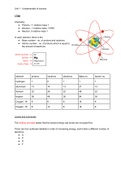
found in the atomic number. For example, if the atomic number of an element - sodium is 11 this
means that it has 11 electrons and 11 protons. The mass number of sodium is 23, therefore the
number of neutrons can be calculated by the calculation below:
23-11 = 12
Mass number - atomic number = number of neutrons
The group number helps too as it is the amount of electrons in its outer shell. This would be
useful in the experiments as it would show the amount of electrons transferred between the
reactants in the practical. For example, with sodium carbonate - this is a combination of sodium
(2), carbon (1) and oxygen (3). The diagram below explains the bonding of this product:
, Unit 1 assignment 3
Oxygen is in group 6, meaning it has 6 electrons in its outer shell and it is in period 2 which
means that it has 2 shells so the outer shell needs to be 8 in order to be full. Therefore oxygen
must gain 2 electrons, making the valency -2. Hydrogen is in group 1 and is in period 1 in the
periodic table so will have 1 electron in its outer shell and have 1 shell. In order to fill a full outer
shell, which would be 2, it will need to gain an extra electron. Hydrogen has a valency of -1.
The number of electrons in the outer shell of an element also determines its reactivity. Each
group is different and will carry different properties. For example, group 1 is the alkali metals.
These elements are all soft, reactive metals with low melting points. They react with water to
produce an alkaline metal hydroxide solution and hydrogen. Reactivity increases down the
group.
Additionally, the periodic table shows how many shells an element has by the period number.
Each electron shell has a different energy level, and shells closest to the nucleus have lower
energy levels than those farther from the nucleus.
As well as this, the periodic table is split into 2 sections which are metals and non metals. It is
interesting to know what category the element is in so that you can determine which bond will
be formed - this can be ionic or covalent.
The periodic table also represents bonding. From the investigation, it can be inferred that they
bond ionically as the compound is made up of sodium (Na+) which is a metal ion attracted to the
non metal ion of hydroxide (OH-). This means that sodium is oxidised as it gives an electron to
hydroxide to become positive and this means that the hydroxide is reduced as it gains an
electron from sodium. This reflects onto sodium carbonate as well - the only is that this one
contains ionic and covalent bonds. The covalent bonds are shared between oxygen and carbon.
The ionic bonds are shared between sodium and oxygen. The carbonate has a valency of 2 as
carbon is in group 4 and oxygen is in group 6.
To figure out the number of moles, you divide the atomic number by the mass number of an
element which can be seen on the periodic table.
Hydrochloric acid reacts with sodium hydroxide to form sodium hydroxide to make sodium
chloride and water. This is made up of Na+ cations from the base and CL- anions from the hcl.
Key features of the periodic table can help to construct a balanced chemical equation for the
chemical reaction carried out. This is because when a reaction occurs, bonds break which
means that new bonds need to be made. The periodic table is used for this to recognise which
element bonds with what through the group number which is the number of electrons in its outer
shell.
To balance a chemical equation using the periodic table you need to find the total molecular
mass. This is found by adding the atomic masses together.
Task 1
1)
● Experiment 1 = preparation of standard solution of sodium hydroxide = completed.
● Experiment 2 = titration to determine the equation for the reaction between sodium
hydroxide and hydrochloric acid = completed.
● Experiment 3 = preparation of a standard solution of sodium carbonate = completed.
● Experiment 4 = titration to determine the reaction between sodium carbonate and
hydrochloric acid = completed.
2)
In experiments 1 and 3, I had to prepare solutions of sodium hydroxide and sodium carbonate.
The periodic table was used to help perform these experiments correctly. The periodic table can
tell you a lot about an element. I needed the periodic table to find the mass number which helps
to calculate the molecular mass. The periodic table gives the amount of protons and neutrons
through the mass number and the electrons are equal to the amount of protons which can be
found in the atomic number. For example, if the atomic number of an element - sodium is 11 this
means that it has 11 electrons and 11 protons. The mass number of sodium is 23, therefore the
number of neutrons can be calculated by the calculation below:
23-11 = 12
Mass number - atomic number = number of neutrons
The group number helps too as it is the amount of electrons in its outer shell. This would be
useful in the experiments as it would show the amount of electrons transferred between the
reactants in the practical. For example, with sodium carbonate - this is a combination of sodium
(2), carbon (1) and oxygen (3). The diagram below explains the bonding of this product:
, Unit 1 assignment 3
Oxygen is in group 6, meaning it has 6 electrons in its outer shell and it is in period 2 which
means that it has 2 shells so the outer shell needs to be 8 in order to be full. Therefore oxygen
must gain 2 electrons, making the valency -2. Hydrogen is in group 1 and is in period 1 in the
periodic table so will have 1 electron in its outer shell and have 1 shell. In order to fill a full outer
shell, which would be 2, it will need to gain an extra electron. Hydrogen has a valency of -1.
The number of electrons in the outer shell of an element also determines its reactivity. Each
group is different and will carry different properties. For example, group 1 is the alkali metals.
These elements are all soft, reactive metals with low melting points. They react with water to
produce an alkaline metal hydroxide solution and hydrogen. Reactivity increases down the
group.
Additionally, the periodic table shows how many shells an element has by the period number.
Each electron shell has a different energy level, and shells closest to the nucleus have lower
energy levels than those farther from the nucleus.
As well as this, the periodic table is split into 2 sections which are metals and non metals. It is
interesting to know what category the element is in so that you can determine which bond will
be formed - this can be ionic or covalent.
The periodic table also represents bonding. From the investigation, it can be inferred that they
bond ionically as the compound is made up of sodium (Na+) which is a metal ion attracted to the
non metal ion of hydroxide (OH-). This means that sodium is oxidised as it gives an electron to
hydroxide to become positive and this means that the hydroxide is reduced as it gains an
electron from sodium. This reflects onto sodium carbonate as well - the only is that this one
contains ionic and covalent bonds. The covalent bonds are shared between oxygen and carbon.
The ionic bonds are shared between sodium and oxygen. The carbonate has a valency of 2 as
carbon is in group 4 and oxygen is in group 6.
To figure out the number of moles, you divide the atomic number by the mass number of an
element which can be seen on the periodic table.
Hydrochloric acid reacts with sodium hydroxide to form sodium hydroxide to make sodium
chloride and water. This is made up of Na+ cations from the base and CL- anions from the hcl.
Key features of the periodic table can help to construct a balanced chemical equation for the
chemical reaction carried out. This is because when a reaction occurs, bonds break which
means that new bonds need to be made. The periodic table is used for this to recognise which
element bonds with what through the group number which is the number of electrons in its outer
shell.
To balance a chemical equation using the periodic table you need to find the total molecular
mass. This is found by adding the atomic masses together.