CONTENTS
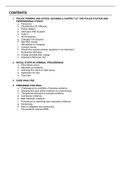
1. POLICE POWERS AND DUTIES, ADVISING A SUSPECT AT THE POLICE STATION AND
PROFESSIONAL ETHICS
a. Personnel
b. Classification Of Offences
c. Police Station
d. Interviews With Suspect
e. Code C
f. ID Procedures
g. Charging The Suspect
h. Bail after charge
i. Alternatives to charging
j. Conduct issues
k. Should the suspect answer questions in an Interview?
l. During the interview
m. Charge and Bail after charge
n. Adverse Inferences (AI)
2. INITIAL STEPS IN CRIMINAL PROCEEDINGS
a. Plea before venue
b. Allocation procedure
c. Advising the client on trial venue
d. Application for bail
e. Court bail
3. CASE ANALYSIS
4. PREPARING FOR TRIAL
a. Challenging the credibility of hearsay evidence
b. Stopping the case where evidence is unconvincing
c. The general discretion to exclude evidence
d. Confession evidence
e. Bad character evidence
f. Procedure for admitting bad character evidence
g. Sentencing
h. Plea in mitigation and sentencing
i. Pre-sentence reports (PSR)
, POLICE POWERS AND DUTIES, ADVISING A SUSPECT AT THE POLICE STATION AND
PROFESSIONAL ETHICS
PERSONNEL
Defence Will often become involved in a criminal case by providing advice and assistance to a suspect in the police
solicitors station, before the suspect is charged
If suspect charged: D Sol will represent in proceedings before the MC & (if necessary), CC
The police Responsible for the investigation of suspected criminal offences
Powers include:
- Stop and search suspected offenders
- Powers to search premises
- Power to arrest suspects
The CPS Responsible for prosecuting individuals (and companies) charged with having committed a criminal offence
Head of the CPA = Director of Public Prosecutions (DPP)
In deciding whether a prosecution should be brought, the CPS must apply the test set out in the Code for Crown
Prosecutors which provides that a prosecution should be brought only if:
1. there is enough evidence to provide a realistic prospect of conviction; and
2. It is in the public interest for a prosecution to be brought
Magistrate After suspect charged, first appearance will be in Magistrates’ court
s Court Depending on the type of offence with which the suspect has been charged, the case may either remain in the
MC or be sent to CC
Functions of MC include:
1. Issuing search and arrest warrants;
2. Issuing warrants for further detention under PACE 1984;
3. Trying summary offences and some either way offences;
4. Sending indictable-only offences and some either-way offences to CC for trial;
5. Dealing with applications for a representation order; and
6. Dealing with applications for bail
Crown Main functions:
Court 1. Conduct trial of and, following conviction, sentence offenders convicted of indictable only and
some either way offences;
2. To determine questions of bail and representation, particularly appeals by a D against refusal of
bail by MC;
3. To hear appeals against conviction and/or sentence from MC
If case goes to trial – before a judge and jury
Probation Representative from Probation Service will always be present at court
Service Responsible for compiling reports on D’s who have been convicted, should the court require a report before
sentencing the D (known as ‘pre-sentence’ report)
Legal Aid Legal Aid Agency (LAA) provides funding for D’s either by entering into a ‘standard crime contract’ with solicitors
in private practice, or by providing salaried public defenders in certain parts of the country
CLASSFICIATION OF OFFENCES
Indictabl Most serious form of criminal offence Examples:
e only Must be dealt with by the Crown Court but D first appearance before Magistrates’ 1. Murder
offences Court 2. Rape
3. Robbery
Either Dealt with either by the Magistrates Court or Crown Court Examples:
way D will make first appearance before Magistrates Court and the Magistrates will 1. Theft
offences decide whether they keep the case before them or sent to Crown Court 2. Assault occasioning
IF Magistrates Court decide to keep the case before them, the D has the right to actual bodily harm
elect trial by a judge and jury in the Crown Court 3. Most forms of
burglary
NB: low value shoplifting offences will be treated as summary only unless an adult D
enters a NG plea, when he will still be given the opportunity to elect for Crown Court
Summary Least serious form of criminal offence and may be dealt with only by the Examples:
,offences Magistrates’ Court 1. Assault
2. Road Traffic
Offences
POLICE STATION
Is there If there is not sufficient evidence to charge a subject immediately, they should be released either on or without
sufficient bail, unless either:
evidence o CO has reasonable grounds for believing that detaining the suspect without charge is necessary to
secure or preserve evidence relating to the offence; or
to charge
o It is necessary to obtain such evidence by questioning – s37(2)
the
S37(3) - If either ground applies, CO can authorise suspect to be kept in police detention
suspect?
S39 - If the CO becomes aware that the grounds on which a suspect’s detention was authorised have ceased to
apply
Conditions Code C:
of detention Para 8.2 - Cell must be adequately heated, cleaned, ventilated and lit
Para 8.3- Bedding must be of reasonable standard and in a clean and sanitary condition
Para 8.4 -Suspect must be provided with access to toilet and washing facilities
CODE C Para 8.6 & 8B -Suspect must be offered at least two light meals and one main meal in any 24 hour period, drinks
should be provided at meal times and on reasonable request
Para 8.7 - Should be offered brief outdoor exercise daily if practicable
Para 9.3 - Suspect should be visited in their cells at least every hour
Para 9.5 & 9.5A -If CO considers they are injured / illness / mental disorder, they should receive appropriate clinical
attention as soon as reasonably practicable
Periods of
detention TIME Suspect attends station as a volunteer and then arrested - the time of his arrest – s41(2)(c)
PACE
Suspect who attends a police station to answer ‘street bail’ - the time when he arrives at
the police station - s41(2)(ca)
Suspect arrested and then taken to police station - the time the suspect arrives at the first
police station after his arrest – s41(1)(d)
Original S41 - Person shall not be kept in police detention for more than 24 hours without being charged
detention (begins from the relevant time). Unless…
First S42 - Police (superintended or above) can extend this up to 36 hours from the ‘relevant
extension time’ if:
- The offence is either-way or indictable;
- Have reasonable grounds for believing the detention w/o charge is
necessary to secure/preserve evidence relating to the offence or to get such
evidence by questioning the suspect; and/or
- Investigation is being carried out diligently and expeditiously
Second S43 - May be extended to 72 hours by obtaining a warrant from MC, if police obtain warrant from
extension magistrates
Police (superintended or above) can extend this:
- But the offence must be either-way or indictable;
- Have reasonable grounds for believing the detention w/o charge is
necessary to secure/preserve evidence relating to the offence or to get such
evidence by questioning the suspect; and/or
- Investigation is being carried out diligently and expeditiously
Final S44 - May be extended to 96 hours by way of magistrate’s warrant
extension - Will only be granted in exceptional cases where there are reasonable grounds
for believing further detention is justified
- Grounds in s43 must be satisfied
- Max. total period in custody is 4 days (86hrs) before release / charge
Review S40 - Police must periodically review the suspect’s detention to ensure the grounds on
which the detention was authorised are still applicable
S40(2)(b) - Must be carried out by an officer of inspector or higher that is not directly involved
in the investigation
Mandatory requirement = If reviews are not carried out, detention is unlawful and
amounts to false imprisonment - Roberts v CCCC
First review - No later than 6 hours after CO first authorised detention (not arrival at station)
(s40)
Second review: within 9 hours of first review
Subsequent reviews -Intervals of no more than nine hours
, Police PACE 1984: detention, stop and search, questioning
powers Codes of Practice provide detailed advice and guidelines (Issued by Home Secretary)
s67(11) PACE: obliges the court to take into account any relevant breaches of the Codes
in relation to an issue in the proceedings
The breach of the codes is not an offence or a civil wrong, but a formal complaint can
be made to the police force and referred to the IPCC
Arresting They have the power to arrest without a warrant under s24 PACE
officer They must tell the arrested person they are under arrest and the grounds; s28
They must caution the suspect before questioning as per Code C Paragraph 10.1 “you do
not have to say anything, but it may harm your defence if you do not mention something
and later try to rely on it at trial” - Paragraph 10.4 Code C
Must take the suspect to the police station immediately after arrest unless it is reasonable
to carry out other investigations elsewhere; s30 ACE
Must bring the suspect to the custody officer ASAP - Code C Paragraph 2.1A
Custody 1. Arrested suspect must be brought before a custody officer upon arrival
officer
Must hold the rank of at least a sergeant and not be involved in the investigation
Para 2.1A, Code C - This should be done ‘as soon as practicable’
2. Custody officer is responsible for opening and maintaining a custody record for each
suspect. This is a written document that contains:
Suspect’s name and address, phone number, DOB and occupation
Offence they have been arrested for and why they were arrested (Code G, para 4.3)
Time of the suspect’s arrest and time of their arrival at the police station
Reason why the suspect’s on-going detention at the police station has been authorised
Time detention was authorised
Confirmation the suspect has been given details of their rights
Whether he requested legal advice from a solicitor
Details of items he had on his person, and any details of medical conditions
3. Custody record will have an attached detention log. This is a record of all
significant events that occur whilst the suspect is in custody.
4. Custody officer must also inform suspect about his on-going rights which may be
exercised at any time whilst they are in custody. Right to:
Have someone informed of their arrest – s56
Consult privately with a solicitor and have free independent legal advice – s58
Right to consult the Codes of Practice
5. The custody office must find out what items of property a suspect has on his person
and make a record of these items – s54(1) & (2)
S54(3) - CO can seize and retain any items the suspect has on him. Clothing and
personal effects can only be seized it CO has reasonable grounds for believing they
may be evidence, or the suspect may use them to harm himself or others, damage
property, interfere with evidence or assist him to escape.
1. POLICE POWERS AND DUTIES, ADVISING A SUSPECT AT THE POLICE STATION AND
PROFESSIONAL ETHICS
a. Personnel
b. Classification Of Offences
c. Police Station
d. Interviews With Suspect
e. Code C
f. ID Procedures
g. Charging The Suspect
h. Bail after charge
i. Alternatives to charging
j. Conduct issues
k. Should the suspect answer questions in an Interview?
l. During the interview
m. Charge and Bail after charge
n. Adverse Inferences (AI)
2. INITIAL STEPS IN CRIMINAL PROCEEDINGS
a. Plea before venue
b. Allocation procedure
c. Advising the client on trial venue
d. Application for bail
e. Court bail
3. CASE ANALYSIS
4. PREPARING FOR TRIAL
a. Challenging the credibility of hearsay evidence
b. Stopping the case where evidence is unconvincing
c. The general discretion to exclude evidence
d. Confession evidence
e. Bad character evidence
f. Procedure for admitting bad character evidence
g. Sentencing
h. Plea in mitigation and sentencing
i. Pre-sentence reports (PSR)
, POLICE POWERS AND DUTIES, ADVISING A SUSPECT AT THE POLICE STATION AND
PROFESSIONAL ETHICS
PERSONNEL
Defence Will often become involved in a criminal case by providing advice and assistance to a suspect in the police
solicitors station, before the suspect is charged
If suspect charged: D Sol will represent in proceedings before the MC & (if necessary), CC
The police Responsible for the investigation of suspected criminal offences
Powers include:
- Stop and search suspected offenders
- Powers to search premises
- Power to arrest suspects
The CPS Responsible for prosecuting individuals (and companies) charged with having committed a criminal offence
Head of the CPA = Director of Public Prosecutions (DPP)
In deciding whether a prosecution should be brought, the CPS must apply the test set out in the Code for Crown
Prosecutors which provides that a prosecution should be brought only if:
1. there is enough evidence to provide a realistic prospect of conviction; and
2. It is in the public interest for a prosecution to be brought
Magistrate After suspect charged, first appearance will be in Magistrates’ court
s Court Depending on the type of offence with which the suspect has been charged, the case may either remain in the
MC or be sent to CC
Functions of MC include:
1. Issuing search and arrest warrants;
2. Issuing warrants for further detention under PACE 1984;
3. Trying summary offences and some either way offences;
4. Sending indictable-only offences and some either-way offences to CC for trial;
5. Dealing with applications for a representation order; and
6. Dealing with applications for bail
Crown Main functions:
Court 1. Conduct trial of and, following conviction, sentence offenders convicted of indictable only and
some either way offences;
2. To determine questions of bail and representation, particularly appeals by a D against refusal of
bail by MC;
3. To hear appeals against conviction and/or sentence from MC
If case goes to trial – before a judge and jury
Probation Representative from Probation Service will always be present at court
Service Responsible for compiling reports on D’s who have been convicted, should the court require a report before
sentencing the D (known as ‘pre-sentence’ report)
Legal Aid Legal Aid Agency (LAA) provides funding for D’s either by entering into a ‘standard crime contract’ with solicitors
in private practice, or by providing salaried public defenders in certain parts of the country
CLASSFICIATION OF OFFENCES
Indictabl Most serious form of criminal offence Examples:
e only Must be dealt with by the Crown Court but D first appearance before Magistrates’ 1. Murder
offences Court 2. Rape
3. Robbery
Either Dealt with either by the Magistrates Court or Crown Court Examples:
way D will make first appearance before Magistrates Court and the Magistrates will 1. Theft
offences decide whether they keep the case before them or sent to Crown Court 2. Assault occasioning
IF Magistrates Court decide to keep the case before them, the D has the right to actual bodily harm
elect trial by a judge and jury in the Crown Court 3. Most forms of
burglary
NB: low value shoplifting offences will be treated as summary only unless an adult D
enters a NG plea, when he will still be given the opportunity to elect for Crown Court
Summary Least serious form of criminal offence and may be dealt with only by the Examples:
,offences Magistrates’ Court 1. Assault
2. Road Traffic
Offences
POLICE STATION
Is there If there is not sufficient evidence to charge a subject immediately, they should be released either on or without
sufficient bail, unless either:
evidence o CO has reasonable grounds for believing that detaining the suspect without charge is necessary to
secure or preserve evidence relating to the offence; or
to charge
o It is necessary to obtain such evidence by questioning – s37(2)
the
S37(3) - If either ground applies, CO can authorise suspect to be kept in police detention
suspect?
S39 - If the CO becomes aware that the grounds on which a suspect’s detention was authorised have ceased to
apply
Conditions Code C:
of detention Para 8.2 - Cell must be adequately heated, cleaned, ventilated and lit
Para 8.3- Bedding must be of reasonable standard and in a clean and sanitary condition
Para 8.4 -Suspect must be provided with access to toilet and washing facilities
CODE C Para 8.6 & 8B -Suspect must be offered at least two light meals and one main meal in any 24 hour period, drinks
should be provided at meal times and on reasonable request
Para 8.7 - Should be offered brief outdoor exercise daily if practicable
Para 9.3 - Suspect should be visited in their cells at least every hour
Para 9.5 & 9.5A -If CO considers they are injured / illness / mental disorder, they should receive appropriate clinical
attention as soon as reasonably practicable
Periods of
detention TIME Suspect attends station as a volunteer and then arrested - the time of his arrest – s41(2)(c)
PACE
Suspect who attends a police station to answer ‘street bail’ - the time when he arrives at
the police station - s41(2)(ca)
Suspect arrested and then taken to police station - the time the suspect arrives at the first
police station after his arrest – s41(1)(d)
Original S41 - Person shall not be kept in police detention for more than 24 hours without being charged
detention (begins from the relevant time). Unless…
First S42 - Police (superintended or above) can extend this up to 36 hours from the ‘relevant
extension time’ if:
- The offence is either-way or indictable;
- Have reasonable grounds for believing the detention w/o charge is
necessary to secure/preserve evidence relating to the offence or to get such
evidence by questioning the suspect; and/or
- Investigation is being carried out diligently and expeditiously
Second S43 - May be extended to 72 hours by obtaining a warrant from MC, if police obtain warrant from
extension magistrates
Police (superintended or above) can extend this:
- But the offence must be either-way or indictable;
- Have reasonable grounds for believing the detention w/o charge is
necessary to secure/preserve evidence relating to the offence or to get such
evidence by questioning the suspect; and/or
- Investigation is being carried out diligently and expeditiously
Final S44 - May be extended to 96 hours by way of magistrate’s warrant
extension - Will only be granted in exceptional cases where there are reasonable grounds
for believing further detention is justified
- Grounds in s43 must be satisfied
- Max. total period in custody is 4 days (86hrs) before release / charge
Review S40 - Police must periodically review the suspect’s detention to ensure the grounds on
which the detention was authorised are still applicable
S40(2)(b) - Must be carried out by an officer of inspector or higher that is not directly involved
in the investigation
Mandatory requirement = If reviews are not carried out, detention is unlawful and
amounts to false imprisonment - Roberts v CCCC
First review - No later than 6 hours after CO first authorised detention (not arrival at station)
(s40)
Second review: within 9 hours of first review
Subsequent reviews -Intervals of no more than nine hours
, Police PACE 1984: detention, stop and search, questioning
powers Codes of Practice provide detailed advice and guidelines (Issued by Home Secretary)
s67(11) PACE: obliges the court to take into account any relevant breaches of the Codes
in relation to an issue in the proceedings
The breach of the codes is not an offence or a civil wrong, but a formal complaint can
be made to the police force and referred to the IPCC
Arresting They have the power to arrest without a warrant under s24 PACE
officer They must tell the arrested person they are under arrest and the grounds; s28
They must caution the suspect before questioning as per Code C Paragraph 10.1 “you do
not have to say anything, but it may harm your defence if you do not mention something
and later try to rely on it at trial” - Paragraph 10.4 Code C
Must take the suspect to the police station immediately after arrest unless it is reasonable
to carry out other investigations elsewhere; s30 ACE
Must bring the suspect to the custody officer ASAP - Code C Paragraph 2.1A
Custody 1. Arrested suspect must be brought before a custody officer upon arrival
officer
Must hold the rank of at least a sergeant and not be involved in the investigation
Para 2.1A, Code C - This should be done ‘as soon as practicable’
2. Custody officer is responsible for opening and maintaining a custody record for each
suspect. This is a written document that contains:
Suspect’s name and address, phone number, DOB and occupation
Offence they have been arrested for and why they were arrested (Code G, para 4.3)
Time of the suspect’s arrest and time of their arrival at the police station
Reason why the suspect’s on-going detention at the police station has been authorised
Time detention was authorised
Confirmation the suspect has been given details of their rights
Whether he requested legal advice from a solicitor
Details of items he had on his person, and any details of medical conditions
3. Custody record will have an attached detention log. This is a record of all
significant events that occur whilst the suspect is in custody.
4. Custody officer must also inform suspect about his on-going rights which may be
exercised at any time whilst they are in custody. Right to:
Have someone informed of their arrest – s56
Consult privately with a solicitor and have free independent legal advice – s58
Right to consult the Codes of Practice
5. The custody office must find out what items of property a suspect has on his person
and make a record of these items – s54(1) & (2)
S54(3) - CO can seize and retain any items the suspect has on him. Clothing and
personal effects can only be seized it CO has reasonable grounds for believing they
may be evidence, or the suspect may use them to harm himself or others, damage
property, interfere with evidence or assist him to escape.