

NURS 340 Health Assessment
Exam 2 Study Guide
Spring 2020
Exam 2 covers chapters 11-15 in the following text:
Hogan-Quigley, B., Palm, M. L., & Bickley, L. (2017). Bates’ nursing guide to physical examination
and history taking (2nd ed.). Wolters Kluwer.
Although an exam question may come from any part of chapters 11-15, the student should
focus on the following:
Chapter 11
Anatomy and physiology of the eye
Sensory organ
o Spherical structure that focuses light on retina > CNII > optic tract > visual cortex
o Muscles of iris control pupillary responses
o Enables vision
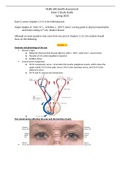
Cranial nerve component
o CN III: oculomotor nerve = innervates the levator palpebrae muscle, which raises the
upper eyelid. CN II is the optic nerve, CN IV is the trochlear nerve, and CN VI is the
abducens nerve.
o CN IV and VI: extraocular movements
o
The cranial nerves affecting the eyes and the function of each
, NURS 340 Health Assessment
Exam 2 Study Guide
Spring 2020
The tests used to assess the eyes (name, how it is performed, why it is used)
• Equipment for examination
– Snellen chart or “E” card
– Rosenbaum, near-vision card
– Index card
– Penlight
– Ophthalmoscope
Visual acuity
• Distal
Snellen eye chart or “E” chart
– Cover one eye with index card, read smallest line
– Repeat with other eye
– Note if testing is completed with corrective lenses
– Findings recorded as fraction (numerator is distance patient is from chart, denominator
is distance normal eye can read chart)- Legally blind = 20/200 or <20 degrees
Near vision
– Rosenbaum chart
– Hold card 14 inches from patient (14/14)
– Helps identify need for bifocals or reading glasses
• Peripheral (visual fields) - Field defects that are all or partly temporal
– Homonymous hemianopsia is a condition in which a person sees
only one side―right or left―of the visual world
• CVA or stroke
– LEFT
– Bitemporal hemianopsia, is the medical description of a type of
partial blindness where vision is missing in the outer half of both the
right and left visual field.
–
– Quadrantic hemianopia - Loss of vision in a quarter section of the
visual field of one or both eyes;
– Homonymous Left superior Quadrantic Defecit
• Position and alignment of the eyes
– Abnormal protrusion: Graves disease, ocular tumors
• Eyebrows
– Scaliness: seborrheic dermatitis
– Lateral sparseness: hypothyroidism
• Eyelids
– Width of palpebral fissures
, NURS 340 Health Assessment
Exam 2 Study Guide
Spring 2020
• Upstarting palpebral fissures: Down syndrome
– Edema
– Color
– Lesions
– Condition and direction of eyelashes
– Adequacy with which eyelids close
• Ptosis – drooping of upper eyelid
• Lid Retraction and Exophthalmos
• Entropion - eyelid is rolled inward against the eyeball
• Ectropion - eyelid turns outward.
• Pinguecula - yellowish, raised growth on the conjunctiva.
• Episcleritis - benign, self-limiting inflammatory disease in
sclera. SLE
• Hordeolum (Sty) - red, painful lump near the edge of the eyelid
that may look like a boil or pimple
, NURS 340 Health Assessment
Exam 2 Study Guide
Spring 2020
• Chalazion - A slow-growing, inflammatory lump in the oil gland
eyelid.
• Xanthelasma - soft, yellowish, fatty deposit that forms under your skin
• Dacryocystitis - infection of the tear (lacrimal) sac usually due
to a blockage in the tear (nasolacrimal) duct.
Conjunctiva and Sclera
• Jaundice
• Conjunctivitis - inflammation or swelling of the conjunctiva
• - Subconjunctival Hemorrhage - A bright red patch appearing in the
white of the eye beneath the clear lining
Cornea and Lens
Exam 2 Study Guide
Spring 2020
Exam 2 covers chapters 11-15 in the following text:
Hogan-Quigley, B., Palm, M. L., & Bickley, L. (2017). Bates’ nursing guide to physical examination
and history taking (2nd ed.). Wolters Kluwer.
Although an exam question may come from any part of chapters 11-15, the student should
focus on the following:
Chapter 11
Anatomy and physiology of the eye
Sensory organ
o Spherical structure that focuses light on retina > CNII > optic tract > visual cortex
o Muscles of iris control pupillary responses
o Enables vision
Cranial nerve component
o CN III: oculomotor nerve = innervates the levator palpebrae muscle, which raises the
upper eyelid. CN II is the optic nerve, CN IV is the trochlear nerve, and CN VI is the
abducens nerve.
o CN IV and VI: extraocular movements
o
The cranial nerves affecting the eyes and the function of each
, NURS 340 Health Assessment
Exam 2 Study Guide
Spring 2020
The tests used to assess the eyes (name, how it is performed, why it is used)
• Equipment for examination
– Snellen chart or “E” card
– Rosenbaum, near-vision card
– Index card
– Penlight
– Ophthalmoscope
Visual acuity
• Distal
Snellen eye chart or “E” chart
– Cover one eye with index card, read smallest line
– Repeat with other eye
– Note if testing is completed with corrective lenses
– Findings recorded as fraction (numerator is distance patient is from chart, denominator
is distance normal eye can read chart)- Legally blind = 20/200 or <20 degrees
Near vision
– Rosenbaum chart
– Hold card 14 inches from patient (14/14)
– Helps identify need for bifocals or reading glasses
• Peripheral (visual fields) - Field defects that are all or partly temporal
– Homonymous hemianopsia is a condition in which a person sees
only one side―right or left―of the visual world
• CVA or stroke
– LEFT
– Bitemporal hemianopsia, is the medical description of a type of
partial blindness where vision is missing in the outer half of both the
right and left visual field.
–
– Quadrantic hemianopia - Loss of vision in a quarter section of the
visual field of one or both eyes;
– Homonymous Left superior Quadrantic Defecit
• Position and alignment of the eyes
– Abnormal protrusion: Graves disease, ocular tumors
• Eyebrows
– Scaliness: seborrheic dermatitis
– Lateral sparseness: hypothyroidism
• Eyelids
– Width of palpebral fissures
, NURS 340 Health Assessment
Exam 2 Study Guide
Spring 2020
• Upstarting palpebral fissures: Down syndrome
– Edema
– Color
– Lesions
– Condition and direction of eyelashes
– Adequacy with which eyelids close
• Ptosis – drooping of upper eyelid
• Lid Retraction and Exophthalmos
• Entropion - eyelid is rolled inward against the eyeball
• Ectropion - eyelid turns outward.
• Pinguecula - yellowish, raised growth on the conjunctiva.
• Episcleritis - benign, self-limiting inflammatory disease in
sclera. SLE
• Hordeolum (Sty) - red, painful lump near the edge of the eyelid
that may look like a boil or pimple
, NURS 340 Health Assessment
Exam 2 Study Guide
Spring 2020
• Chalazion - A slow-growing, inflammatory lump in the oil gland
eyelid.
• Xanthelasma - soft, yellowish, fatty deposit that forms under your skin
• Dacryocystitis - infection of the tear (lacrimal) sac usually due
to a blockage in the tear (nasolacrimal) duct.
Conjunctiva and Sclera
• Jaundice
• Conjunctivitis - inflammation or swelling of the conjunctiva
• - Subconjunctival Hemorrhage - A bright red patch appearing in the
white of the eye beneath the clear lining
Cornea and Lens

