Alba Casado Vallarino
British Culture
History
Prehistory and the Celts
- Human habitation 800,000 BC
- Britain becomes island 6,000 – 5,000 BC
- Neolithic people1 (barrows2 & henges3) 3,000 BC
- Beaker people 2,400 BC
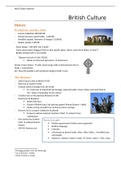
Stone henge = still WHY was it built?
Some stoned were dragged 25km to that specific place, others come from Wales how??
Beaker people built it, not druids!
- Takeover/arrival of Celts 700 BC:
Better in tribal and agriculture dominance
Druids ‘future tellers’ after stone henge (still no link between the 2)
Bards = entertainers
Art: they left jewellery with particular designs (Celtic cross)
The Romans
- Julius Caesar came to Britain 55 BC
- Went up to Thames 54 BC
- Gradual cultural change from the inside
Ex. Took sons of important ppl hostage, educated with roman culture and send back to
UK = hope of spreading roman culture
- Claudius tries to incorporate Britannia 43 AD
- Resistance of Boadicea
British folk hero
Queen of British Iceni, led uprising against Roman Empire = failed
Statue wrong, shouldn’t be on Roman horse carriage
- Romans fail to conquer Caledonia (Scotland)
Emperor Hadrian ordered ‘Hadrian’s Wall’ protects from
Caledonians
- First attacks by Scottish Rome brought:
Celts collapse Roman
Modern government (tribes were organized)
Empire
Written language
- 409 AD: Romans out
Calendar
Infrastructure (paved roads, cities, villas, baths,..) travelled easy
and quickly
Names in -chester/-cester/-caster roman ‘castra’ = fort, camp
1
First new people, from the Stone age
2
a.k.a. burrows = tombs
3
Circle of stone or wood
, Alba Casado Vallarino
The (Anglo-)Saxons
Romans left need of ‘power’ Saxons filled that position
- Invasions:
Saxons: south (Sussex, Essex, Wessex)
Angels: east + north (England)
Jutes: Kent (= smallest tribe, not that important)
- Celts driven west and north
- ‘Legend of King Arthur’ no evidence of existence
Prob. Based on numerous people
He would be a celt fighting WITH Saxons/English
- Augustine spreads Christianity (end of 6th C.) spreads very quickly
- Invasions by Vikings and Danes (end 8th C.) = Scandinavians
- King Egbert: confederation (early 9th C.)
- King Alfred and the Danelaw
- Edgar reunites England (10th C.)
- Ethelred ‘the Unready’ pays off the Vikings: Danegeld
- Cnut (Canute): England under Scandinavian control
- Danes/Vikings and Anglo-Saxons live together
- Edward ‘the Confessor’
Old English
- English developed from Ingveonic dialects
- Old English late 9th C.
- Bede: Ecclesiastical History Examples:
- Anglo-Saxon Chronicles = writing down - Prepositions: on, in, to, into, by, with
events that occurred - Articles/pronouns: the, a, you, he, I, me, that, which
- Placenames: - Verbs: is, was, are, have, can, make, like, write, come
‘-ing’ = the people of - Nouns: word, time, people, water, day, oil
‘-ton’ = village - Others; not, as, or, and, so, no, if, one, two
‘-ham’ = farm
- 96/100 modern English words come from Old English
1066
- Edward ‘the Confessor’ dies no obvious successor
Harald Hardraada: related to previous king
Edgar atheling: 14y, very sick quickly ruled out
Duke of Normandy William and Harold Godwinson
- Closest to Edward Harold Godwinson crowns himself
- September: Viking king Harald attacks from north battle of Stanford bridge = Harold won
- William attacks from south Harold directly heads to south (tired army)
- Battle of Hastings = Harold killed
- William ‘the Conqueror’ crowned king Important invasion because:
(25/12/1066 in Westminster)
1. Last successful hostile invasion in England
2. Society changes introduction of feudal system
3. French language dominates English blown away
British Culture
History
Prehistory and the Celts
- Human habitation 800,000 BC
- Britain becomes island 6,000 – 5,000 BC
- Neolithic people1 (barrows2 & henges3) 3,000 BC
- Beaker people 2,400 BC
Stone henge = still WHY was it built?
Some stoned were dragged 25km to that specific place, others come from Wales how??
Beaker people built it, not druids!
- Takeover/arrival of Celts 700 BC:
Better in tribal and agriculture dominance
Druids ‘future tellers’ after stone henge (still no link between the 2)
Bards = entertainers
Art: they left jewellery with particular designs (Celtic cross)
The Romans
- Julius Caesar came to Britain 55 BC
- Went up to Thames 54 BC
- Gradual cultural change from the inside
Ex. Took sons of important ppl hostage, educated with roman culture and send back to
UK = hope of spreading roman culture
- Claudius tries to incorporate Britannia 43 AD
- Resistance of Boadicea
British folk hero
Queen of British Iceni, led uprising against Roman Empire = failed
Statue wrong, shouldn’t be on Roman horse carriage
- Romans fail to conquer Caledonia (Scotland)
Emperor Hadrian ordered ‘Hadrian’s Wall’ protects from
Caledonians
- First attacks by Scottish Rome brought:
Celts collapse Roman
Modern government (tribes were organized)
Empire
Written language
- 409 AD: Romans out
Calendar
Infrastructure (paved roads, cities, villas, baths,..) travelled easy
and quickly
Names in -chester/-cester/-caster roman ‘castra’ = fort, camp
1
First new people, from the Stone age
2
a.k.a. burrows = tombs
3
Circle of stone or wood
, Alba Casado Vallarino
The (Anglo-)Saxons
Romans left need of ‘power’ Saxons filled that position
- Invasions:
Saxons: south (Sussex, Essex, Wessex)
Angels: east + north (England)
Jutes: Kent (= smallest tribe, not that important)
- Celts driven west and north
- ‘Legend of King Arthur’ no evidence of existence
Prob. Based on numerous people
He would be a celt fighting WITH Saxons/English
- Augustine spreads Christianity (end of 6th C.) spreads very quickly
- Invasions by Vikings and Danes (end 8th C.) = Scandinavians
- King Egbert: confederation (early 9th C.)
- King Alfred and the Danelaw
- Edgar reunites England (10th C.)
- Ethelred ‘the Unready’ pays off the Vikings: Danegeld
- Cnut (Canute): England under Scandinavian control
- Danes/Vikings and Anglo-Saxons live together
- Edward ‘the Confessor’
Old English
- English developed from Ingveonic dialects
- Old English late 9th C.
- Bede: Ecclesiastical History Examples:
- Anglo-Saxon Chronicles = writing down - Prepositions: on, in, to, into, by, with
events that occurred - Articles/pronouns: the, a, you, he, I, me, that, which
- Placenames: - Verbs: is, was, are, have, can, make, like, write, come
‘-ing’ = the people of - Nouns: word, time, people, water, day, oil
‘-ton’ = village - Others; not, as, or, and, so, no, if, one, two
‘-ham’ = farm
- 96/100 modern English words come from Old English
1066
- Edward ‘the Confessor’ dies no obvious successor
Harald Hardraada: related to previous king
Edgar atheling: 14y, very sick quickly ruled out
Duke of Normandy William and Harold Godwinson
- Closest to Edward Harold Godwinson crowns himself
- September: Viking king Harald attacks from north battle of Stanford bridge = Harold won
- William attacks from south Harold directly heads to south (tired army)
- Battle of Hastings = Harold killed
- William ‘the Conqueror’ crowned king Important invasion because:
(25/12/1066 in Westminster)
1. Last successful hostile invasion in England
2. Society changes introduction of feudal system
3. French language dominates English blown away