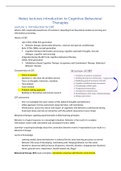
Notes lectures Introduction to Cognitive Behavioral
Therapies
Lecture 1: Introduction to CBT
What is CBT; empirically based form of treatment, departing from theoretical models on learning and
information processing.
History of CBT:
- Late 1950s-1960s first generation
Behavior therapy (observable behaviors, classical and operant conditioning)
- Early 1970s-1980s; second generation
Cognitive therapy (information processing, negative automatic thoughts, Socratic
dialogue, cognitive restructuring)
- Integrated during the 80’3 into cognitive-behavioral therapy
- 2000s; third generation
Mindfulness Based Cognitive Therapy, Acceptance and Commitment Therapy, Dialectical
Behavior Therapy
Characteristics of CBT;
- Focus on present
- Question is; why does the problem persist
- Focus on thoughts, behaviors, emotions
- Time-limited
- Goal oriented
- Problem solving approach
- Building on theoretical and clinical research
CBT assessment;
- Aim; to investigate the exact nature of this patients thoughts and behaviors
- Initial approach; formal assessment using interview, self-monitoring
- Maintenance; assess the nature and impact of cognitions and behaviors continuously during
treatment phase and also in interaction with the patient (assessment never stops)
Behavioral therapy= applying experimentally verified learning principles.
Behavior is a logical response to a meaningful situation. Behavior is the result of a complex
information system with antecedent and consequent factors (ABC).
Learning= acquiring knowledge about the connection between events (=expectations) can result in a
behavioral change.
Levels of knowledge;
- Learning model; abnormal behavior is achieved by the same learning processes as normal
behavior (the ways of developing, maintaining and changing behavior are the same)
- Normal or abnormal; deficits/excess (frequency, intensity, duration, inappropriate situation).
Norm; general norm, impairment, health-related risk, illegal
Behavioral therapy (BT); basic principles; interaction of person with his/her environment.
, 1. Antecedents; conditions/stimuli that set the occasion for behavior to occur
2. Behavior; anything a person does (or does not)
3. Consequences; effect that behavior produces (immediate and delayed)
Behavior is maintained by its consequences.
Assessment;
- Intake evaluation; assessing problem behavior (behavioral excesses/deficits), coping
behavior
- Registration of problem behavior and antecedents/consequences (typically in BT) or thought
records (typically in CT)
Functional analysis – antecedents
- Discriminative stimuli (Sd); events/situations
that elicit the behavior and predict
reinforcement/punishment.
- Establishing operations (EO);
Factors changing the
reinforcing/punishing properties of other
environmental events (hunger, thirst,
craving, negative mood, thoughts rules)
Motivational factors
- S-delta; situations/circumstances in which
the behavior does not take place.
Cognitive therapy (CT); basic principles of CT
- Thoughts (cognitions) give meaning to neutral stimulus and determine feelings and behavior
- Beliefs/schema’s are developed through (childhood) experiences and form a filter
- Identify thoughts
- Distinguish between automatic thoughts, (intermediate) beliefs, and core beliefs
- Challenge and change thoughts
Analyses in CBT on different levels;
- Most specific (movie-like)
Topographical analyses (chain of behaviors)
- On the level of problem behavior
Functional analysis in BT (describing antecedents (Sd/EO) – behavior – positive and
negative consequences
Cognitive conceptualization in CT (core beliefs, beliefs, situation, automatic thoughts,
reactions (emotional, physiological, behavioral))
- On the level of an overview of problem areas and their interactions/causal relations
Case formulation/holistic theory
New developments in CBT;
- Mindfulness
Mindfulness-based cognitive therapy (MBCT); non-judgmental observation of present
experiences
Thoughts can be observed
, Meditation
- Acceptance and commitment therapy (ACT)
Acceptance= willingness to stay in contact with aversive experiences
Commitment to life values and goals
Cognitive diffusion
Lecture 2: Exposure in practice
How do you apply exposure:
- Analysis of meaning: how do we think the classical of fear response is conditioned
- Conditioned stimulus (CS) unconditioned stimulus (UCS) conditioned response (CR)
Exposure to what? What is being avoided/prevented to happen;
- Situations (e.g. social interaction)
- Emotions (e.g. fear)
- Bodily sensations (e.g. palpitations)
- Cognitive contents (e.g. memories)
Classical conditioning;
- Little Albert; rabbit (CS) unexpected loud noise (UCS) fear (CS)
- Pavlov and the dog food; sound (CS) food (UCS) drooling (CS)
Fear responses in the brain:
- Quick route: eyes thalamus amygdala brainstem
Super quick fight, flight
In anxiety disorders is the amygdala very active sweating, difficulty thinking, rapid
breathing, stomachache, increasing heartrate, shaking
- Long route: eyes thalamus visual cortex amygdala brainstem
Takes longer, interpretation is involved
Exposure to the conditioned stimulus (CS) in exposure therapy.
Panic disorder:
- Dizziness (CS) faint (UCS) fear (CR)
- Higher heart rate (CS) having heart attack and dying (UCS) fear (CR)
Interoceptive exposure= exposure to bodily sensations.
Interceptive exposure in action;
- Hyperventilation provocation; dizziness (CS) fainting, going crazy, losing control, heart
attack (UCS) fear (CR)
- Breathing though a straw
- Walking the stairs
- Shaking your head
- Spinning around
- Holding your breath
- Looking at stripes
, Exposure: variants
- Exposure in vivo/in real life (agoraphobia)
- Exposure invitro/imagery exposure (PTSD)
- Interceptive exposure (panic disorders, hypochondriasis)
- Cue exposure (bulimia, addictive behaviors)
- Exposure with response prevention (OCD)
- Social mishap exposure (social phobia)
- Therapist-assistant/self-directed exposure
- Virtual reality exposure therapy (VRET)
Social anxiety disorder (SAD); social mishap (CS) rejection (UCS) fear (CR)
Mowrer’s two-factor theory;
- Classical conditioning to develop fear
- Operant conditioning to maintain fear through safety behaviors
Safety behavior=
- Behaviors that predict safety (absence of UCS) and that there are related to the prevention
of the feared outcome
- Safety behavior = R (operant)
Safety signal=
- Predictors of the absence of UCS
- Safety signal = CS
Avoidance behavior;
- Passive avoidance; avoiding situations/objects to prevent the expected feared outcome to
occur.
- Active avoidance; escaping from (leaving) the anxiety provoking situation (and therefore the
feared outcome).
Obsessive compulsive disorder (OCD);
- Obsessions that give rise to anxiety
My hands are dirty
Harming self/others
Did I leave the gas on
Did I just hit someone
I am gay
God is bad
- Compulsions that function as a mean to
diminish this anxiety (can be overt and
covert)
Washing (hands)
Cleaning
Checking
Praying
Counting
Therapies
Lecture 1: Introduction to CBT
What is CBT; empirically based form of treatment, departing from theoretical models on learning and
information processing.
History of CBT:
- Late 1950s-1960s first generation
Behavior therapy (observable behaviors, classical and operant conditioning)
- Early 1970s-1980s; second generation
Cognitive therapy (information processing, negative automatic thoughts, Socratic
dialogue, cognitive restructuring)
- Integrated during the 80’3 into cognitive-behavioral therapy
- 2000s; third generation
Mindfulness Based Cognitive Therapy, Acceptance and Commitment Therapy, Dialectical
Behavior Therapy
Characteristics of CBT;
- Focus on present
- Question is; why does the problem persist
- Focus on thoughts, behaviors, emotions
- Time-limited
- Goal oriented
- Problem solving approach
- Building on theoretical and clinical research
CBT assessment;
- Aim; to investigate the exact nature of this patients thoughts and behaviors
- Initial approach; formal assessment using interview, self-monitoring
- Maintenance; assess the nature and impact of cognitions and behaviors continuously during
treatment phase and also in interaction with the patient (assessment never stops)
Behavioral therapy= applying experimentally verified learning principles.
Behavior is a logical response to a meaningful situation. Behavior is the result of a complex
information system with antecedent and consequent factors (ABC).
Learning= acquiring knowledge about the connection between events (=expectations) can result in a
behavioral change.
Levels of knowledge;
- Learning model; abnormal behavior is achieved by the same learning processes as normal
behavior (the ways of developing, maintaining and changing behavior are the same)
- Normal or abnormal; deficits/excess (frequency, intensity, duration, inappropriate situation).
Norm; general norm, impairment, health-related risk, illegal
Behavioral therapy (BT); basic principles; interaction of person with his/her environment.
, 1. Antecedents; conditions/stimuli that set the occasion for behavior to occur
2. Behavior; anything a person does (or does not)
3. Consequences; effect that behavior produces (immediate and delayed)
Behavior is maintained by its consequences.
Assessment;
- Intake evaluation; assessing problem behavior (behavioral excesses/deficits), coping
behavior
- Registration of problem behavior and antecedents/consequences (typically in BT) or thought
records (typically in CT)
Functional analysis – antecedents
- Discriminative stimuli (Sd); events/situations
that elicit the behavior and predict
reinforcement/punishment.
- Establishing operations (EO);
Factors changing the
reinforcing/punishing properties of other
environmental events (hunger, thirst,
craving, negative mood, thoughts rules)
Motivational factors
- S-delta; situations/circumstances in which
the behavior does not take place.
Cognitive therapy (CT); basic principles of CT
- Thoughts (cognitions) give meaning to neutral stimulus and determine feelings and behavior
- Beliefs/schema’s are developed through (childhood) experiences and form a filter
- Identify thoughts
- Distinguish between automatic thoughts, (intermediate) beliefs, and core beliefs
- Challenge and change thoughts
Analyses in CBT on different levels;
- Most specific (movie-like)
Topographical analyses (chain of behaviors)
- On the level of problem behavior
Functional analysis in BT (describing antecedents (Sd/EO) – behavior – positive and
negative consequences
Cognitive conceptualization in CT (core beliefs, beliefs, situation, automatic thoughts,
reactions (emotional, physiological, behavioral))
- On the level of an overview of problem areas and their interactions/causal relations
Case formulation/holistic theory
New developments in CBT;
- Mindfulness
Mindfulness-based cognitive therapy (MBCT); non-judgmental observation of present
experiences
Thoughts can be observed
, Meditation
- Acceptance and commitment therapy (ACT)
Acceptance= willingness to stay in contact with aversive experiences
Commitment to life values and goals
Cognitive diffusion
Lecture 2: Exposure in practice
How do you apply exposure:
- Analysis of meaning: how do we think the classical of fear response is conditioned
- Conditioned stimulus (CS) unconditioned stimulus (UCS) conditioned response (CR)
Exposure to what? What is being avoided/prevented to happen;
- Situations (e.g. social interaction)
- Emotions (e.g. fear)
- Bodily sensations (e.g. palpitations)
- Cognitive contents (e.g. memories)
Classical conditioning;
- Little Albert; rabbit (CS) unexpected loud noise (UCS) fear (CS)
- Pavlov and the dog food; sound (CS) food (UCS) drooling (CS)
Fear responses in the brain:
- Quick route: eyes thalamus amygdala brainstem
Super quick fight, flight
In anxiety disorders is the amygdala very active sweating, difficulty thinking, rapid
breathing, stomachache, increasing heartrate, shaking
- Long route: eyes thalamus visual cortex amygdala brainstem
Takes longer, interpretation is involved
Exposure to the conditioned stimulus (CS) in exposure therapy.
Panic disorder:
- Dizziness (CS) faint (UCS) fear (CR)
- Higher heart rate (CS) having heart attack and dying (UCS) fear (CR)
Interoceptive exposure= exposure to bodily sensations.
Interceptive exposure in action;
- Hyperventilation provocation; dizziness (CS) fainting, going crazy, losing control, heart
attack (UCS) fear (CR)
- Breathing though a straw
- Walking the stairs
- Shaking your head
- Spinning around
- Holding your breath
- Looking at stripes
, Exposure: variants
- Exposure in vivo/in real life (agoraphobia)
- Exposure invitro/imagery exposure (PTSD)
- Interceptive exposure (panic disorders, hypochondriasis)
- Cue exposure (bulimia, addictive behaviors)
- Exposure with response prevention (OCD)
- Social mishap exposure (social phobia)
- Therapist-assistant/self-directed exposure
- Virtual reality exposure therapy (VRET)
Social anxiety disorder (SAD); social mishap (CS) rejection (UCS) fear (CR)
Mowrer’s two-factor theory;
- Classical conditioning to develop fear
- Operant conditioning to maintain fear through safety behaviors
Safety behavior=
- Behaviors that predict safety (absence of UCS) and that there are related to the prevention
of the feared outcome
- Safety behavior = R (operant)
Safety signal=
- Predictors of the absence of UCS
- Safety signal = CS
Avoidance behavior;
- Passive avoidance; avoiding situations/objects to prevent the expected feared outcome to
occur.
- Active avoidance; escaping from (leaving) the anxiety provoking situation (and therefore the
feared outcome).
Obsessive compulsive disorder (OCD);
- Obsessions that give rise to anxiety
My hands are dirty
Harming self/others
Did I leave the gas on
Did I just hit someone
I am gay
God is bad
- Compulsions that function as a mean to
diminish this anxiety (can be overt and
covert)
Washing (hands)
Cleaning
Checking
Praying
Counting