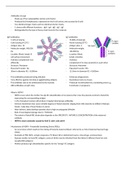
Antibodies (recap)
- Made up of four polypeptides (amino acid chains)
- Produced by B-lymphocytes: expressed on the B cell surface and secreted by B cells
- Two identical longer chains and two identical shorter chains
- 5 classes with different functions; - IgM - IgA - IgD - IgG - IgE
- Distinguished by the type of heavy chain found in the molecule
IgM antibodies: IgG antibodies
- 5-10% of total Ig - 70-80% of total IgG
- Cold reacting (4-22°C) - Warm reacting (37°C)
- Antigen sites: 10 - Antigen sites: 2
- Molecular weight: 900,000 - Molecular weight:
Da 160,000 Da
- Location: Blood, lymph, B - Location: Blood,
cell surface (monomer) lymph, intestine
- Activates complement very - Activates
efficiently complement if in close proximity to each other
- Structure: Pentamer - Structure: Monomer
- Placental Transfer: No - Placental Transfer: YES
- 30nm in diameter RC = 8,000nm - 12-14nm in diameter RC = 8,000nm
- First antibodies produced during infection - Enhances phagocytosis
- Very effective against microbes & agglutinating antigens - Neutralises toxins & viruses
- First antibody class to be synthesised by the neonate - Produced via stimulation by a sensitising event e.g.
- ABO antibodies are IgM class transfusion or pregnancy
What is HDFN?
- HDFN occurs when the mother has IgG RC alloantibodies in her plasma that cross the placenta & bind to foetal RCs
expressing the corresponding antigen
- 1-2% of pregnant women will produce irregular blood group antibodies
- Immune haemolysis may cause variable degrees of foetal anaemia ranging from mild anaemia to stillborn (Hydrops
Fetalis - baby dies of heart failure in utero)
- After delivery, baby develops jaundice due to high unconjugated bilirubin
- Risk of neurological damage due to ↑bilirubin
- The extent of foetal RBC destruction depends on the SPECIFICITY, NATURE & CONCENTRATION of the maternal
antibody
- HDFN is most commonly caused by Anti-D, anti-c and anti-K
Mechanisms of HDFN - Potentially Sensitising Events (PSEs):
- An occurrence which results in the mixing of foetal & maternal blood, referred to as: Feto-Maternal Haemorrhage
(FMH)
- Examples of PSE: Birth, ectopic pregnancy, PV bleed, fall or abdominal trauma, miscarriage, amniocentesis
- Exposes mother to foetal RC antigens, some of which may be inherited from the father & different from her own
(usually RhD antigens)
- Mother produces IgG alloantibodies specific for the ‘foreign’ RC antigens
, - IgGs can cross the placenta & enter the foetal circulation due to their size and the presence of Fc receptors on the
membrane of placental cells
- IgGs (& perhaps compliment) bind to the foetal RBCs resulting in sensitisation and destruction by the RE system
Foetal RC destruction - how HDFN develops:
During a PSE: First pregnancy
Immune response
Second pregnancy
- Made up of four polypeptides (amino acid chains)
- Produced by B-lymphocytes: expressed on the B cell surface and secreted by B cells
- Two identical longer chains and two identical shorter chains
- 5 classes with different functions; - IgM - IgA - IgD - IgG - IgE
- Distinguished by the type of heavy chain found in the molecule
IgM antibodies: IgG antibodies
- 5-10% of total Ig - 70-80% of total IgG
- Cold reacting (4-22°C) - Warm reacting (37°C)
- Antigen sites: 10 - Antigen sites: 2
- Molecular weight: 900,000 - Molecular weight:
Da 160,000 Da
- Location: Blood, lymph, B - Location: Blood,
cell surface (monomer) lymph, intestine
- Activates complement very - Activates
efficiently complement if in close proximity to each other
- Structure: Pentamer - Structure: Monomer
- Placental Transfer: No - Placental Transfer: YES
- 30nm in diameter RC = 8,000nm - 12-14nm in diameter RC = 8,000nm
- First antibodies produced during infection - Enhances phagocytosis
- Very effective against microbes & agglutinating antigens - Neutralises toxins & viruses
- First antibody class to be synthesised by the neonate - Produced via stimulation by a sensitising event e.g.
- ABO antibodies are IgM class transfusion or pregnancy
What is HDFN?
- HDFN occurs when the mother has IgG RC alloantibodies in her plasma that cross the placenta & bind to foetal RCs
expressing the corresponding antigen
- 1-2% of pregnant women will produce irregular blood group antibodies
- Immune haemolysis may cause variable degrees of foetal anaemia ranging from mild anaemia to stillborn (Hydrops
Fetalis - baby dies of heart failure in utero)
- After delivery, baby develops jaundice due to high unconjugated bilirubin
- Risk of neurological damage due to ↑bilirubin
- The extent of foetal RBC destruction depends on the SPECIFICITY, NATURE & CONCENTRATION of the maternal
antibody
- HDFN is most commonly caused by Anti-D, anti-c and anti-K
Mechanisms of HDFN - Potentially Sensitising Events (PSEs):
- An occurrence which results in the mixing of foetal & maternal blood, referred to as: Feto-Maternal Haemorrhage
(FMH)
- Examples of PSE: Birth, ectopic pregnancy, PV bleed, fall or abdominal trauma, miscarriage, amniocentesis
- Exposes mother to foetal RC antigens, some of which may be inherited from the father & different from her own
(usually RhD antigens)
- Mother produces IgG alloantibodies specific for the ‘foreign’ RC antigens
, - IgGs can cross the placenta & enter the foetal circulation due to their size and the presence of Fc receptors on the
membrane of placental cells
- IgGs (& perhaps compliment) bind to the foetal RBCs resulting in sensitisation and destruction by the RE system
Foetal RC destruction - how HDFN develops:
During a PSE: First pregnancy
Immune response
Second pregnancy