SECTION: Types and Explanations of Conformity
TOPIC: Social Influence
SUMMARY OF KEY IDEAS (K/U)
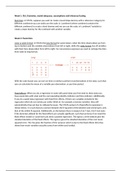
1. Kelman suggested there are ways in which people conform:
Internalisation – when a person genuinely accepts group norms. A private and public change of opinion/behaviour
results usually in permanent due to them being internalised.
Identification – a moderate type, the group is genuinely value by the individual, so views are publicly and privately
changed, but the behaviours don’t continue around other groups.
Compliance – the weakest form, simply ‘going along with others.’ Views are changed publicly but privately an
individual will disagree.
Psychologists argued humans conform for two reasons, based on humans needs – need to be right and the need to be
liked.
2. Informational Social Influence (ISI) – when uncertain what behaviours are right, people follow the behaviours of the
group to have more chance of being right. It is a cognitive process and leads to internalisation. ISI is most likely to
happen in new situations, with higher ambiguity or crisis/quick decision situations.
3. Normative Social Influence (NMI) – to gain social approval and avoid rejection people often conform to the ‘social
norms.’ This emotional process is usually a temporary change but is most common around known people, the need to
fit in.
PEEL STRENGTH NSI PEEL STRENGTH NSI
Research support – after Asch’s study some participant Research Support - When problems were more
admitted they felt self-conscious answering, afraid of ambiguous participants were more uncertain in their own
disapproval. When participants wrote their answers intuition. To avoid being wrong they relied on the group
down conformity fell very low. (12.5%) Shows forms of to be right, explaining why conformity increased with
conformity is due to desire to fit in. task difficulty.
PEEL WEAKNESS
It is difficult to separate ISI or NSI influence. When a dissenter was added they provided social support meaning NSI was
reduced but when providing a different answer, they reduced power of ISI due to the alternative option. Therefore, ISI
and NSI probably work together in real conformity situations.
PEEL WEAKNESS
There are individual differences – some people are
greater concerned of people opinions than others, having
a strong need for affiliation. These differences cannot be
explained by ISI or NSI.
TOPIC: Social Influence
SUMMARY OF KEY IDEAS (K/U)
1. Kelman suggested there are ways in which people conform:
Internalisation – when a person genuinely accepts group norms. A private and public change of opinion/behaviour
results usually in permanent due to them being internalised.
Identification – a moderate type, the group is genuinely value by the individual, so views are publicly and privately
changed, but the behaviours don’t continue around other groups.
Compliance – the weakest form, simply ‘going along with others.’ Views are changed publicly but privately an
individual will disagree.
Psychologists argued humans conform for two reasons, based on humans needs – need to be right and the need to be
liked.
2. Informational Social Influence (ISI) – when uncertain what behaviours are right, people follow the behaviours of the
group to have more chance of being right. It is a cognitive process and leads to internalisation. ISI is most likely to
happen in new situations, with higher ambiguity or crisis/quick decision situations.
3. Normative Social Influence (NMI) – to gain social approval and avoid rejection people often conform to the ‘social
norms.’ This emotional process is usually a temporary change but is most common around known people, the need to
fit in.
PEEL STRENGTH NSI PEEL STRENGTH NSI
Research support – after Asch’s study some participant Research Support - When problems were more
admitted they felt self-conscious answering, afraid of ambiguous participants were more uncertain in their own
disapproval. When participants wrote their answers intuition. To avoid being wrong they relied on the group
down conformity fell very low. (12.5%) Shows forms of to be right, explaining why conformity increased with
conformity is due to desire to fit in. task difficulty.
PEEL WEAKNESS
It is difficult to separate ISI or NSI influence. When a dissenter was added they provided social support meaning NSI was
reduced but when providing a different answer, they reduced power of ISI due to the alternative option. Therefore, ISI
and NSI probably work together in real conformity situations.
PEEL WEAKNESS
There are individual differences – some people are
greater concerned of people opinions than others, having
a strong need for affiliation. These differences cannot be
explained by ISI or NSI.