SECTION: Working Memory Model
TOPIC: Memory
SUMMARY OF KEY IDEAS + EVIDENCE
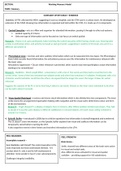
Baddeley (1974) criticised the MSM, suggesting it was too simplistic and the STM wasn’t a unitary store. He developed an
extension of the MSM showing how information is organised and held within the STM, it is made up of 4 components.
1. Central Executive = acts as a filter and organiser for attended information, passing it through to other sub systems.
Limited capacity of 4 items
Only one type of information can be focused on, but focus can switch quickly
Research – Braver et al. gave participants tasks involving the central executive whilst having a brain scan; found greater
activity in prefrontal cortex, and activity increased as task got harder, suggesting it could be in this brain area and it is a
different sub system to
2. Phonological Loop = receives and store auditory information which can be separated into two types. The Phonological
Store holds recently heard information; the articulatory process uses this information for maintenance rehearsal with
the inner voice.
Articulatory Suppression = Occurs when rehearsal is prevented, other sounds may interrupt/displace actual information
wanting to be remembered.
Research – Baddeley - Word Length Effect - presented p’s with a list of five words and they had to recall the list in the
correct order. Some of the lists contained one-syllable words and other lists contained 2-5 syllables. Participants with a list
of shorter words had better recall than the others. He argued that the longer the word, the longer it takes for verbal
rehearsal.
Suggests the capacity of the PL is set by how long it takes to say words, (known as the inner voice) estimated to be what
can be said in about 2 seconds.
3. Visuo-Spatial Sketchpad = receives and stores visual information which is also divided into two components. The inner
scribe stores the arrangement/organisation helping with navigation and the visual cache determines colour and form
of the environment.
Research – Vogel showed P’s a display of objects from 3-12 items, after 900ms another (similar) was shown. They had
to decide if it was the same display or different (additional or removed objects.) It found visual coding is limited to
around 3 or 4 items.
4. Episodic Buffer = Introduced in 2000 due to criticism questions how information is stored/integrated and transferred.
The CE doesn’t store information, so the Episodic buffer explains how visual and auditory information can be
temporarily stored before reaching the LTM.
It also organises events in time frames and transfers information to the LTM.
PEEL WEAKNESS
PEEL STRENGTH
Incomplete research –
Brain Scans –
Even Baddeley said himself ‘the central executive is the
Smith, showed how different areas of the brain were active
most important but least understood element.’ It is
for visual and verbal tasks.
unclear what it’s role is and its full involvement in
Also, different areas activated for visual and spatial
attention. Some predict it has it’s own subcomponents.
activities – providing support for VSS subdivisions.
Challenges integrity/credibility.
TOPIC: Memory
SUMMARY OF KEY IDEAS + EVIDENCE
Baddeley (1974) criticised the MSM, suggesting it was too simplistic and the STM wasn’t a unitary store. He developed an
extension of the MSM showing how information is organised and held within the STM, it is made up of 4 components.
1. Central Executive = acts as a filter and organiser for attended information, passing it through to other sub systems.
Limited capacity of 4 items
Only one type of information can be focused on, but focus can switch quickly
Research – Braver et al. gave participants tasks involving the central executive whilst having a brain scan; found greater
activity in prefrontal cortex, and activity increased as task got harder, suggesting it could be in this brain area and it is a
different sub system to
2. Phonological Loop = receives and store auditory information which can be separated into two types. The Phonological
Store holds recently heard information; the articulatory process uses this information for maintenance rehearsal with
the inner voice.
Articulatory Suppression = Occurs when rehearsal is prevented, other sounds may interrupt/displace actual information
wanting to be remembered.
Research – Baddeley - Word Length Effect - presented p’s with a list of five words and they had to recall the list in the
correct order. Some of the lists contained one-syllable words and other lists contained 2-5 syllables. Participants with a list
of shorter words had better recall than the others. He argued that the longer the word, the longer it takes for verbal
rehearsal.
Suggests the capacity of the PL is set by how long it takes to say words, (known as the inner voice) estimated to be what
can be said in about 2 seconds.
3. Visuo-Spatial Sketchpad = receives and stores visual information which is also divided into two components. The inner
scribe stores the arrangement/organisation helping with navigation and the visual cache determines colour and form
of the environment.
Research – Vogel showed P’s a display of objects from 3-12 items, after 900ms another (similar) was shown. They had
to decide if it was the same display or different (additional or removed objects.) It found visual coding is limited to
around 3 or 4 items.
4. Episodic Buffer = Introduced in 2000 due to criticism questions how information is stored/integrated and transferred.
The CE doesn’t store information, so the Episodic buffer explains how visual and auditory information can be
temporarily stored before reaching the LTM.
It also organises events in time frames and transfers information to the LTM.
PEEL WEAKNESS
PEEL STRENGTH
Incomplete research –
Brain Scans –
Even Baddeley said himself ‘the central executive is the
Smith, showed how different areas of the brain were active
most important but least understood element.’ It is
for visual and verbal tasks.
unclear what it’s role is and its full involvement in
Also, different areas activated for visual and spatial
attention. Some predict it has it’s own subcomponents.
activities – providing support for VSS subdivisions.
Challenges integrity/credibility.