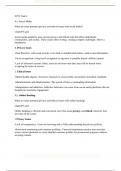
SECTION: Long Term Memory – Different Stores
TOPIC: Memory
KEY IDEAS (K/U)
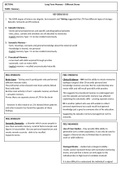
1. The MSM argues all stores are singular, but research and Tulving suggested the LTM has different types of storage:
Episodic, Semantic and Procedural.
2. Episodic Memory -
- stores personal experiences and specific autobiographical episodes
- time, place, context and emotions are all attached to memories
- Explicit memory type = it can be recalled consciously
3. Semantic Memory -
- facts, meanings, concepts and general knowledge about the external world
- Knowledge is shared, not personal
- Explicit memory type = it can be recalled consciously
4. Procedural Memory -
- concerned with skills acquired through practise
- automatic, such as motor skills
- Implicit memory = recalled unconsciously/naturally
PEEL STRENGTH PEEL STRENGTH
Brain Scans – Tulving used 6 participants who performed Clinical Evidence – HM lost the ability to retain memories
different memory tasks. (epilepsy surgery) after 30 seconds personal and
The prefrontal cortex showed most brain activity (blood knowledge memory was lost. But he could develop new
flow) with both motor skills and still recall past skills with practise.
But the most activity in front = episodic memory and back
This suggests his procedural memory is undamaged and
= semantic memory
just the episodic and semantic memory was affected
Proves there are separate stores of LTM in the brain
explaining the automatic skills – proving separate stores.
KC is another patient who was left unable to collect
– however in this research on 3/6 showed these patterns
personal experiences but could recall facts/general
and other research has found the opposite of these
knowledge just a good as someone else of his education.
findings.
Suggesting his episodic memory damaged but not his
semantic.
PEEL STRENGTH
Semantic Dementia – a disorder which causes people to PEEL WEAKNESS
lose their semantic memory, recall of facts/concepts and
figures is inaccessible. But any personal experiences and Use of Case Studies – they provide little ability to
events remain accurate - able to be recalled. generalise over a wider population, it can only be used to
Supports stores. suggest a theory but due to limited data it cannot be
used as valid evidence.
Damaged Brains – studies lack ecological validity -
results cannot represent those with normally functioning
brains, any task that is done can only apply to the
individual due to high level of variables involved.
It is also difficult to understand the individual’s original
TOPIC: Memory
KEY IDEAS (K/U)
1. The MSM argues all stores are singular, but research and Tulving suggested the LTM has different types of storage:
Episodic, Semantic and Procedural.
2. Episodic Memory -
- stores personal experiences and specific autobiographical episodes
- time, place, context and emotions are all attached to memories
- Explicit memory type = it can be recalled consciously
3. Semantic Memory -
- facts, meanings, concepts and general knowledge about the external world
- Knowledge is shared, not personal
- Explicit memory type = it can be recalled consciously
4. Procedural Memory -
- concerned with skills acquired through practise
- automatic, such as motor skills
- Implicit memory = recalled unconsciously/naturally
PEEL STRENGTH PEEL STRENGTH
Brain Scans – Tulving used 6 participants who performed Clinical Evidence – HM lost the ability to retain memories
different memory tasks. (epilepsy surgery) after 30 seconds personal and
The prefrontal cortex showed most brain activity (blood knowledge memory was lost. But he could develop new
flow) with both motor skills and still recall past skills with practise.
But the most activity in front = episodic memory and back
This suggests his procedural memory is undamaged and
= semantic memory
just the episodic and semantic memory was affected
Proves there are separate stores of LTM in the brain
explaining the automatic skills – proving separate stores.
KC is another patient who was left unable to collect
– however in this research on 3/6 showed these patterns
personal experiences but could recall facts/general
and other research has found the opposite of these
knowledge just a good as someone else of his education.
findings.
Suggesting his episodic memory damaged but not his
semantic.
PEEL STRENGTH
Semantic Dementia – a disorder which causes people to PEEL WEAKNESS
lose their semantic memory, recall of facts/concepts and
figures is inaccessible. But any personal experiences and Use of Case Studies – they provide little ability to
events remain accurate - able to be recalled. generalise over a wider population, it can only be used to
Supports stores. suggest a theory but due to limited data it cannot be
used as valid evidence.
Damaged Brains – studies lack ecological validity -
results cannot represent those with normally functioning
brains, any task that is done can only apply to the
individual due to high level of variables involved.
It is also difficult to understand the individual’s original