SECTION: Phobias – explanations and treatments
TOPIC: Psychopathology
KEY IDEAS (K/U)
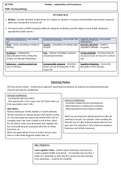
1. Phobias = (anxiety disorder) irrational fear of an object or situation, it involves uncontrollable and extreme responses
taken out of proportion to actual risk
2. The latest version of DSM recognises different categories of phobias: specific (object), social (public situations),
agoraphobia (public spaces.)
Behavioural Response: ways people Emotional Response: ways people feel Cognitive Response: ways people
act think/believe
Panic - crying, screaming, running or Anxiety – prevention of relaxing, high Selective Attention – ready to
freezing arousal respond to stimulus – on guard
Avoidance – stopping the Fear – intense, immediate response Irrational Beliefs – increase pressure
object/situation from coming into of unpleasant anxiety on person to act or not act in a certain
contact (can disrupt functioning.) way
Endurance – remains present but Unreasonable response – emotions Cognitive Distortion – inaccurate
wary of stimulus shown are out of proportion to the perception of the stimulus
actual risk
Explaining Phobias
The two-process model – a behavioural approach explaining how phobias are acquired and maintained through
classical and operant conditioning.
Classical Conditioning:
- Learning through association
Operant Conditioning:
- A NS paired with a UCS creates and UCR (fear) which can
- Learning is shaped around consequences
form associations later in life.
-When behaviour is reinforced is continues
Little Albert: - When punished its more likely to extinct
Watson and Rayner (1920) studied a 9-month-old baby.
The boy who had no unusual anxiety when shown a white
When we act/respond to phobia stimuli we often do
rat . But the researchers paired the animal with a UCS of
anything to escape. For example, when avoiding the
a banging noise, this noise created a UCR of fear. When
stimulus, we are able to keep anxiety levels low and
the rat and the noise were presented close together the
stay calm, this reduction in fear reinforces avoidance
fear eventually became associated with the rat, Albert
behaviour and inhibits treatment.
feared the rat.
Albert also generalised his fear to similar stimuli, Santa
Claus or cotton balls triggered anxiety later on.
PEEL STRENGTH
Lacks cognitive Value – phobia impact behaviours but they also
create cognitive beliefs around fear – for example one may fear a
snake as it resembles an alien but this cannot have been formed
from experience – could be too simplistic
TOPIC: Psychopathology
KEY IDEAS (K/U)
1. Phobias = (anxiety disorder) irrational fear of an object or situation, it involves uncontrollable and extreme responses
taken out of proportion to actual risk
2. The latest version of DSM recognises different categories of phobias: specific (object), social (public situations),
agoraphobia (public spaces.)
Behavioural Response: ways people Emotional Response: ways people feel Cognitive Response: ways people
act think/believe
Panic - crying, screaming, running or Anxiety – prevention of relaxing, high Selective Attention – ready to
freezing arousal respond to stimulus – on guard
Avoidance – stopping the Fear – intense, immediate response Irrational Beliefs – increase pressure
object/situation from coming into of unpleasant anxiety on person to act or not act in a certain
contact (can disrupt functioning.) way
Endurance – remains present but Unreasonable response – emotions Cognitive Distortion – inaccurate
wary of stimulus shown are out of proportion to the perception of the stimulus
actual risk
Explaining Phobias
The two-process model – a behavioural approach explaining how phobias are acquired and maintained through
classical and operant conditioning.
Classical Conditioning:
- Learning through association
Operant Conditioning:
- A NS paired with a UCS creates and UCR (fear) which can
- Learning is shaped around consequences
form associations later in life.
-When behaviour is reinforced is continues
Little Albert: - When punished its more likely to extinct
Watson and Rayner (1920) studied a 9-month-old baby.
The boy who had no unusual anxiety when shown a white
When we act/respond to phobia stimuli we often do
rat . But the researchers paired the animal with a UCS of
anything to escape. For example, when avoiding the
a banging noise, this noise created a UCR of fear. When
stimulus, we are able to keep anxiety levels low and
the rat and the noise were presented close together the
stay calm, this reduction in fear reinforces avoidance
fear eventually became associated with the rat, Albert
behaviour and inhibits treatment.
feared the rat.
Albert also generalised his fear to similar stimuli, Santa
Claus or cotton balls triggered anxiety later on.
PEEL STRENGTH
Lacks cognitive Value – phobia impact behaviours but they also
create cognitive beliefs around fear – for example one may fear a
snake as it resembles an alien but this cannot have been formed
from experience – could be too simplistic