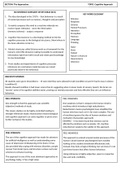
SECTION: The Approaches TOPIC: Cognitive Approach
SIX SENTENCE SUMMARY OF KEY IDEAS (K/U)
KEY WORD GLOSSARY
1. The idea developed in the 1950’s – that behaviour is a result
of mental processes such as memory, thoughts and perception Stimulus
Response
2. It mainly compares the mind to a machine whereby we Schema
receive inputs (stimulus) – store the information Mental Processes
(memory/schema) – output a response Attention
Perception
3. Cognitive Neuroscience is a developing method to link the Memory
cognitive processes to the biological structures. (How/where in Language
the brain attention is link to.) Thinking
Input
4. Mental structures called Schema work as a framework for the Store
human’s mind (file drawers) making it possible to understand Output
information right from birth (recall and relate past knowledge Nature vs Nurture
to new knowledge) Neuroscience
Inference
5. From studies and experiments of cognitive processes
inferences are conclusions made because we cannot
psychically observe the behaviour.
RELEVENT EVIDENCE
30 students were given 30 problems – 15 were told they were allowed to talk (condition A) and 15 had to stay in silence
(condition B)
Results showed Condition A had lower scores than B, suggesting when in lower levels of sensory (quiet), the brain can
'recover' some of its cognitive abilities easier, proving our mental processes and how effective they are can influence
behaviour.
PEEL STRENGTH PEEL WEAKNESS
One strength is that this approach uses scientific One weakness is that it compares the human mind to
(objective) methods of study. machines which introduces high reductionism.
Reductionism means psychologists have simplified the
This means studies can be highly controlled leading to
human mind too much as it is far more complex. The use
stronger inferences made. Neuroscience means biological
of machines ignores the idea of human emotions and
and cognitive approach can come together to prove even
motivation (humanistic approach)
further (enhance) the studies.
EXAMPLE – it has been found that memory can be
affected by emotions such as anxiety. SO, machine
reductionism weakens the validity of this approach.
PEEL STRENGTH PEEL WEAKNESS
The use of the cognitive approach has made far advances This approach is centred around mental processes of the
for artificial intelligence as well as understanding some human’s brain however psychologists have avoided
cause of depression (misbalancing in the brain.) It has looking at the creative/emotional/affectionate side.
also provided help coping with memory disorders, people Instead, they look at logical thinking, but we know it’s not
recover from brain injury and structure various curricular just these factors that affect human behaviour.
schemes to enhance learning.
Using inferences is highly subjective, open to researcher
This approach is one of the most dominant approaches in bias and lacks credibility.
psychology today, it has a high value.
SIX SENTENCE SUMMARY OF KEY IDEAS (K/U)
KEY WORD GLOSSARY
1. The idea developed in the 1950’s – that behaviour is a result
of mental processes such as memory, thoughts and perception Stimulus
Response
2. It mainly compares the mind to a machine whereby we Schema
receive inputs (stimulus) – store the information Mental Processes
(memory/schema) – output a response Attention
Perception
3. Cognitive Neuroscience is a developing method to link the Memory
cognitive processes to the biological structures. (How/where in Language
the brain attention is link to.) Thinking
Input
4. Mental structures called Schema work as a framework for the Store
human’s mind (file drawers) making it possible to understand Output
information right from birth (recall and relate past knowledge Nature vs Nurture
to new knowledge) Neuroscience
Inference
5. From studies and experiments of cognitive processes
inferences are conclusions made because we cannot
psychically observe the behaviour.
RELEVENT EVIDENCE
30 students were given 30 problems – 15 were told they were allowed to talk (condition A) and 15 had to stay in silence
(condition B)
Results showed Condition A had lower scores than B, suggesting when in lower levels of sensory (quiet), the brain can
'recover' some of its cognitive abilities easier, proving our mental processes and how effective they are can influence
behaviour.
PEEL STRENGTH PEEL WEAKNESS
One strength is that this approach uses scientific One weakness is that it compares the human mind to
(objective) methods of study. machines which introduces high reductionism.
Reductionism means psychologists have simplified the
This means studies can be highly controlled leading to
human mind too much as it is far more complex. The use
stronger inferences made. Neuroscience means biological
of machines ignores the idea of human emotions and
and cognitive approach can come together to prove even
motivation (humanistic approach)
further (enhance) the studies.
EXAMPLE – it has been found that memory can be
affected by emotions such as anxiety. SO, machine
reductionism weakens the validity of this approach.
PEEL STRENGTH PEEL WEAKNESS
The use of the cognitive approach has made far advances This approach is centred around mental processes of the
for artificial intelligence as well as understanding some human’s brain however psychologists have avoided
cause of depression (misbalancing in the brain.) It has looking at the creative/emotional/affectionate side.
also provided help coping with memory disorders, people Instead, they look at logical thinking, but we know it’s not
recover from brain injury and structure various curricular just these factors that affect human behaviour.
schemes to enhance learning.
Using inferences is highly subjective, open to researcher
This approach is one of the most dominant approaches in bias and lacks credibility.
psychology today, it has a high value.