2.4- Perception, Brain and Cognition
Problem 1- The Eye
Learning Goals
- What are the eye parts?
- How does the eye focus?
- How do we see color
- What affects perception?
- Why are some things lighter or darker?
Vision
- Product of visible light (energy in the electromagnetic spectrum → can be described in terms
of waves)
Eg: gamma rays (10^-12 m- very short) or radio waves (10^4m- very long)
- Humans can see light from 400- 700 nanometers
(the different wavelengths are associated with color)
- Photon: smallest light quantity
, Eye Anatomy
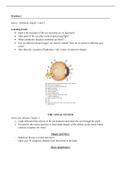
- Parts of the eye
1. Cornea: transparent membrane through which
light enters and gets bend
2. Iris: colored part of the eye, controls the size of
pupil by making it smaller if the light is too intense
or bigger when its darker
3. Pupil: black part through which light enters the
eye
- Focusing of the Lens
1. Relaxed eye and object is far (20 feet): the light rays
that reach the eye are parallel, focused on point A
2. If the object comes closer the light enters the eye at
an angle, pushing the focus to point B (blurred
vision)
3. Accommodation: focus the image on the retina by tightening and increasing the curve
of the lens so it gets thicker using the ciliary muscle. The curve of the lens focuses the
light on point A again making the image sharp
Problem 1- The Eye
Learning Goals
- What are the eye parts?
- How does the eye focus?
- How do we see color
- What affects perception?
- Why are some things lighter or darker?
Vision
- Product of visible light (energy in the electromagnetic spectrum → can be described in terms
of waves)
Eg: gamma rays (10^-12 m- very short) or radio waves (10^4m- very long)
- Humans can see light from 400- 700 nanometers
(the different wavelengths are associated with color)
- Photon: smallest light quantity
, Eye Anatomy
- Parts of the eye
1. Cornea: transparent membrane through which
light enters and gets bend
2. Iris: colored part of the eye, controls the size of
pupil by making it smaller if the light is too intense
or bigger when its darker
3. Pupil: black part through which light enters the
eye
- Focusing of the Lens
1. Relaxed eye and object is far (20 feet): the light rays
that reach the eye are parallel, focused on point A
2. If the object comes closer the light enters the eye at
an angle, pushing the focus to point B (blurred
vision)
3. Accommodation: focus the image on the retina by tightening and increasing the curve
of the lens so it gets thicker using the ciliary muscle. The curve of the lens focuses the
light on point A again making the image sharp