Section 18
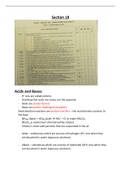
Acids and Bases:
- H+ ions are called protons
- Anything that acids are, bases are the opposite
- Acids are proton donors
- Bases are proton (hydrogen) acceptors
Neutralisation reactions are proton transfers – the acid donates a proton to
the base
- NH3(g) (base) + HCl(g) (acid) → NH4+ + Cl- to make NH4Cl(s)
- NH4Cl(s) is ammonium chloride (white smoke)
- Smoke is small solid particles that are suspended in the air
- Acids – substances which are sources of hydrogen (H+) ions when they
are dissolved in water (aqueous solutions)
- Alkalis – substances which are sources of hydroxide (OH-) ions when they
are dissolved in water (aqueous solutions)
, Reactions with Acids:
- 2HCl(aq) + Mg(s) → MgCl2 + H2(g)
o fizzing (effervescence), steam, solid disappears
o HCl → chloride salts
- H2SO4(aq) + Mg(s) → MgSO4 + H2(g)
o H2SO4 → sulphate salts (contain SO42+) ions
- Nitric acid does not behave ‘normally’ like other acids so is not included
Making pure, dry copper sulphate crystals (a soluble salt) from copper oxide
(an insoluble reactant)
The reaction:
- CuO(s)(black solid) + H2SO4(aq) → CuSO4(aq)(blue solution) + H2O(l)
- DO NOT SAY DISSOLVE – SAY REACTING
1. Measure the sulphuric acid into a beaker
2. Add a spatula measurement of CuO
3. Heat and stir to speed up the reaction
4. Continue to add CuO until it is in excess to make sure that all of the acid
has reacted, and unreacted black solid can be seen in the solution
5. Filter to remove the excess copper oxide
6. Boil the solution to evaporate some (not all) of the water so the solution
will crystallise on cooling (the solution will crystallise on the end of a
glass rod)
7. Allow the solution to cool and crystallise
8. Decant (pour the solution away), leaving the crystals behind
9. Leave the crystals in a WARM oven to dry
Acids and Bases:
- H+ ions are called protons
- Anything that acids are, bases are the opposite
- Acids are proton donors
- Bases are proton (hydrogen) acceptors
Neutralisation reactions are proton transfers – the acid donates a proton to
the base
- NH3(g) (base) + HCl(g) (acid) → NH4+ + Cl- to make NH4Cl(s)
- NH4Cl(s) is ammonium chloride (white smoke)
- Smoke is small solid particles that are suspended in the air
- Acids – substances which are sources of hydrogen (H+) ions when they
are dissolved in water (aqueous solutions)
- Alkalis – substances which are sources of hydroxide (OH-) ions when they
are dissolved in water (aqueous solutions)
, Reactions with Acids:
- 2HCl(aq) + Mg(s) → MgCl2 + H2(g)
o fizzing (effervescence), steam, solid disappears
o HCl → chloride salts
- H2SO4(aq) + Mg(s) → MgSO4 + H2(g)
o H2SO4 → sulphate salts (contain SO42+) ions
- Nitric acid does not behave ‘normally’ like other acids so is not included
Making pure, dry copper sulphate crystals (a soluble salt) from copper oxide
(an insoluble reactant)
The reaction:
- CuO(s)(black solid) + H2SO4(aq) → CuSO4(aq)(blue solution) + H2O(l)
- DO NOT SAY DISSOLVE – SAY REACTING
1. Measure the sulphuric acid into a beaker
2. Add a spatula measurement of CuO
3. Heat and stir to speed up the reaction
4. Continue to add CuO until it is in excess to make sure that all of the acid
has reacted, and unreacted black solid can be seen in the solution
5. Filter to remove the excess copper oxide
6. Boil the solution to evaporate some (not all) of the water so the solution
will crystallise on cooling (the solution will crystallise on the end of a
glass rod)
7. Allow the solution to cool and crystallise
8. Decant (pour the solution away), leaving the crystals behind
9. Leave the crystals in a WARM oven to dry