x
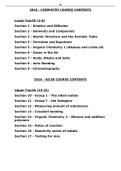
2016 - CHEMISTRY COURSE CONTENTS
Lower Fourth (1-9)
Section 1 – Kinetics and Diffusion
Section 2 – Elements and Compounds
Section 3 – Atomic Structure and the Periodic Table
Section 4 – Formulae and Equations
Section 5 – Organic Chemistry 1 (Alkanes and crude oil)
Section 6 – Gases in the Air
Section 7 – Acids, Alkalis and Salts
Section 8 – Ionic Bonding
Section 9 - Chromatography
2016 - IGCSE COURSE CONTENTS
Upper Fourth (10-16)
Section 10 – Group 1 – The alkali metals
Section 11 – Group 7 – the Halogens
Section 12 – Measuring amount of substances
Section 13 – Covalent bonding
Section 14 – Organic Chemistry 2 – Alkenes and addition
polymers
Section 15 – Rates of reaction
Section 16 – Reactivity series of metals
Section 17 – Testing for ions
, 2016 - IGCSE COURSE CONTENTS
FIFTH FORM TOPICS - TRIPLE
Topic 17 – Testing for ions
Topic 18 – Acids alkalis and salts
Topic 19 – Energetics
Topic 20 – Reversible reactions
Topic 21 – Metallic bonding
Topic 22 – Electrolysis
Topic 23 – Extraction of Metals
Topic 24 – Organic 3 – Alcohols, Carboxylic acids, Esters
and Condensation polymers
, 2016 – Section 1 – Kinetics and Diffusion
Bold = triple award only
Chapter
Learning Outcomes:
Revision
1.1 I can describe the arrangement, movement and energy 1
of particles in solids, liquids and gases.
1.2 I can name the interconversions between solids, liquids 1
and gases.
1.2 I can describe how to interconvert between solids, 1
liquids and gases.
1.2 I can describe the changes in arrangement, movement 1
and energy of particles when converting between
solids, liquids and gases.
1.3 I can explain how to carry out an experiment to explain 1
the dilution of coloured solutions.
1.3 I can explain what is meant by diffusion of gases. 1
2016 – Section 2 – Elements and Compounds
Bold = triple award only
Chapter
Learning Outcomes:
Revision
1.8 I can define element, compound and mixture in 2
terms of atoms.
1.8 I can classify materials as elements, compounds 2
and mixtures.
1.9 I can describe that the melting and boiling points 2
of pure substances are fixed but mixtures may
melt or boil over a range of temperatures.
2016 - CHEMISTRY COURSE CONTENTS
Lower Fourth (1-9)
Section 1 – Kinetics and Diffusion
Section 2 – Elements and Compounds
Section 3 – Atomic Structure and the Periodic Table
Section 4 – Formulae and Equations
Section 5 – Organic Chemistry 1 (Alkanes and crude oil)
Section 6 – Gases in the Air
Section 7 – Acids, Alkalis and Salts
Section 8 – Ionic Bonding
Section 9 - Chromatography
2016 - IGCSE COURSE CONTENTS
Upper Fourth (10-16)
Section 10 – Group 1 – The alkali metals
Section 11 – Group 7 – the Halogens
Section 12 – Measuring amount of substances
Section 13 – Covalent bonding
Section 14 – Organic Chemistry 2 – Alkenes and addition
polymers
Section 15 – Rates of reaction
Section 16 – Reactivity series of metals
Section 17 – Testing for ions
, 2016 - IGCSE COURSE CONTENTS
FIFTH FORM TOPICS - TRIPLE
Topic 17 – Testing for ions
Topic 18 – Acids alkalis and salts
Topic 19 – Energetics
Topic 20 – Reversible reactions
Topic 21 – Metallic bonding
Topic 22 – Electrolysis
Topic 23 – Extraction of Metals
Topic 24 – Organic 3 – Alcohols, Carboxylic acids, Esters
and Condensation polymers
, 2016 – Section 1 – Kinetics and Diffusion
Bold = triple award only
Chapter
Learning Outcomes:
Revision
1.1 I can describe the arrangement, movement and energy 1
of particles in solids, liquids and gases.
1.2 I can name the interconversions between solids, liquids 1
and gases.
1.2 I can describe how to interconvert between solids, 1
liquids and gases.
1.2 I can describe the changes in arrangement, movement 1
and energy of particles when converting between
solids, liquids and gases.
1.3 I can explain how to carry out an experiment to explain 1
the dilution of coloured solutions.
1.3 I can explain what is meant by diffusion of gases. 1
2016 – Section 2 – Elements and Compounds
Bold = triple award only
Chapter
Learning Outcomes:
Revision
1.8 I can define element, compound and mixture in 2
terms of atoms.
1.8 I can classify materials as elements, compounds 2
and mixtures.
1.9 I can describe that the melting and boiling points 2
of pure substances are fixed but mixtures may
melt or boil over a range of temperatures.