CHAPTER 5: STATIC MODELS OF
INFECTION
INTRODUCTION
Dynamic models: SIR models expressed as differential equations; describe changes over time (of proportions of
different population components)
Static models: do not explicitly describes how the things are going to change over time but it describes
- the general properties of a system: what is the state the system is in now
- the properties of the system under certain conditions (may also include an indication of what
will happen over time)
we’re not going to look at what is happening at each timestep but we rather look at what is the
general condition of the system and would this lead to an increase in the proportion of infections
in the population?
E.g. models that are expressing the value of R0 (already seen before in chapter 4)
Different types of variables possible in a static model: host abundance, vector abundance, host age, weather
(T, humidity), time (!) what would happen to any of these factors over time?
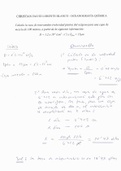
EXAMPLE: GROWTH RATE OF PARASITE POPULATIONS FOR MICROPARASITES WITH DIRECT
TRANSMISSION
R0 S . .L
- R0: basic reproductive rate for the parasite (number of secondary infections originating from
one primary infection in a non-infected population)
- β: transmission rate (contact rate x infectiousness), probability that infection is transmitted
- S: population size non-infected hosts
- L: time during which host remains infectious
It doesn’t explicitly say how many individuals that are going to be added to the population which is infectious
over time (you cannot see that immediately time step per step) but you can already see that:
- if the infection can be treated (if L decreases): R0 is decreasing less transmission in
population
- If there is less contact in the population (if β decreases): R0 is decreasing
- …
, This is a static representation: it tells you what the condition is at this moment and then you can find out what
is going to happen with the infection if all these current conditions remain the same or how changes in the
conditions will change the fade of the infection. time component is not there in an explicit way!
ZOONOSES: “FORCE OF INFECTION ON HUMANS”
Zoonoses: infection that is transmitted from animals to humans
cpv
- λ: force of infection (~probability for a human to become infected)
- c: contact rate with the reservoir (animal)
- p: prevalence in the reservoir
- v: probability that infection happens during contact
The larger the reservoir density, the larger the contact rate:
(reservoir population size) Linear relation
We can re-write the constant parameters as one over-all constant, resulting in: the transmission coefficient
the transmission coefficient tells me what the probability is that during a contact there is going to
be transmission and what the probability is that I’m going to have contact with those N
individuals (probability to come infected as an S individual)
You re-write this as:
Relation between N and p: not always simple
1) no relationship between prevalence and abundance
Np
INFECTION
INTRODUCTION
Dynamic models: SIR models expressed as differential equations; describe changes over time (of proportions of
different population components)
Static models: do not explicitly describes how the things are going to change over time but it describes
- the general properties of a system: what is the state the system is in now
- the properties of the system under certain conditions (may also include an indication of what
will happen over time)
we’re not going to look at what is happening at each timestep but we rather look at what is the
general condition of the system and would this lead to an increase in the proportion of infections
in the population?
E.g. models that are expressing the value of R0 (already seen before in chapter 4)
Different types of variables possible in a static model: host abundance, vector abundance, host age, weather
(T, humidity), time (!) what would happen to any of these factors over time?
EXAMPLE: GROWTH RATE OF PARASITE POPULATIONS FOR MICROPARASITES WITH DIRECT
TRANSMISSION
R0 S . .L
- R0: basic reproductive rate for the parasite (number of secondary infections originating from
one primary infection in a non-infected population)
- β: transmission rate (contact rate x infectiousness), probability that infection is transmitted
- S: population size non-infected hosts
- L: time during which host remains infectious
It doesn’t explicitly say how many individuals that are going to be added to the population which is infectious
over time (you cannot see that immediately time step per step) but you can already see that:
- if the infection can be treated (if L decreases): R0 is decreasing less transmission in
population
- If there is less contact in the population (if β decreases): R0 is decreasing
- …
, This is a static representation: it tells you what the condition is at this moment and then you can find out what
is going to happen with the infection if all these current conditions remain the same or how changes in the
conditions will change the fade of the infection. time component is not there in an explicit way!
ZOONOSES: “FORCE OF INFECTION ON HUMANS”
Zoonoses: infection that is transmitted from animals to humans
cpv
- λ: force of infection (~probability for a human to become infected)
- c: contact rate with the reservoir (animal)
- p: prevalence in the reservoir
- v: probability that infection happens during contact
The larger the reservoir density, the larger the contact rate:
(reservoir population size) Linear relation
We can re-write the constant parameters as one over-all constant, resulting in: the transmission coefficient
the transmission coefficient tells me what the probability is that during a contact there is going to
be transmission and what the probability is that I’m going to have contact with those N
individuals (probability to come infected as an S individual)
You re-write this as:
Relation between N and p: not always simple
1) no relationship between prevalence and abundance
Np