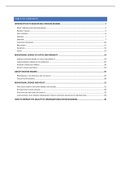
TABLE OF CONTENTS
INTRODUCTION TO BEHAVIOURAL DECISION-MAKING .................................................................................. 2
WHAT IS BEHAVIOURAL DECISION MAKING .................................................................................................................. 2
PROSPECT THEORY .................................................................................................................................................. 5
LOSS AVERSION ...................................................................................................................................................... 6
FRAMING .............................................................................................................................................................. 7
EMOTION.............................................................................................................................................................. 7
COGNITIVE DISSONANCE ........................................................................................................................................ 10
WILLPOWER ........................................................................................................................................................ 11
INCENTIVES ......................................................................................................................................................... 13
SOCIAL ............................................................................................................................................................... 13
BEHAVIOURAL SCIENCE OF JUSTICE AND MORALITY .................................................................................... 14
INTRODUCTION AND ORIGINS OF JUSTICE AND MORALITY .............................................................................................. 14
UNDERSTANDING FAIRNESS IN THE WORKPLACE .......................................................................................................... 16
RECIPIENT’S PERCEIVED FAIRNESS .............................................................................................................................18
ACTOR’S JUSTICE ENACTMENT ................................................................................................................................. 22
GROUP DECISION MAKING .......................................................................................................................... 25
PERFORMANCE: THE INDIVIDUAL AND THE GROUP ....................................................................................................... 25
COLLECTIVE INTELLIGENCE ...................................................................................................................................... 28
BEHAVIOURAL SCIENCE AND POLICY ........................................................................................................... 31
HOW SOCIAL IDENTITY CAN SHAPE NORMS FOR CHEATING ............................................................................................. 31
ATTRIBUTIONS OF GOOD AND BAD ........................................................................................................................... 33
ETHICS POLICIES AND CODES OF CONDUCT ................................................................................................................. 33
A BEHAVIOURAL ETHICS INSPIRED FRAMEWORK TO REDUCE UNETHICAL BEHAVIOUR IN ORGANISATIONS.................................. 34
HOW TO IMPROVE THE QUALITY OF ORGANIZATIONAL DECISION-MAKING ................................................ 40
,INTRODUCTION TO BEHAVIOURAL DECISION-MAKING
Service: caffè Sapienza
Supporting organizations to build (or strengthen) their own internal capacity for evidence-
based decision-making
First problem
Linda is 31 years old, single, outspoken, and very bright. She majored in philosophy. As a
student, she was deeply concerned with issues of discrimination and social justice, and also
participated in anti-nuclear demonstrations.
Which is more probable?
a) Linda is a bank teller è it is less probable that both characteristics apply to Linda
(mathematically speaking)
b) Linda is a bank teller and is active in the feminist movement
Representative bias = according to the information available you will create a certain image
about the person, but in the end, you are just speculating (human thinking)
Behavioural decision making is about decision making under circumstances of risk and
uncertainty
WHAT IS BEHAVIOURAL DECISION MAKING
- Decision making for humans
o Based on insights from behavioural economics research (and related
disciplines like behavioural ethics, behavioural law etc.)
- Behavioral Economics (BE): adding behavioral scientific insights (e.g., cognitive
and social psychology) to economic analysis in order to strengthen economics in its
own domain (e.g., increasing effectiveness of policy-making)
- Emerged about 40 years ago as a collaboration between Richard Thaler (financial
economist), Daniel Kahneman and Amos Tversky (two cognitive psychologists)
è Behavioral Economics is based on a marriage between financial economics
and cognitive psychology
- Focus: human judgment and decision-making under circumstances that involve risk
or uncertainty
Where does BE come from
Richard H. Thaler (co-author of Nudging)
- The making of Behavioral Economics – Misbehaving
,Why study ‘econs’?
Thaler portrays economics as studying these fictional creatures, called 'econs'
- 'Econs' correspond to the 'ideal' of perfectly rational decision-makers
o Optimization (based on available information)
o No self-control problems
o Unbiased beliefs
o Self-interest
- According to Thaler "no one, not even economists themselves think and act like
econs"; "I have never met one, myself"
è Even economists don’t think like econs, they also tend to make ‘stupid’
decisions
- Yet, 'econs' may exist today (i.e., the algorithmic decision-making that characterizes
AI and machine learning could be regarded as making decisions in a very 'econ'-like
manner)
AI = decision making based on algorithms, based on formulas
- Only suitable for things with one correct solution, where there is certainty
- Algorithms incorporate the same biases as humans (are thus not unbiased)
BE is about how much humans differ from ‘econs’
- Herbert Simon coined the term “bounded rationality” to describe the decision-making
of humans
o Complexity and time constraints make people rely on mental shortcuts (i.e.,
heuristics) rather than on full cost-benefit analyses.
- Thaler argued that economic policy-making should target humans, not econs, and
that this is possible because human ‘irrationalities’ are not random, but predictable
(systematic).
è According to Thaler, BE is about understanding how humans differ from
econs
è You can predict how the irrational thinking of humans will deviate from econs
(it is not random but systematic)
Bounded rationality = humans make irrational decisions due to complexity or time constraint
- Humans are capable or rational decision making, but don’t do so because of these
factors
, Econ-Human conversation
- Econ: Why did you remove the cashews?
- Human: Because I did not want to eat any more of them.
- Econ: If you did not want to eat any more nuts, then why go to the trouble of
removing them? You could have simply acted on your preference and stopped
eating.
- Human: I removed the bowl because if the nuts were still available, I would have
eaten more.
- Econ: I that case, you prefer to eat more cashews, so removing them was stupid.
Humans don’t have fixed preferences; preferences can be influenced by small things in the
context
The methodology of BDM research
- Originally: only experiments – theory development
o Experimental control helped delineate behavioral explanations from standard
ones
o Choice of contrasts – conditions (importance of reference points)
- Gradual evolution toward a broader set - applicability
o Field studies – secondary data
o Natural experiments – random controlled trials
o Computer simulations
o Brain scans
Experimental control = coming up with manipulations during experiments (quantitative
changes during treatment)
Impact of BDM on governance is premature, appealing and controversial
- Growing awareness of the limits and inadequacy of current economic systems
- Evolutionary scope of behavioural sciences ("harnessing the power of our
unconsciousness")
- Major opportunities due to Big data analytics and Artificial Intelligence
- Health, well-being, and governance implications
o Simple, insightful solutions
o Relatively costless regulation
Important concept of Thaler: use latest insights of human psychology to guide people
towards better and healthier decisions (philosophy of nudging)
INTRODUCTION TO BEHAVIOURAL DECISION-MAKING .................................................................................. 2
WHAT IS BEHAVIOURAL DECISION MAKING .................................................................................................................. 2
PROSPECT THEORY .................................................................................................................................................. 5
LOSS AVERSION ...................................................................................................................................................... 6
FRAMING .............................................................................................................................................................. 7
EMOTION.............................................................................................................................................................. 7
COGNITIVE DISSONANCE ........................................................................................................................................ 10
WILLPOWER ........................................................................................................................................................ 11
INCENTIVES ......................................................................................................................................................... 13
SOCIAL ............................................................................................................................................................... 13
BEHAVIOURAL SCIENCE OF JUSTICE AND MORALITY .................................................................................... 14
INTRODUCTION AND ORIGINS OF JUSTICE AND MORALITY .............................................................................................. 14
UNDERSTANDING FAIRNESS IN THE WORKPLACE .......................................................................................................... 16
RECIPIENT’S PERCEIVED FAIRNESS .............................................................................................................................18
ACTOR’S JUSTICE ENACTMENT ................................................................................................................................. 22
GROUP DECISION MAKING .......................................................................................................................... 25
PERFORMANCE: THE INDIVIDUAL AND THE GROUP ....................................................................................................... 25
COLLECTIVE INTELLIGENCE ...................................................................................................................................... 28
BEHAVIOURAL SCIENCE AND POLICY ........................................................................................................... 31
HOW SOCIAL IDENTITY CAN SHAPE NORMS FOR CHEATING ............................................................................................. 31
ATTRIBUTIONS OF GOOD AND BAD ........................................................................................................................... 33
ETHICS POLICIES AND CODES OF CONDUCT ................................................................................................................. 33
A BEHAVIOURAL ETHICS INSPIRED FRAMEWORK TO REDUCE UNETHICAL BEHAVIOUR IN ORGANISATIONS.................................. 34
HOW TO IMPROVE THE QUALITY OF ORGANIZATIONAL DECISION-MAKING ................................................ 40
,INTRODUCTION TO BEHAVIOURAL DECISION-MAKING
Service: caffè Sapienza
Supporting organizations to build (or strengthen) their own internal capacity for evidence-
based decision-making
First problem
Linda is 31 years old, single, outspoken, and very bright. She majored in philosophy. As a
student, she was deeply concerned with issues of discrimination and social justice, and also
participated in anti-nuclear demonstrations.
Which is more probable?
a) Linda is a bank teller è it is less probable that both characteristics apply to Linda
(mathematically speaking)
b) Linda is a bank teller and is active in the feminist movement
Representative bias = according to the information available you will create a certain image
about the person, but in the end, you are just speculating (human thinking)
Behavioural decision making is about decision making under circumstances of risk and
uncertainty
WHAT IS BEHAVIOURAL DECISION MAKING
- Decision making for humans
o Based on insights from behavioural economics research (and related
disciplines like behavioural ethics, behavioural law etc.)
- Behavioral Economics (BE): adding behavioral scientific insights (e.g., cognitive
and social psychology) to economic analysis in order to strengthen economics in its
own domain (e.g., increasing effectiveness of policy-making)
- Emerged about 40 years ago as a collaboration between Richard Thaler (financial
economist), Daniel Kahneman and Amos Tversky (two cognitive psychologists)
è Behavioral Economics is based on a marriage between financial economics
and cognitive psychology
- Focus: human judgment and decision-making under circumstances that involve risk
or uncertainty
Where does BE come from
Richard H. Thaler (co-author of Nudging)
- The making of Behavioral Economics – Misbehaving
,Why study ‘econs’?
Thaler portrays economics as studying these fictional creatures, called 'econs'
- 'Econs' correspond to the 'ideal' of perfectly rational decision-makers
o Optimization (based on available information)
o No self-control problems
o Unbiased beliefs
o Self-interest
- According to Thaler "no one, not even economists themselves think and act like
econs"; "I have never met one, myself"
è Even economists don’t think like econs, they also tend to make ‘stupid’
decisions
- Yet, 'econs' may exist today (i.e., the algorithmic decision-making that characterizes
AI and machine learning could be regarded as making decisions in a very 'econ'-like
manner)
AI = decision making based on algorithms, based on formulas
- Only suitable for things with one correct solution, where there is certainty
- Algorithms incorporate the same biases as humans (are thus not unbiased)
BE is about how much humans differ from ‘econs’
- Herbert Simon coined the term “bounded rationality” to describe the decision-making
of humans
o Complexity and time constraints make people rely on mental shortcuts (i.e.,
heuristics) rather than on full cost-benefit analyses.
- Thaler argued that economic policy-making should target humans, not econs, and
that this is possible because human ‘irrationalities’ are not random, but predictable
(systematic).
è According to Thaler, BE is about understanding how humans differ from
econs
è You can predict how the irrational thinking of humans will deviate from econs
(it is not random but systematic)
Bounded rationality = humans make irrational decisions due to complexity or time constraint
- Humans are capable or rational decision making, but don’t do so because of these
factors
, Econ-Human conversation
- Econ: Why did you remove the cashews?
- Human: Because I did not want to eat any more of them.
- Econ: If you did not want to eat any more nuts, then why go to the trouble of
removing them? You could have simply acted on your preference and stopped
eating.
- Human: I removed the bowl because if the nuts were still available, I would have
eaten more.
- Econ: I that case, you prefer to eat more cashews, so removing them was stupid.
Humans don’t have fixed preferences; preferences can be influenced by small things in the
context
The methodology of BDM research
- Originally: only experiments – theory development
o Experimental control helped delineate behavioral explanations from standard
ones
o Choice of contrasts – conditions (importance of reference points)
- Gradual evolution toward a broader set - applicability
o Field studies – secondary data
o Natural experiments – random controlled trials
o Computer simulations
o Brain scans
Experimental control = coming up with manipulations during experiments (quantitative
changes during treatment)
Impact of BDM on governance is premature, appealing and controversial
- Growing awareness of the limits and inadequacy of current economic systems
- Evolutionary scope of behavioural sciences ("harnessing the power of our
unconsciousness")
- Major opportunities due to Big data analytics and Artificial Intelligence
- Health, well-being, and governance implications
o Simple, insightful solutions
o Relatively costless regulation
Important concept of Thaler: use latest insights of human psychology to guide people
towards better and healthier decisions (philosophy of nudging)