LUCÍA ROMERO
10. METALS
DEFINITIONS
Alloy: a mixture of two or more metals or a metal and a nonmetal
10.1 PROPERTIES OF METALS
Characteristics of metals
CHEMICAL PROPERTIES
1. Good conductors of electricity and heat
WHY? Because of the free electrons that are available to move and carry charge
2. High melting and boiling points
WHY? Strong metallic bonds in giant metallic structures (large amounts of heat are needed to break these bonds apart)
3. React with cold water – to form: metal hydroxide & hydrogen gas
Ca + 2H2O → Ca(OH)2 + H2
4. React with steam – to form: metal oxide & hydrogen gas
Zn + H2O → ZnO + H2
5. React with acids (unreactive metals such as gold and copper don’t)– to form: a salt & hydrogen gas´
(the hydrogen atom in the acid is replaced by the metal atom)
Fe + 2HCl → FeCl2 + H2
6. React with oxygen (some reactive metals such as alkali metals / copper and iron → more slowly) – to form: metal oxide
2Cu + O2 → 2CuO
PHYSICAL PROPERTIES
1. Malleable and ductile
- malleable: can be bent into shape
- ductile: can be drawn into wires
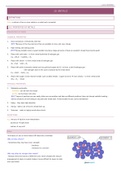
WHY? Layers of positive ions can easily slide over one another and take up different positions (does not disrupt metallic bonding –
valence electrons do not belong to any particular metal atom → electrostatic forces can be maintained)
2. Heavy – they have high densities
3. Strong – takes a lot of force to break them up
4. Sonorous – make a ringing sound when struck
EXCEPTIONS
e.g., mercury → liquid at room temperature
aluminium → light metal
sodium → very soft
Alloys
→ mixtures of: two or more metals OR metal and a nonmetal
Why are they chosen?
- Sometimes they may have more: strength
: hardness
: resistance to corrosion
Why may alloys be stronger than metals?
- Because they have atoms of different sizes, which changes the natural
arrangement of atoms in metals (makes it more difficult for layers to slide
over each other)
, LUCÍA ROMERO
EXAMPLES OF ALLOYS
Alloy Made up of.... Special properties Uses
Stainless steel 1. 70% Iron Does not rust 1. Surgical instruments
2. 20% Chromium 2. Car parts
3. 10% Nickel 3. Cutlery
Brass 1. 70% copper 1. Harder than copper 1. Musical instruments
2. 30% zinc 2. Does not corrode 2. Door knobs
10.2 REACTIVITY SERIES
• Based on observations of the reactions of metals with water, acid (dilute hydrochloric acid), their reactivities can be put into order, and
the reactivity series formed
• Same goes for metal oxides, which are reacted with carbon (to try to reduce them), to try to get them into order.
Reactions of the metal oxides Reactions of the metals
- Carbon (acts as a reducing agent) will remove oxygen from an oxide only if the metal is less reactive than carbon
The reactivity series
-> Most reactive metals belong to
Groups I and II
-> The least reactive metals are
transition metals (except lead – goes
in between zinc and iron)
Carbon can’t reduce the oxides of metals above this line
Metals above this line displace hydrogen from acids
The reactivity series and competition reactions
10. METALS
DEFINITIONS
Alloy: a mixture of two or more metals or a metal and a nonmetal
10.1 PROPERTIES OF METALS
Characteristics of metals
CHEMICAL PROPERTIES
1. Good conductors of electricity and heat
WHY? Because of the free electrons that are available to move and carry charge
2. High melting and boiling points
WHY? Strong metallic bonds in giant metallic structures (large amounts of heat are needed to break these bonds apart)
3. React with cold water – to form: metal hydroxide & hydrogen gas
Ca + 2H2O → Ca(OH)2 + H2
4. React with steam – to form: metal oxide & hydrogen gas
Zn + H2O → ZnO + H2
5. React with acids (unreactive metals such as gold and copper don’t)– to form: a salt & hydrogen gas´
(the hydrogen atom in the acid is replaced by the metal atom)
Fe + 2HCl → FeCl2 + H2
6. React with oxygen (some reactive metals such as alkali metals / copper and iron → more slowly) – to form: metal oxide
2Cu + O2 → 2CuO
PHYSICAL PROPERTIES
1. Malleable and ductile
- malleable: can be bent into shape
- ductile: can be drawn into wires
WHY? Layers of positive ions can easily slide over one another and take up different positions (does not disrupt metallic bonding –
valence electrons do not belong to any particular metal atom → electrostatic forces can be maintained)
2. Heavy – they have high densities
3. Strong – takes a lot of force to break them up
4. Sonorous – make a ringing sound when struck
EXCEPTIONS
e.g., mercury → liquid at room temperature
aluminium → light metal
sodium → very soft
Alloys
→ mixtures of: two or more metals OR metal and a nonmetal
Why are they chosen?
- Sometimes they may have more: strength
: hardness
: resistance to corrosion
Why may alloys be stronger than metals?
- Because they have atoms of different sizes, which changes the natural
arrangement of atoms in metals (makes it more difficult for layers to slide
over each other)
, LUCÍA ROMERO
EXAMPLES OF ALLOYS
Alloy Made up of.... Special properties Uses
Stainless steel 1. 70% Iron Does not rust 1. Surgical instruments
2. 20% Chromium 2. Car parts
3. 10% Nickel 3. Cutlery
Brass 1. 70% copper 1. Harder than copper 1. Musical instruments
2. 30% zinc 2. Does not corrode 2. Door knobs
10.2 REACTIVITY SERIES
• Based on observations of the reactions of metals with water, acid (dilute hydrochloric acid), their reactivities can be put into order, and
the reactivity series formed
• Same goes for metal oxides, which are reacted with carbon (to try to reduce them), to try to get them into order.
Reactions of the metal oxides Reactions of the metals
- Carbon (acts as a reducing agent) will remove oxygen from an oxide only if the metal is less reactive than carbon
The reactivity series
-> Most reactive metals belong to
Groups I and II
-> The least reactive metals are
transition metals (except lead – goes
in between zinc and iron)
Carbon can’t reduce the oxides of metals above this line
Metals above this line displace hydrogen from acids
The reactivity series and competition reactions