
'
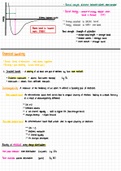
Bond length distance between atoms when bonded
Bond amount of energy released when
energy
•
=
°
bona is formed an
§Ñ
distance between nuclei
→
Energy supplied to BREAK bond
→
Energy released to FORM new bond .
Atoms bond to become
more STABLE Bond strength strength
: of attraction
→
shorter bond length =
stronger bond
→
smaller atoms =
stronger bond
more bonds stronger bond
→
=
chemical bonding
0
Bonds = forces of attraction : hold atoms together .
Bonding gain stability [octet / noble gas]
0 =
1. Covalent bonds :
A sharing of at least one pair of electrons by two non -
metals
°
Diatomic molecules =
atoms from same element E. H2
g
°
molecules =
atoms from different elements
Electronegativity :
A measure of the tendency of an atom to attract a bonding pair of electrons .
Polar covalent bond :
An intramolecular bond that arises due to unequal sharing of electrons leading to a dipole forming
as a result of electronegativity difference .
→
EN 1=0
Different atoms
→
→
e- not shared equally :
shift to higher EN ( has stronger force)
→
charges develop =
dipole formed
Non polar covalent bond An intramolecular bond that arises due
-
: to equal sharing of electrons .
→
EN =
0
diatomic molecules
→
→
e- shared
equally
→
No charges developed .
Polarity of MOLECULE using charge distribution .
Non -
polar molecule : even distribution (no poles) E.g. CH4
Polar molecule :
uneven distribution ( poles) E.g HC1
, Steps to follow
I. Central atom { valence e-
2. Lone pairs of e-
3.
Shape
4. Bond polarity
5. Molecule polarity NOTE !
☐
valency = # of e- to be accepted / donated
tg.HU # of
• valence e- =
outermost electrons
↳
I. Group # valence e- valency # of bonds group # =
# of valence e-
Hydrogen 1 I 1 1
Chlorine 7 7 8-7=1 I
2 .
No central atom or lone pairs
3. :
linear
4 .
g- < I
gt
i.
polar covalent bond
a- It
EN 3,0
__
EN -2,1 -
Sgt , > 8-
H -
'
II :
/ °
i.
polar molecule
1-
g. C02 # of
1 . Group # valence e- valency # of bonds
Types of shapes
carbon 4 4 8-4=4 4
Oxygen 6 6 8-6=2 2 '
Linear
2. Carbon
2 lone
central
pairs on
atom
each oxygen atom .
-
Tetrahedral
o¥o
A
Pyramidal
.
3 . .
0 :C :O 650
.
linear
. ' '
.
4.
g- 1 ft a :
polar covalent bond
O=c
EN -3,0 -
EN -2,5
s . 50=6 g-
i.
non -
polar molecule

