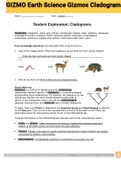
GIZMO Earth Science Gizmos Cladograms
Name: Date: 2/5/19
Student Exploration: Cladograms
Vocabulary: adaptation, amino acid, amnion, artiodactyla, bipedal, clade, cladistics, cladogram,
convergent evolution, evolution, flower, mammary glands, molecular, morphological,
multicellular, parsimony, sagittal crest, phloem, selenodont teeth, SNP, xylem
Prior Knowledge Questions (Do these BEFORE using the Gizmo.)
1. Look at the images below. Which two organisms do you think are most closely related?
I think the deer and turtle are most closely related.
Worm Deer Turtle
2. Why do you think so? Both of them are four legged animals.
Gizmo Warm-up
Cladistics is a method of hypothesizing the evolutionary
relationships between species. A cladogram is a branching diagram
that illustrates these relationships. For example, the cladogram on the
right shows that deer are more closely related to turtles than to
worms. In the Cladograms Gizmo, you will use morphological
(physical characteristics) and molecular data to create cladograms.
To begin, make sure Plants is selected for the Organism group and Morphological is selected
for the Data type. Click on one of the characteristics to the left of the table on the TABLE tab.
Information about the characteristic will be shown on the ORGANISM tab.
Using the information on the ORGANISM tab, describe each of the characteristics below.
Xylem and phloem: Xylem and phloem are tissues in plants that transport water and
solutes up the plant (xylem) and food down the plant (phloem).
Flowers: A flower is the part of a plant containing reproductive organs (stamen and carpel)
surrounded by brightly colored petals.
Multicellularity: A multicellular organism is composed of more than one cell.
2018
,Activity A: Get the Gizmo ready:
Morphological Check that Plants and Morphological are still
cladogram selected for the group and data type.
Question: How do you build a simple cladogram based on physical characteristics?
1. Fill in: Using what you learned in the warm-up, fill in the table. Clicking one of the boxes of
the table will add a check mark to indicate the presence of a characteristic. Then, select
Check table and adjust any of the boxes you may have filled in incorrectly.
Which organism has the fewest shared characteristics? Flowers
2. Organize: Now you are ready to organize the table.
A. How many characteristics (check marks) does each organism have?
Algae: 0 Arabidopsis: 3 Cycad: 2 Moss: 1
Drag the arrows ( ) below the table to order the organism columns from fewest
characteristics on the left to most on the right.
B. How many organisms have each characteristic?
Multicellularity: 3 Xylem and phloem: 2 Flowers: 1
Drag the arrows to the right of the table to order the characteristics from fewest
organisms on the top to most on the bottom.
3. Build: Select the CLADOGRAM tab at the top left. The goal of a cladogram is to show the
relationships among a group of organisms. Organisms that are most closely related should
share the most recent common ancestor (highest branch on the tree). Organisms that are
most distantly related should share the oldest common ancestor (lowest branch on the tree).
Click the segments on the cladogram template
to build your own cladogram that shows how
you think the different plants are related.
Sketch you cladogram in the space to the
below.
2018
, Answer the following questions based on your cladogram.
A. Which two organisms are most closely related? Cycad and Arabidopsis
B. Which organisms are most distantly related? Algae and Arabidopsis
(Activity A continued on next page)
2018
Name: Date: 2/5/19
Student Exploration: Cladograms
Vocabulary: adaptation, amino acid, amnion, artiodactyla, bipedal, clade, cladistics, cladogram,
convergent evolution, evolution, flower, mammary glands, molecular, morphological,
multicellular, parsimony, sagittal crest, phloem, selenodont teeth, SNP, xylem
Prior Knowledge Questions (Do these BEFORE using the Gizmo.)
1. Look at the images below. Which two organisms do you think are most closely related?
I think the deer and turtle are most closely related.
Worm Deer Turtle
2. Why do you think so? Both of them are four legged animals.
Gizmo Warm-up
Cladistics is a method of hypothesizing the evolutionary
relationships between species. A cladogram is a branching diagram
that illustrates these relationships. For example, the cladogram on the
right shows that deer are more closely related to turtles than to
worms. In the Cladograms Gizmo, you will use morphological
(physical characteristics) and molecular data to create cladograms.
To begin, make sure Plants is selected for the Organism group and Morphological is selected
for the Data type. Click on one of the characteristics to the left of the table on the TABLE tab.
Information about the characteristic will be shown on the ORGANISM tab.
Using the information on the ORGANISM tab, describe each of the characteristics below.
Xylem and phloem: Xylem and phloem are tissues in plants that transport water and
solutes up the plant (xylem) and food down the plant (phloem).
Flowers: A flower is the part of a plant containing reproductive organs (stamen and carpel)
surrounded by brightly colored petals.
Multicellularity: A multicellular organism is composed of more than one cell.
2018
,Activity A: Get the Gizmo ready:
Morphological Check that Plants and Morphological are still
cladogram selected for the group and data type.
Question: How do you build a simple cladogram based on physical characteristics?
1. Fill in: Using what you learned in the warm-up, fill in the table. Clicking one of the boxes of
the table will add a check mark to indicate the presence of a characteristic. Then, select
Check table and adjust any of the boxes you may have filled in incorrectly.
Which organism has the fewest shared characteristics? Flowers
2. Organize: Now you are ready to organize the table.
A. How many characteristics (check marks) does each organism have?
Algae: 0 Arabidopsis: 3 Cycad: 2 Moss: 1
Drag the arrows ( ) below the table to order the organism columns from fewest
characteristics on the left to most on the right.
B. How many organisms have each characteristic?
Multicellularity: 3 Xylem and phloem: 2 Flowers: 1
Drag the arrows to the right of the table to order the characteristics from fewest
organisms on the top to most on the bottom.
3. Build: Select the CLADOGRAM tab at the top left. The goal of a cladogram is to show the
relationships among a group of organisms. Organisms that are most closely related should
share the most recent common ancestor (highest branch on the tree). Organisms that are
most distantly related should share the oldest common ancestor (lowest branch on the tree).
Click the segments on the cladogram template
to build your own cladogram that shows how
you think the different plants are related.
Sketch you cladogram in the space to the
below.
2018
, Answer the following questions based on your cladogram.
A. Which two organisms are most closely related? Cycad and Arabidopsis
B. Which organisms are most distantly related? Algae and Arabidopsis
(Activity A continued on next page)
2018