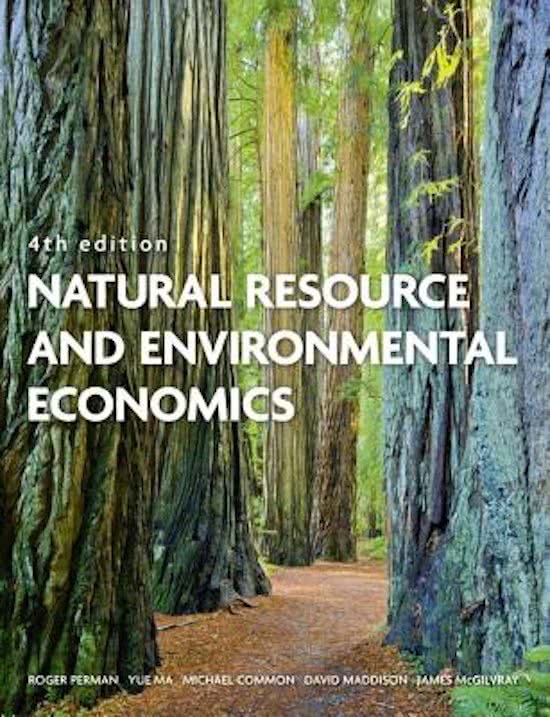
Summary Environmental Economics book
Chapter 2
Interdependence
The economy and the environment are liked through many complex relationships. Economic
activity affects the environment, which affects the economy. The economy and the
environment are interdependent systems.
Impact scale
The scale of humanity’s current impact on the natural environment is without precedent and
raises the question of whether the natural environment can tolerate it without serious
change, likely to be detrimental to human interests.
Impact drivers – IPAT
Humanity’s impacts on the natural environment are driven by the size of the human
population, the level of human affluence and the technologies that humans use.
Behavior
P, A an T all depend on human behavior, which changes over time as the incentives facing
people change. Policy affects the incentives that people face.
Poverty and inequality
The current human condition involves massive inequalities in many aspects of well-being and
gross poverty for many millions of people.
Sustainable development
Sustainable development seeks to improve the lot of the world’s poor without reducing the
capacity of the natural environment to deliver a diverse set of services to the global
economy.
IPAT identity
I=PxAxT
I is impact, measured as mass or volume
P is population size
A is per capita affluence, measured in currency units
T is technology, as amount of the resource used or waste generated per unit production
[population] x [GDP/Population] x [Resource use/GDP]
, Chapter 5
The concept of a pollution target
Unless government takes the view that pollution levels should be decided entirely by free
market out- comes, a policy maker will, for any particular pollution problem, need to make a
decision about how much of that pollution should be permitted. Sometimes – as in the case
of greenhouse gas emissions – this target is announced explicitly in terms of a total amount
of allowable emissions of the polluting substance over some specified interval of time. Such
choices logically precede any subsequent choices to be made about how that goal is to be
achieved. Pollution problems may sometimes take different forms to those addressed in this
chapter. One important kind is legacy effects, such as contaminated land. In that case, the
choice concerns the rate at which the existing pollution stocks should be con- verted into
harmless forms. Although we did not cover such legacy effects in this chapter, the
techniques we have developed here can, with a little modification, be readily applied to such
cases.
Different criteria can be used to determine pollution targets
The dominant approach taken by economists is to determine pollution targets on the
presumption that the relevant objective criterion is economic efficiency. Much of this
chapter has consisted of an exposition of that approach. However, economic efficiency is not
the only relevant criterion for pollution target setting. Put another way, efficiency is only one
of many criteria that policy makers might use – singly or jointly – in determining pollution
targets. For many commentators, sustainability should be the principal criterion. In practice,
much pollution target setting has been heavily determined by one principal damage route:
impacts on human health and mortality. Several others were discussed in the chapter. Which
criteria are important to policy makers will tend to reflect their policy objectives and the
constraints under which they operate.
It is important to recognize that policy makers are likely to have multiple objectives.
Efficiency matters, but it is not the only thing that matters. It is not surprising, therefore, that
targets (or ‘environ- mental standards’ as they are sometimes called) are often chosen in
practice on the basis of a mix of objectives. The mix may include health or safety
considerations, equity, and perceptions of what is technically feasible (usually subject to
some ‘reasonable cost’ qualification). In recent years, sustain- ability has taken its place as
another stated goal of policy. As we show in Chapter 7, sustainability in conjunction with
imperfect information and uncertainty may also point to some form of precautionary
principle being incorporated in the set of objectives pursued by policy makers.
National and international policy is also determined in the context of a network of pressures
and influences. Political feasibility, therefore, plays a significant role. This has been
particularly important in the area of international environmental agreements over such
things as ozone depletion, acid rain and the greenhouse effect, as we show in Chapter 9.
Alternative policy objectives usually imply different pollution targets
Different policy objectives usually imply different pollution targets. One particular
comparison has received much attention in recent years: whether economic efficiency and
sustainability are policy substitutes in the sense that the pursuit of the first implies the
attainment of the latter. In general this will not be the case. As we showed earlier and will
Chapter 2
Interdependence
The economy and the environment are liked through many complex relationships. Economic
activity affects the environment, which affects the economy. The economy and the
environment are interdependent systems.
Impact scale
The scale of humanity’s current impact on the natural environment is without precedent and
raises the question of whether the natural environment can tolerate it without serious
change, likely to be detrimental to human interests.
Impact drivers – IPAT
Humanity’s impacts on the natural environment are driven by the size of the human
population, the level of human affluence and the technologies that humans use.
Behavior
P, A an T all depend on human behavior, which changes over time as the incentives facing
people change. Policy affects the incentives that people face.
Poverty and inequality
The current human condition involves massive inequalities in many aspects of well-being and
gross poverty for many millions of people.
Sustainable development
Sustainable development seeks to improve the lot of the world’s poor without reducing the
capacity of the natural environment to deliver a diverse set of services to the global
economy.
IPAT identity
I=PxAxT
I is impact, measured as mass or volume
P is population size
A is per capita affluence, measured in currency units
T is technology, as amount of the resource used or waste generated per unit production
[population] x [GDP/Population] x [Resource use/GDP]
, Chapter 5
The concept of a pollution target
Unless government takes the view that pollution levels should be decided entirely by free
market out- comes, a policy maker will, for any particular pollution problem, need to make a
decision about how much of that pollution should be permitted. Sometimes – as in the case
of greenhouse gas emissions – this target is announced explicitly in terms of a total amount
of allowable emissions of the polluting substance over some specified interval of time. Such
choices logically precede any subsequent choices to be made about how that goal is to be
achieved. Pollution problems may sometimes take different forms to those addressed in this
chapter. One important kind is legacy effects, such as contaminated land. In that case, the
choice concerns the rate at which the existing pollution stocks should be con- verted into
harmless forms. Although we did not cover such legacy effects in this chapter, the
techniques we have developed here can, with a little modification, be readily applied to such
cases.
Different criteria can be used to determine pollution targets
The dominant approach taken by economists is to determine pollution targets on the
presumption that the relevant objective criterion is economic efficiency. Much of this
chapter has consisted of an exposition of that approach. However, economic efficiency is not
the only relevant criterion for pollution target setting. Put another way, efficiency is only one
of many criteria that policy makers might use – singly or jointly – in determining pollution
targets. For many commentators, sustainability should be the principal criterion. In practice,
much pollution target setting has been heavily determined by one principal damage route:
impacts on human health and mortality. Several others were discussed in the chapter. Which
criteria are important to policy makers will tend to reflect their policy objectives and the
constraints under which they operate.
It is important to recognize that policy makers are likely to have multiple objectives.
Efficiency matters, but it is not the only thing that matters. It is not surprising, therefore, that
targets (or ‘environ- mental standards’ as they are sometimes called) are often chosen in
practice on the basis of a mix of objectives. The mix may include health or safety
considerations, equity, and perceptions of what is technically feasible (usually subject to
some ‘reasonable cost’ qualification). In recent years, sustain- ability has taken its place as
another stated goal of policy. As we show in Chapter 7, sustainability in conjunction with
imperfect information and uncertainty may also point to some form of precautionary
principle being incorporated in the set of objectives pursued by policy makers.
National and international policy is also determined in the context of a network of pressures
and influences. Political feasibility, therefore, plays a significant role. This has been
particularly important in the area of international environmental agreements over such
things as ozone depletion, acid rain and the greenhouse effect, as we show in Chapter 9.
Alternative policy objectives usually imply different pollution targets
Different policy objectives usually imply different pollution targets. One particular
comparison has received much attention in recent years: whether economic efficiency and
sustainability are policy substitutes in the sense that the pursuit of the first implies the
attainment of the latter. In general this will not be the case. As we showed earlier and will