Finance function
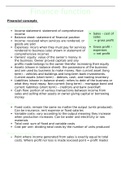
Financial concepts
Income statement
Income statement: statement of comprehensive
income Sales – cost of
Balance sheet: statement of financial position sales
Income: received when services are rendered, or = gross profit
goods are sold
Expenses: incurs when they must pay for services Gross profit –
rendered to business (also shown in statement of expenses
comprehensive income) = net profit
Owners’ equity: value of the owner’s money in
the business. Owner proved capitals and any
profits made belongs to the owner therefor increasing their equity
Assets (shown in balance sheet): the possessions of the business
and are used by business to make money. Non currant asset (long
term) – vehicles and buildings and long-term bank investments.
Current assets (short term) – debtors, cash, and trading inventory
Liabilities (shown in balance sheet): refers to debt of the business or
what they must repay. Non-current (long term) – mortgage bond and
current liabilities (short term) – creditors and bank overdraft
Cash flow: portion of various transactions between income from
sales and selling other assets or owner giving capital or borrowing
money
Costs
Fixed costs: remain the same no matter the output (units produced).
Can be insurance, rent expense or fixed salaries
Variable costs: vary according to the output meaning they increase
when production increases. Can be water and electricity or raw
materials
Total cost: sum of fixed and variable costs
Cost per unit: dividing total costs by the number of units produced
Break even analysis
Point where income generated from sales is exactly equal to total
costs. Where profit nor loss is made (exceed point = profit made)
Financial concepts
Income statement
Income statement: statement of comprehensive
income Sales – cost of
Balance sheet: statement of financial position sales
Income: received when services are rendered, or = gross profit
goods are sold
Expenses: incurs when they must pay for services Gross profit –
rendered to business (also shown in statement of expenses
comprehensive income) = net profit
Owners’ equity: value of the owner’s money in
the business. Owner proved capitals and any
profits made belongs to the owner therefor increasing their equity
Assets (shown in balance sheet): the possessions of the business
and are used by business to make money. Non currant asset (long
term) – vehicles and buildings and long-term bank investments.
Current assets (short term) – debtors, cash, and trading inventory
Liabilities (shown in balance sheet): refers to debt of the business or
what they must repay. Non-current (long term) – mortgage bond and
current liabilities (short term) – creditors and bank overdraft
Cash flow: portion of various transactions between income from
sales and selling other assets or owner giving capital or borrowing
money
Costs
Fixed costs: remain the same no matter the output (units produced).
Can be insurance, rent expense or fixed salaries
Variable costs: vary according to the output meaning they increase
when production increases. Can be water and electricity or raw
materials
Total cost: sum of fixed and variable costs
Cost per unit: dividing total costs by the number of units produced
Break even analysis
Point where income generated from sales is exactly equal to total
costs. Where profit nor loss is made (exceed point = profit made)