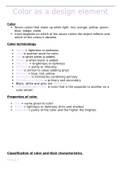
Color as a design element
Color
Seven colors that make up white light: red, orange, yellow, green,
blue, indigo, violet
Color depends on which of the seven colors the object reflects and
which of the colors it absorbs
Color terminology
Value = lightness or darkness
Hue is another word for color.
Tint is when white is added
Shade is when black is added
Intensity = brightness or darkness
Chroma = purity or intensity
Tone is similar to value (adding grey)
Primary = blue, red, yellow
Secondary is formed by combining primary
Tertiary or intimate = primary and secondary
Black, white and grey are autocratic
Complementary color is color that is the opposite to another on a
color wheel
Properties of color
Hue = name given to color
Value = lightness or darkness (tints and shades)
Intensity = purity of the color and the higher the brighter.
Classification of color and their characteristics
Primary
, Red: warm passionate and fiery
yellow: warm and happy
Blue: cool and calm
Secondary
Orange: warm and welcoming
Green: fresh
Violet: rich and relaxing
Tertiary
Yellow orange: flash of flesh of light
Red orange: present and inviting
Red violet: dusk
Blue violet: mysterious
Blue green: cooling and comforting
Color combinations
Monochromatic
Using different tints and shades of one color
E.g., light and dark green
, Analogous
Two or three colors that are situated side by side on the color wheel
E.g., green, blue green and blue
Complementary color scheme
Two colors that would lie opposite each other
E.g., green and red
Double complementary scheme
Two colors next to each other and the tow colors that lie directly
opposite them.
Split complementary
One color and the two colors that lie opposite its complementary
Double spilt complementary (rectangular)
Two colors that lie on their side of a color with their complements
Triadic
Three colors found at each point of triangle
Must be equilateral triangle
Square
Forms square on wheel
Color
Seven colors that make up white light: red, orange, yellow, green,
blue, indigo, violet
Color depends on which of the seven colors the object reflects and
which of the colors it absorbs
Color terminology
Value = lightness or darkness
Hue is another word for color.
Tint is when white is added
Shade is when black is added
Intensity = brightness or darkness
Chroma = purity or intensity
Tone is similar to value (adding grey)
Primary = blue, red, yellow
Secondary is formed by combining primary
Tertiary or intimate = primary and secondary
Black, white and grey are autocratic
Complementary color is color that is the opposite to another on a
color wheel
Properties of color
Hue = name given to color
Value = lightness or darkness (tints and shades)
Intensity = purity of the color and the higher the brighter.
Classification of color and their characteristics
Primary
, Red: warm passionate and fiery
yellow: warm and happy
Blue: cool and calm
Secondary
Orange: warm and welcoming
Green: fresh
Violet: rich and relaxing
Tertiary
Yellow orange: flash of flesh of light
Red orange: present and inviting
Red violet: dusk
Blue violet: mysterious
Blue green: cooling and comforting
Color combinations
Monochromatic
Using different tints and shades of one color
E.g., light and dark green
, Analogous
Two or three colors that are situated side by side on the color wheel
E.g., green, blue green and blue
Complementary color scheme
Two colors that would lie opposite each other
E.g., green and red
Double complementary scheme
Two colors next to each other and the tow colors that lie directly
opposite them.
Split complementary
One color and the two colors that lie opposite its complementary
Double spilt complementary (rectangular)
Two colors that lie on their side of a color with their complements
Triadic
Three colors found at each point of triangle
Must be equilateral triangle
Square
Forms square on wheel