Europees recht
Week 1
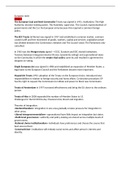
The European Coal and Steel Community Treaty was signed in 1951. Institutions: The High
Authority; decision-making power, The Assembly; supervisor, The Council; representatives of
governments and the CoJ. No European army because this required a common foreign
policy.
The EEC Treaty (of Rome) was signed in 1957 and established a common market, common
custom tariff and free movement of goods, workers, capital and services. Legislative power
was divided between the Commission; initiative and The Council voted. The Parliament only
consulted.
In 1965 was the Merger treaty signed -> ECSC, Euratom and EEC shared institutions.
Tensions between intergovernmental (France (unanimity voting)) and supranational views
on the Community in which the empty-chair policy came by and resulted in agreement to
disagree on voting.
Single European Act was signed in 1986 and established an expansion of Member States, a
legal basis to the European Council and the Parliament became more important.
Maastricht Treaty 1992: adoption of the Treaty on the European Union. Introduced new
responsibilities in relation to foreign security and home affairs. Co-decision procedure: EP
has the right to request the Commission to initiate and power to block new Commission.
Treaty of Amsterdam in 1997 increased effectiveness and bring the EU closer to the ordinary
person.
Treaty of Nice in 2000 expanded the number of Member States to 15.
Challenges for the EU till this day: financial crisis, Brexit and migration
Theories of integration:
-Neofunctionalism= integration in one area gradually creates pressure for integration in
other areas.
-Liberal intergovernmentalism= supranational have little impact on integration but states.
-Multi-level governance= authority and policy-making are shared across multiple levels of
governments
-Rational choice institutionalism= individuals have preferences and choose the course that
best secures them.
-Constructivism= institutions will embody social norms and affect person’s interest and
identity.
Week 1
The European Coal and Steel Community Treaty was signed in 1951. Institutions: The High
Authority; decision-making power, The Assembly; supervisor, The Council; representatives of
governments and the CoJ. No European army because this required a common foreign
policy.
The EEC Treaty (of Rome) was signed in 1957 and established a common market, common
custom tariff and free movement of goods, workers, capital and services. Legislative power
was divided between the Commission; initiative and The Council voted. The Parliament only
consulted.
In 1965 was the Merger treaty signed -> ECSC, Euratom and EEC shared institutions.
Tensions between intergovernmental (France (unanimity voting)) and supranational views
on the Community in which the empty-chair policy came by and resulted in agreement to
disagree on voting.
Single European Act was signed in 1986 and established an expansion of Member States, a
legal basis to the European Council and the Parliament became more important.
Maastricht Treaty 1992: adoption of the Treaty on the European Union. Introduced new
responsibilities in relation to foreign security and home affairs. Co-decision procedure: EP
has the right to request the Commission to initiate and power to block new Commission.
Treaty of Amsterdam in 1997 increased effectiveness and bring the EU closer to the ordinary
person.
Treaty of Nice in 2000 expanded the number of Member States to 15.
Challenges for the EU till this day: financial crisis, Brexit and migration
Theories of integration:
-Neofunctionalism= integration in one area gradually creates pressure for integration in
other areas.
-Liberal intergovernmentalism= supranational have little impact on integration but states.
-Multi-level governance= authority and policy-making are shared across multiple levels of
governments
-Rational choice institutionalism= individuals have preferences and choose the course that
best secures them.
-Constructivism= institutions will embody social norms and affect person’s interest and
identity.