Grade 11 Trigonometry
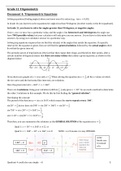
Document 4: Trigonometric Equations
Solving equations (finding angles) when you know one of its ratios [e.g. tan 𝑥 = 0,45]
In Grade 10, you learnt to solve equations for angles less than 90 degrees (in other words, in the first quadrant).
In Grade 11, you learn to solve for angles greater than 90 degrees, or negative angles.
If sin 𝑥 , cos 𝑥 or tan 𝑥 has a particular value, and the angle 𝑥 lies between 0 and 360 degrees, the angle can
have TWO possible values, but your calculator will only give you one answer . So you have to determine both
answers, by using your calculator answer in a particular way.
Solving trig equations requires that we find the value(s) of the angles that satisfy the equation. If a specific
interval for the equation is given, then we will find the general solution, followed by the actual angles which
lie within the given interval.
The periodic nature of trig functions (the fact that they repeat their shape, and therefore their points, after a
certain number of degrees) means that there are many values that satisfy a given equation, as shown in the
diagram below:
1 1
Given above are graphs of 𝑦 = 𝑠𝑖𝑛𝑥 and 𝑦 = . When solving the equation sin 𝑥 = , all the 𝑥-values at which
2 2
the sin-curve and the horizontal line intersect, are solutions.
Here the given interval is −360° < 𝑥 < 360°.
1
There are 4 solutions. Using your calculator [shift sin 2 ] only gives 𝑥 = 30°. So we need a method to determine
the other 3 solutions in this example. We do this by first finding the “general solution”.
Developing the concept:
The period of the function 𝑦 = sin 𝑥 is 360°, which means the curve repeats every 𝟑𝟔𝟎°.
1 1
sin 30° = 2, but so does sin 390° = sin (30° + 360°) = sin 30° = 2.
1
sin 750° = sin (30° + 2 × 360°) =
2
1
sin 1 110° = sin(30° + 3 × 360°) =
2
1
Therefore, you can summarise the solutions as the GENERAL SOLUTION of the equation sin 𝑥 = 2:
Quad 1: 𝑥 = 30° + 𝑛. 360°, 𝑛 ∈ ℤ, or
Quad 2: 𝑥 = 180° − 30° + 𝑛. 360°, 𝑛 ∈ ℤ NOTE: 𝑛 ∈ ℤ means 𝑛 is any INTEGER.
some
books use
180° − 𝜃 𝜃 𝑘 instead
of 𝑛
180° + 𝜃 360° − 𝜃
Quadrant 4 could also use simply −𝜃. 1
, Worked Example 1: Find the GENERAL SOLUTION to the equation 𝟑 𝐬𝐢𝐧 𝟐𝒙 = −𝟎, 𝟕𝟓𝟕
Follow these steps always for solving trig equations with one ratio. Lets call this type ‘Pattern A’
Step 1: Solve for the given ratio/isolate the ratio:
3 sin 2𝑥 = −0,757
0,757
sin 𝟐𝒙 = − 3
NOTE: It is important to isolate the ratio (sin 2𝑥) even if the angle is compound
(the angle here is 2𝑥).
Step 2: Determine in which two quadrants the solution lies. Use the CAST diagram. This will be where the given
ratio is negative, in the given example; Write these down, leaving a few lines open in between:
Q3……………….
S A
……………….
Q4………………
……………….
Step 3 Fill in the following according to the quads:
Q3 2𝑥 = 𝟏𝟖𝟎° + ⋯ … ….(the reference angle) + 𝑛. 360°, 𝑛 ∈ ℤ
T C
The angle ………………………………………………………
Q4 2𝑥 = 𝟑𝟔𝟎° − ⋯ … ….(the reference angle) + 𝑛. 360°
……………………………………………………..
Step 4 Find the reference angle (the calculator angle) by pressing shift sin of the POSITIVE ratio (value)
0,757
and fill it in, correct to 2 decimal places [sin−1 ( ) = 14,62°].
3
The reference angle is the positive ACUTE angle between the 𝑥-axis and the rotating arm. (Be careful: if
you type the negative ratio into the calculator, then a negative angle is given and this is not the
reference angle. It would be the negative of the reference angle.
1
Eg. sin−1 − = −30, whereas the reference angle is actually 30°
2
NOW ONLY DO YOU SOLVE THE TWO EQUATIONS IN THE CHOSEN QUADRANTS:
Q3 2𝑥 = 𝟏𝟖𝟎° + 14,62° + 𝑛. 360°, 𝑛 ∈ ℤ
2𝑥 = 165,38° + 𝑛. 360°
∴ 𝑥 = 82,69° + 𝑛. 180° NOTE: Also divide the 360 by 2
Q4 2𝑥 = 𝟑𝟔𝟎° − 14,62° + 𝑛. 360° The + 𝑛360° or + 𝑛180° must
2𝑥 = 345,38° + 𝑛. 360° appear as soon as you start
working in the two quadrants.
𝑥 = 172,69° + 𝑛. 180°
𝑛 ∈ ℤ needs to appear ONCE
only somewhere in your solution.
2
Document 4: Trigonometric Equations
Solving equations (finding angles) when you know one of its ratios [e.g. tan 𝑥 = 0,45]
In Grade 10, you learnt to solve equations for angles less than 90 degrees (in other words, in the first quadrant).
In Grade 11, you learn to solve for angles greater than 90 degrees, or negative angles.
If sin 𝑥 , cos 𝑥 or tan 𝑥 has a particular value, and the angle 𝑥 lies between 0 and 360 degrees, the angle can
have TWO possible values, but your calculator will only give you one answer . So you have to determine both
answers, by using your calculator answer in a particular way.
Solving trig equations requires that we find the value(s) of the angles that satisfy the equation. If a specific
interval for the equation is given, then we will find the general solution, followed by the actual angles which
lie within the given interval.
The periodic nature of trig functions (the fact that they repeat their shape, and therefore their points, after a
certain number of degrees) means that there are many values that satisfy a given equation, as shown in the
diagram below:
1 1
Given above are graphs of 𝑦 = 𝑠𝑖𝑛𝑥 and 𝑦 = . When solving the equation sin 𝑥 = , all the 𝑥-values at which
2 2
the sin-curve and the horizontal line intersect, are solutions.
Here the given interval is −360° < 𝑥 < 360°.
1
There are 4 solutions. Using your calculator [shift sin 2 ] only gives 𝑥 = 30°. So we need a method to determine
the other 3 solutions in this example. We do this by first finding the “general solution”.
Developing the concept:
The period of the function 𝑦 = sin 𝑥 is 360°, which means the curve repeats every 𝟑𝟔𝟎°.
1 1
sin 30° = 2, but so does sin 390° = sin (30° + 360°) = sin 30° = 2.
1
sin 750° = sin (30° + 2 × 360°) =
2
1
sin 1 110° = sin(30° + 3 × 360°) =
2
1
Therefore, you can summarise the solutions as the GENERAL SOLUTION of the equation sin 𝑥 = 2:
Quad 1: 𝑥 = 30° + 𝑛. 360°, 𝑛 ∈ ℤ, or
Quad 2: 𝑥 = 180° − 30° + 𝑛. 360°, 𝑛 ∈ ℤ NOTE: 𝑛 ∈ ℤ means 𝑛 is any INTEGER.
some
books use
180° − 𝜃 𝜃 𝑘 instead
of 𝑛
180° + 𝜃 360° − 𝜃
Quadrant 4 could also use simply −𝜃. 1
, Worked Example 1: Find the GENERAL SOLUTION to the equation 𝟑 𝐬𝐢𝐧 𝟐𝒙 = −𝟎, 𝟕𝟓𝟕
Follow these steps always for solving trig equations with one ratio. Lets call this type ‘Pattern A’
Step 1: Solve for the given ratio/isolate the ratio:
3 sin 2𝑥 = −0,757
0,757
sin 𝟐𝒙 = − 3
NOTE: It is important to isolate the ratio (sin 2𝑥) even if the angle is compound
(the angle here is 2𝑥).
Step 2: Determine in which two quadrants the solution lies. Use the CAST diagram. This will be where the given
ratio is negative, in the given example; Write these down, leaving a few lines open in between:
Q3……………….
S A
……………….
Q4………………
……………….
Step 3 Fill in the following according to the quads:
Q3 2𝑥 = 𝟏𝟖𝟎° + ⋯ … ….(the reference angle) + 𝑛. 360°, 𝑛 ∈ ℤ
T C
The angle ………………………………………………………
Q4 2𝑥 = 𝟑𝟔𝟎° − ⋯ … ….(the reference angle) + 𝑛. 360°
……………………………………………………..
Step 4 Find the reference angle (the calculator angle) by pressing shift sin of the POSITIVE ratio (value)
0,757
and fill it in, correct to 2 decimal places [sin−1 ( ) = 14,62°].
3
The reference angle is the positive ACUTE angle between the 𝑥-axis and the rotating arm. (Be careful: if
you type the negative ratio into the calculator, then a negative angle is given and this is not the
reference angle. It would be the negative of the reference angle.
1
Eg. sin−1 − = −30, whereas the reference angle is actually 30°
2
NOW ONLY DO YOU SOLVE THE TWO EQUATIONS IN THE CHOSEN QUADRANTS:
Q3 2𝑥 = 𝟏𝟖𝟎° + 14,62° + 𝑛. 360°, 𝑛 ∈ ℤ
2𝑥 = 165,38° + 𝑛. 360°
∴ 𝑥 = 82,69° + 𝑛. 180° NOTE: Also divide the 360 by 2
Q4 2𝑥 = 𝟑𝟔𝟎° − 14,62° + 𝑛. 360° The + 𝑛360° or + 𝑛180° must
2𝑥 = 345,38° + 𝑛. 360° appear as soon as you start
working in the two quadrants.
𝑥 = 172,69° + 𝑛. 180°
𝑛 ∈ ℤ needs to appear ONCE
only somewhere in your solution.
2