Rates of Change
These are special types of minima/maxima problems.
Generally rate of change refers to how quickly a variable changes with respect to TIME.
The rate of change is an indication of how quickly one variable (the dependent variable) changes
with respect to a change in the independent variable.
If this sounds familiar, that’s because it is one of the definitions of gradient and gradient is the same
as the derivative…so rate of change is the same as the derivative!
It is important to draw a distinction between the instantaneous rate of change and the average rate
of change.
The Instantaneous rate of change is the gradient of the tangent to the curve at the point in
question
𝐼𝑛𝑠𝑡𝑎𝑛𝑡𝑎𝑛𝑡𝑒𝑜𝑢𝑠 𝑟𝑎𝑡𝑒 𝑜𝑓 𝑐ℎ𝑎𝑛𝑔𝑒 = 𝑚 = 𝑓 ′ (𝑥)
The average rate of change is the same as the average gradient of a secant drawn between
two points on the curve.
𝑓(𝑥2 ) − 𝑓(𝑥1 )
𝐴𝑣𝑒𝑟𝑎𝑔𝑒 𝑟𝑎𝑡𝑒 𝑜𝑓 𝑐ℎ𝑎𝑛𝑔𝑒 =
𝑥2 − 𝑥1
𝑥1 𝑥2
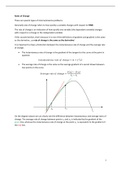
On the diagram above we can clearly see the difference between instantaneous and average rates of
change. The average rate of change between points 𝑥1 and 𝑥2 is indicated by the gradient of the
green line, whereas the instantaneous rate of change at the point 𝑥1 is equivalent to the gradient of
the red line.
1
, Example:
A tank of water has water being pumped into it at a certain rate, and water being pumped out of
it at a different rate. The volume of water in the tank can be described by the equation
𝑽(𝒕) = 𝒕𝟑 − 𝟒𝒕𝟐 − 𝟏𝟔𝒕 + 𝟓𝟎, where 𝒕 is the time (in minutes) and 𝑽 is the volume, measured in
litres.
Determine:
a) How much water is in the tank initially?
b) How much water is in the tank after 𝟏 minute?
c) Determine an expression for the rate of change of the volume of water in the tank.
d) After how long will the volume of water in the tank be a minimum?
e) How much water is in the tank when the rate of change is 𝟒𝟒 litres per minute?
a) The initial amount of water is the volume at 𝑡 = 0, as no time has lapsed.
To find the volume at time 𝑡 = 0 we substitute 𝑡 = 0 into the expression for 𝑉(𝑡)
𝑉(0) = (0)3 − 4(0)2 − 16(0) + 50 = 50 l
Notice that the volume at 𝑡 = 0 is the same as the constant term in the expression.
b) Similarly to find the volume of water in the tank after 1 minute we substitute 𝑡 = 1
into the expression for 𝑉(𝑡).
𝑉(1) = (1)3 − 4(1)2 − 16(1) + 50 = 31 𝑙
c) The rate of change in this case refers to the instantaneous rate of change, we want
to know how fast the volume changes per passing unit of time or in derivatives
𝑑𝑉
notation: 𝑑𝑡
so to find an expression for the instantaneous rate of change of volume, we take the
derivative of the volume (𝑉) with respect to time (𝑡)
𝑑𝑉
𝑑𝑡
= 3𝑡 2 − 8𝑡 − 16
𝑑𝑉
d) The volume will be at a minimum when the rate of change is zero or when 𝑑𝑡
=0
𝑑𝑉
Min/max: set 𝑑𝑡
=0
3𝑡 2 − 8𝑡 − 16 = 0
∴ (3𝑡 + 4)(𝑡 − 4) = 0
4
∴ 𝑡 = − 3 𝑜𝑟 𝑡 = 4
(𝑖𝑛𝑣𝑎𝑙𝑖𝑑) ∴ 𝑡 = 4 minutes
Note: the negative value is invalid because of the context, time cannot be negative.
2
These are special types of minima/maxima problems.
Generally rate of change refers to how quickly a variable changes with respect to TIME.
The rate of change is an indication of how quickly one variable (the dependent variable) changes
with respect to a change in the independent variable.
If this sounds familiar, that’s because it is one of the definitions of gradient and gradient is the same
as the derivative…so rate of change is the same as the derivative!
It is important to draw a distinction between the instantaneous rate of change and the average rate
of change.
The Instantaneous rate of change is the gradient of the tangent to the curve at the point in
question
𝐼𝑛𝑠𝑡𝑎𝑛𝑡𝑎𝑛𝑡𝑒𝑜𝑢𝑠 𝑟𝑎𝑡𝑒 𝑜𝑓 𝑐ℎ𝑎𝑛𝑔𝑒 = 𝑚 = 𝑓 ′ (𝑥)
The average rate of change is the same as the average gradient of a secant drawn between
two points on the curve.
𝑓(𝑥2 ) − 𝑓(𝑥1 )
𝐴𝑣𝑒𝑟𝑎𝑔𝑒 𝑟𝑎𝑡𝑒 𝑜𝑓 𝑐ℎ𝑎𝑛𝑔𝑒 =
𝑥2 − 𝑥1
𝑥1 𝑥2
On the diagram above we can clearly see the difference between instantaneous and average rates of
change. The average rate of change between points 𝑥1 and 𝑥2 is indicated by the gradient of the
green line, whereas the instantaneous rate of change at the point 𝑥1 is equivalent to the gradient of
the red line.
1
, Example:
A tank of water has water being pumped into it at a certain rate, and water being pumped out of
it at a different rate. The volume of water in the tank can be described by the equation
𝑽(𝒕) = 𝒕𝟑 − 𝟒𝒕𝟐 − 𝟏𝟔𝒕 + 𝟓𝟎, where 𝒕 is the time (in minutes) and 𝑽 is the volume, measured in
litres.
Determine:
a) How much water is in the tank initially?
b) How much water is in the tank after 𝟏 minute?
c) Determine an expression for the rate of change of the volume of water in the tank.
d) After how long will the volume of water in the tank be a minimum?
e) How much water is in the tank when the rate of change is 𝟒𝟒 litres per minute?
a) The initial amount of water is the volume at 𝑡 = 0, as no time has lapsed.
To find the volume at time 𝑡 = 0 we substitute 𝑡 = 0 into the expression for 𝑉(𝑡)
𝑉(0) = (0)3 − 4(0)2 − 16(0) + 50 = 50 l
Notice that the volume at 𝑡 = 0 is the same as the constant term in the expression.
b) Similarly to find the volume of water in the tank after 1 minute we substitute 𝑡 = 1
into the expression for 𝑉(𝑡).
𝑉(1) = (1)3 − 4(1)2 − 16(1) + 50 = 31 𝑙
c) The rate of change in this case refers to the instantaneous rate of change, we want
to know how fast the volume changes per passing unit of time or in derivatives
𝑑𝑉
notation: 𝑑𝑡
so to find an expression for the instantaneous rate of change of volume, we take the
derivative of the volume (𝑉) with respect to time (𝑡)
𝑑𝑉
𝑑𝑡
= 3𝑡 2 − 8𝑡 − 16
𝑑𝑉
d) The volume will be at a minimum when the rate of change is zero or when 𝑑𝑡
=0
𝑑𝑉
Min/max: set 𝑑𝑡
=0
3𝑡 2 − 8𝑡 − 16 = 0
∴ (3𝑡 + 4)(𝑡 − 4) = 0
4
∴ 𝑡 = − 3 𝑜𝑟 𝑡 = 4
(𝑖𝑛𝑣𝑎𝑙𝑖𝑑) ∴ 𝑡 = 4 minutes
Note: the negative value is invalid because of the context, time cannot be negative.
2