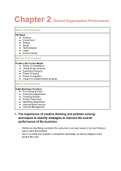
Chapter 2- Overall Organisation Performance
Macro Environment
PE2STLE
● Political
● Economical
● Ethical
● Social
● Technological
● Legal
● Environmental
Market Environment
Porter’s Six Forces Model
● Power of competitors
● Threat of new entrants
● Substitute Products
● Power of buyers
● Power of suppliers
● Impact of complementary products
Micro Environment
Eight Business Function
● Purchasing function
● Production department
● Financial function
● Human Resources
● Marketing department
● Administrative function
● General Management
1. The importance of creative thinking and problem solving
techniques to identify strategies to improve the overall
performance of the business
- Defined as identifying a problem the consumer is not even aware of yet and finding a
way to solve that problem
- Aim is to create and maintain a competitive advantage, as well as adaption of the
product life cycle
,2. Problem-solving Techniques
2.1 Pros and Cons Chart
- Make a decision based on the advantages and disadvantages of a specific option
PROs CONs
*CHECK BOOK p.29
2.2 Decision Tree
- Visual representation of different outcomes to a single event
2.3 Value Chain Analysis
- Aim is to add value for the stakeholders/customers to be satisfied
- Review entire business process to decide where value is added / can be added in a cost
effective manner to enhance the quality of the product or service rendered
2.4 PE2STLE Analysis
- Analyse each sector and formulate strategies to overcome the challenges
2.5 SWOT Analysis
- Used to assess the internal and external environments\
- Strength & Weakness > Internal (8 Business functions/ Micro Environment)
- Opportunity & Threat > External (Makro/ Market Environments)
*CHECK BOOK p.31
2.6 The Delphi Technique
- Obtains the opinions of experts on a particular topic without face-to-face engagement
- Experts remaining anonymous prevents subjectivity and bias when expressing their
opinions / recommendations critically
- First information will be collected from a panel of people about their expectations
, - Information analysed and and relayed for second round of discussions and the
panel has an opportunity to revise conclusions
2.7 Resource-based Approach
- Find out resources that are of strategic importance to the business
- Important to create an competitive advantage in the market
- When facing a problem, need to determine the needed resources to solve the problem
(incl. The availability of resources and cost)
- Intangible (patents, established brand) or tangible (scarce raw materials, financial
resources)
2.8 Balanced Scorecard
- Developed by Kaplan and Norton
- Describe the key outcomes the business would like to measure in order to improve these
outcomes
- Forces management to focus on issues that are important and that create value in and
for the business
- Develop and plan strategies that create/ maintain/ improve the competitive advantage
- Financial perspective max utilisation of assets with min costs
- Customer perspective how customers see the business and what their
expectations are
- Internal business perspective developing innovative products and services/
management of operations
- Learning and growth perspective how employees can continue to improve and
create value where leadership, accountability, culture and teamwork are
important
3. Identify strategies to improve overall performance
- Strategic management is the top management that analyses events taking place in the
business environment. Events may develop into a trend or as a surprise (crisis)
- Vision Statement is about what your organisation wants to become
- Mission Statement is a description of what an organisation does or the purpose of the
business
- Long-term and short-term objectives how the business will reach its goals/ mission and
vision
- Strategies are then implemented (plan of action)
3.1 Generic Strategies
3.1.1 Low cost strategy
- C.A. is created by having the lowest cost in the industry by
- Low input costs
- Low cost of manufacturing (mass production)
, 3.1.2 Niche Market (Focus)
- Develop a C.A. by aiming all efforts at a specific market segment based on geography,
culture, age, hobbies or any other criteria that creates a unique group of customers
- Must be big enough or have growth potential to make it valuable
- Must have expert knowledge and the ability to develop the products in the segment
3.1.3 Differentiation
- All efforts aimed at providing a unique product/ service that ensure customer loyalty
allowing the business to charge a premium price
- Determined by:
- Quality
- After-sales support
- Product features
- Distribution or marketing efforts
- Must be difficult for a business to copy
- Ensure the continuous development of products and services to stay ahead of the
challenges
3.2 Corporate Strategies
3.2.1 Corporate Combination
- Joint venture when two or more business enter an agreement to combine resources in
order to improve (or share resources) the functioning of both businesses
- Merge or takeover when the individual businesses no longer exist separately, but are
combined to form one new business. Competition Board has to approve to ensure fair
competition continues in the industry
3.2.2 Decline/ Defensive Strategies
- Decides to scale down or reduce operations or product offerings
- Retrenchment reduces the size of the business or reduces the diversity of products or
services sold - in order to reduce expenses and improve the financial position of the
business
- Divestiture part of retrenchment and involves selling of its operations because assets in
these operations are under-utilised and it hampers financial performance
- Liquidation means the business is bankrupt and all the assets are sold to pay for the
debt of the business and it ceases to exist
Macro Environment
PE2STLE
● Political
● Economical
● Ethical
● Social
● Technological
● Legal
● Environmental
Market Environment
Porter’s Six Forces Model
● Power of competitors
● Threat of new entrants
● Substitute Products
● Power of buyers
● Power of suppliers
● Impact of complementary products
Micro Environment
Eight Business Function
● Purchasing function
● Production department
● Financial function
● Human Resources
● Marketing department
● Administrative function
● General Management
1. The importance of creative thinking and problem solving
techniques to identify strategies to improve the overall
performance of the business
- Defined as identifying a problem the consumer is not even aware of yet and finding a
way to solve that problem
- Aim is to create and maintain a competitive advantage, as well as adaption of the
product life cycle
,2. Problem-solving Techniques
2.1 Pros and Cons Chart
- Make a decision based on the advantages and disadvantages of a specific option
PROs CONs
*CHECK BOOK p.29
2.2 Decision Tree
- Visual representation of different outcomes to a single event
2.3 Value Chain Analysis
- Aim is to add value for the stakeholders/customers to be satisfied
- Review entire business process to decide where value is added / can be added in a cost
effective manner to enhance the quality of the product or service rendered
2.4 PE2STLE Analysis
- Analyse each sector and formulate strategies to overcome the challenges
2.5 SWOT Analysis
- Used to assess the internal and external environments\
- Strength & Weakness > Internal (8 Business functions/ Micro Environment)
- Opportunity & Threat > External (Makro/ Market Environments)
*CHECK BOOK p.31
2.6 The Delphi Technique
- Obtains the opinions of experts on a particular topic without face-to-face engagement
- Experts remaining anonymous prevents subjectivity and bias when expressing their
opinions / recommendations critically
- First information will be collected from a panel of people about their expectations
, - Information analysed and and relayed for second round of discussions and the
panel has an opportunity to revise conclusions
2.7 Resource-based Approach
- Find out resources that are of strategic importance to the business
- Important to create an competitive advantage in the market
- When facing a problem, need to determine the needed resources to solve the problem
(incl. The availability of resources and cost)
- Intangible (patents, established brand) or tangible (scarce raw materials, financial
resources)
2.8 Balanced Scorecard
- Developed by Kaplan and Norton
- Describe the key outcomes the business would like to measure in order to improve these
outcomes
- Forces management to focus on issues that are important and that create value in and
for the business
- Develop and plan strategies that create/ maintain/ improve the competitive advantage
- Financial perspective max utilisation of assets with min costs
- Customer perspective how customers see the business and what their
expectations are
- Internal business perspective developing innovative products and services/
management of operations
- Learning and growth perspective how employees can continue to improve and
create value where leadership, accountability, culture and teamwork are
important
3. Identify strategies to improve overall performance
- Strategic management is the top management that analyses events taking place in the
business environment. Events may develop into a trend or as a surprise (crisis)
- Vision Statement is about what your organisation wants to become
- Mission Statement is a description of what an organisation does or the purpose of the
business
- Long-term and short-term objectives how the business will reach its goals/ mission and
vision
- Strategies are then implemented (plan of action)
3.1 Generic Strategies
3.1.1 Low cost strategy
- C.A. is created by having the lowest cost in the industry by
- Low input costs
- Low cost of manufacturing (mass production)
, 3.1.2 Niche Market (Focus)
- Develop a C.A. by aiming all efforts at a specific market segment based on geography,
culture, age, hobbies or any other criteria that creates a unique group of customers
- Must be big enough or have growth potential to make it valuable
- Must have expert knowledge and the ability to develop the products in the segment
3.1.3 Differentiation
- All efforts aimed at providing a unique product/ service that ensure customer loyalty
allowing the business to charge a premium price
- Determined by:
- Quality
- After-sales support
- Product features
- Distribution or marketing efforts
- Must be difficult for a business to copy
- Ensure the continuous development of products and services to stay ahead of the
challenges
3.2 Corporate Strategies
3.2.1 Corporate Combination
- Joint venture when two or more business enter an agreement to combine resources in
order to improve (or share resources) the functioning of both businesses
- Merge or takeover when the individual businesses no longer exist separately, but are
combined to form one new business. Competition Board has to approve to ensure fair
competition continues in the industry
3.2.2 Decline/ Defensive Strategies
- Decides to scale down or reduce operations or product offerings
- Retrenchment reduces the size of the business or reduces the diversity of products or
services sold - in order to reduce expenses and improve the financial position of the
business
- Divestiture part of retrenchment and involves selling of its operations because assets in
these operations are under-utilised and it hampers financial performance
- Liquidation means the business is bankrupt and all the assets are sold to pay for the
debt of the business and it ceases to exist