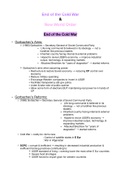
End of the Cold War
&
New World Order
End of the Cold War
- Gorbachev’s Aims:
⌑ (1985) Gorbachev = Secretary General of Soviet Communist Party
⌙ Life-long communist & believed in its ideology — not a
hardliner like previous leaders
⌙ Inherited country facing internal & external problems
⌙ Hoped to revive USSR’s economy → improve industrial
output, technology, & expanding markets
⌙ Attacked Brezhbev for “years of stagnation” → started reforms
⌑ Gorbachev’s aims when assuming power:
Restructure & restore Soviet economy → reducing CP control over
economy
Reduce military spending
Encourage Western companies to invent in USSR
Facilitate transparency abt gov policy
Listen & take note of public opinion
Allow some form of elections BUT maintaining real power lie in hands of
CP
- Gorbachev’s Reforms:
(1985) Gorbachev = Secretary General of Soviet Communist Party
= Life-long communist & believed in its
ideology — not a hardliner like previous
leaders
= Inherited country facing internal & external
problems
= Hoped to revive USSR’s economy →
improve industrial output, technology, &
expanding markets
= Attacked Brezhbev for “years of
stagnation” → started reforms
Cold War = costly bc: Arms race
: Control of satellite states in E Eur
: War in Afganistan
SCPC = corrupt & ine cient → resulting in decreased industrial production &
ine cient farming practices contributing to:
✧ USSR standard of living = evening lower the most other E Eur countries
✧ Severe food shortages
✧ USSR forced to import grain for western countries
⚛︎ ffi
⭐︎ ffi
, ✧ Shortages of goods
✧ Poor health standards & inadequate health care
✧ In ation
Reforms → Contributed to end of Cold War & disintegration of USSR
Perestroika (recontruction) - economic reforms Glasnot (openess) - politcal reform
Based on economy ⌘ Free, open debate & criticism abt Russia’s political
E ciency for gov — looked @ Stalin & Lenin’s ways for problems
radical changes ⌘ Wanted to hear ppl’s ideas (not only combust party
Workers & managers could make own decisions w/out ⌘ Allowed media to critics gov
contacting Moscow ⌘ Resulted: in attack on Gorbachev, country & gov AND
Small business & farms allowed demand for more freedom
Permission to buy/sell goods & services for pro t
Investments from capitalist west encouraged
Campaign encouraging ppl to work harder — incentives
→ controlled making/ selling alcohol
Democratisation Détente
• Other political parties allowed & formed Creating better international relations
• Free elections International interest
• More attacks on Communism & Gorbachev Could not a ord arms race
Improved relations w/ countries no ‘friendly’ w/
Reduction of nuclear war tensions — Reagan -
negotiate reduction of nuclear & other weapons
Patch up relations w/ china
Withdrew from Afghanistan
→ Had impact on events globally
Reforms:
⭐︎ffifl
♠︎
⚛︎ ff fi
, - Events in Poland:
• Poland = USSR satellite state (dependent on the USSR)
• Satellite states:
⌘ All one party communist regimes w/ nationalised economies
⌘ 1955 — joined Soviet-led military alliance (Warsaw Pact)
⌘ All had a secret police → close watch of dissidents & any resistance =
brutally crushed
⌘ USSR didn’t intervene to support communist regimes
• Poland = most restless and di cult fro USSR to control bc Poles:
proud of their country’s long history & culture — hated Russians &
being under Soviet domination
Nearly all = devout Catholics → Catholics = powerful anti-communist
in uence
Polish intelligentsia constantly questioned & criticised Poland’s
communist regime
+60% = farmers — opposed to collectivisation & kept their fars →
strongly anti-communist political force
Workers in Industries = disgruntled & rioted bc:
⌑ Working conditions
⌑ Low standard of living
⌑ Only communist trade unions allowed
⌑ Frequent shortages of food and consumer goods
⌑ In ation
- Events in Poland: Solidarity:
→ Mid-1970’s — uno cial trade union formed: Solidarity
→ Solidarity
= joined by leading members of intelligentsia
= Had full support of Catholic Church
→ 1980 — strike in Leni Shipyard (Dkansk)
⌙ Led by Lech Walsea (electrician already intoruble for critisising gov.)
⌙ Set of wave of strikes across Poland — attracted huge international
attention
⌙ Polish communist gov = forced to recognise worker’s right to strike & form
independent trade unions
⌙ W/in few months →10mil workers joined Solidarity
→ 1981— General Jaruzelski = heal of polish gov & declared martial gov. :
☇ Feared if he didn’t do this USSR would invade
Poland (like it invaded Czechoslovakia in 1968)
☇ Lech Walsea & 1000s Solidarity members arrested
→ Lech Walsea
Released: 1982
1983: awarded Nobel Pease Prize → showed how much International
support he had
→ Early 1989 — Jaruzelski realised he would have to negotiate w/ Solidarity
→ Economic conditions = getting worse → Jaruzelski saw that ISSR not coming to
save him & Polish communism
→ Polish round table talks started: Feb 1989
⚛︎ fl ffi ffi
, → Partially free elections began: June 1989
→ Solidarity’s success
☇ Even though some seats saved for communists — solidarity still won them &
formed 1st non-communist Gove since 1945
☇ Dec 1990: Lech Walsea = elected President of Poland
→ Solidarity’s success & fact USSR didn’t try stop them → encouraged opposition
movements in all other satellite states of E Eur
→ Satellite states = supported by West (money, equipment & advisors to help them)
→ 45yrs of Communism & Soviet power came to end in E Eur
→ These events led to free elections during 1990 in Eastern bloc
⌙ Non-communist parties won majority votes
⌙ New Govs left Warsaw Pact → told USSr to remove soldiers and close
its military bases in their countries
⌙ Dismantled communist structures
⌙ Introduced free market economies
⌙ Drew up democratic constitutions
⌙ Opened membership negotionaions w/ European Community (1992
renamed to EU)
→ 45yrs of Communism & Soviet power came to end in E Eur
‣ How did the Soviet Union React
• After Gdansk Agreement — Soviet Union stepped up pressure on
Polish gov (which was rapidly losing control over Poland)
• Soviets put General Wojciech Jaruzelski in charge & expected
crackdown on Solidarity movement
• Jaruzelski took following actions:
: Dec 13 1981 — declared martial law
: Arrested +/- 5000 Solidarity members (incl. Walesea)
: Expanded censorship & police lled the street
: 100s strikes put down throughout country → resulted several
deaths in Gdansk & at Wujek Coal Mine
• Oct 1982: Solidarity banned & many leaders arrested → end of 1982
strikes stopped & Solidarity seemed it would no longer function
• Underground structures began to form — incl. Solidarity Radio & 500
underground publications in operation → Solidarity persevered
• Solidarity gained a lot of international support:
World Leaders:
✧ Ronald Reagan (USA)
✧ Margaret Thatcher (Britain)
✧ Pope John Paul II & Carrillo (Spain)
Organisations:
= NATO
= Various Christian Groups
= Western communists, liberals, conservatives &
socialists
⚛︎
fi
&
New World Order
End of the Cold War
- Gorbachev’s Aims:
⌑ (1985) Gorbachev = Secretary General of Soviet Communist Party
⌙ Life-long communist & believed in its ideology — not a
hardliner like previous leaders
⌙ Inherited country facing internal & external problems
⌙ Hoped to revive USSR’s economy → improve industrial
output, technology, & expanding markets
⌙ Attacked Brezhbev for “years of stagnation” → started reforms
⌑ Gorbachev’s aims when assuming power:
Restructure & restore Soviet economy → reducing CP control over
economy
Reduce military spending
Encourage Western companies to invent in USSR
Facilitate transparency abt gov policy
Listen & take note of public opinion
Allow some form of elections BUT maintaining real power lie in hands of
CP
- Gorbachev’s Reforms:
(1985) Gorbachev = Secretary General of Soviet Communist Party
= Life-long communist & believed in its
ideology — not a hardliner like previous
leaders
= Inherited country facing internal & external
problems
= Hoped to revive USSR’s economy →
improve industrial output, technology, &
expanding markets
= Attacked Brezhbev for “years of
stagnation” → started reforms
Cold War = costly bc: Arms race
: Control of satellite states in E Eur
: War in Afganistan
SCPC = corrupt & ine cient → resulting in decreased industrial production &
ine cient farming practices contributing to:
✧ USSR standard of living = evening lower the most other E Eur countries
✧ Severe food shortages
✧ USSR forced to import grain for western countries
⚛︎ ffi
⭐︎ ffi
, ✧ Shortages of goods
✧ Poor health standards & inadequate health care
✧ In ation
Reforms → Contributed to end of Cold War & disintegration of USSR
Perestroika (recontruction) - economic reforms Glasnot (openess) - politcal reform
Based on economy ⌘ Free, open debate & criticism abt Russia’s political
E ciency for gov — looked @ Stalin & Lenin’s ways for problems
radical changes ⌘ Wanted to hear ppl’s ideas (not only combust party
Workers & managers could make own decisions w/out ⌘ Allowed media to critics gov
contacting Moscow ⌘ Resulted: in attack on Gorbachev, country & gov AND
Small business & farms allowed demand for more freedom
Permission to buy/sell goods & services for pro t
Investments from capitalist west encouraged
Campaign encouraging ppl to work harder — incentives
→ controlled making/ selling alcohol
Democratisation Détente
• Other political parties allowed & formed Creating better international relations
• Free elections International interest
• More attacks on Communism & Gorbachev Could not a ord arms race
Improved relations w/ countries no ‘friendly’ w/
Reduction of nuclear war tensions — Reagan -
negotiate reduction of nuclear & other weapons
Patch up relations w/ china
Withdrew from Afghanistan
→ Had impact on events globally
Reforms:
⭐︎ffifl
♠︎
⚛︎ ff fi
, - Events in Poland:
• Poland = USSR satellite state (dependent on the USSR)
• Satellite states:
⌘ All one party communist regimes w/ nationalised economies
⌘ 1955 — joined Soviet-led military alliance (Warsaw Pact)
⌘ All had a secret police → close watch of dissidents & any resistance =
brutally crushed
⌘ USSR didn’t intervene to support communist regimes
• Poland = most restless and di cult fro USSR to control bc Poles:
proud of their country’s long history & culture — hated Russians &
being under Soviet domination
Nearly all = devout Catholics → Catholics = powerful anti-communist
in uence
Polish intelligentsia constantly questioned & criticised Poland’s
communist regime
+60% = farmers — opposed to collectivisation & kept their fars →
strongly anti-communist political force
Workers in Industries = disgruntled & rioted bc:
⌑ Working conditions
⌑ Low standard of living
⌑ Only communist trade unions allowed
⌑ Frequent shortages of food and consumer goods
⌑ In ation
- Events in Poland: Solidarity:
→ Mid-1970’s — uno cial trade union formed: Solidarity
→ Solidarity
= joined by leading members of intelligentsia
= Had full support of Catholic Church
→ 1980 — strike in Leni Shipyard (Dkansk)
⌙ Led by Lech Walsea (electrician already intoruble for critisising gov.)
⌙ Set of wave of strikes across Poland — attracted huge international
attention
⌙ Polish communist gov = forced to recognise worker’s right to strike & form
independent trade unions
⌙ W/in few months →10mil workers joined Solidarity
→ 1981— General Jaruzelski = heal of polish gov & declared martial gov. :
☇ Feared if he didn’t do this USSR would invade
Poland (like it invaded Czechoslovakia in 1968)
☇ Lech Walsea & 1000s Solidarity members arrested
→ Lech Walsea
Released: 1982
1983: awarded Nobel Pease Prize → showed how much International
support he had
→ Early 1989 — Jaruzelski realised he would have to negotiate w/ Solidarity
→ Economic conditions = getting worse → Jaruzelski saw that ISSR not coming to
save him & Polish communism
→ Polish round table talks started: Feb 1989
⚛︎ fl ffi ffi
, → Partially free elections began: June 1989
→ Solidarity’s success
☇ Even though some seats saved for communists — solidarity still won them &
formed 1st non-communist Gove since 1945
☇ Dec 1990: Lech Walsea = elected President of Poland
→ Solidarity’s success & fact USSR didn’t try stop them → encouraged opposition
movements in all other satellite states of E Eur
→ Satellite states = supported by West (money, equipment & advisors to help them)
→ 45yrs of Communism & Soviet power came to end in E Eur
→ These events led to free elections during 1990 in Eastern bloc
⌙ Non-communist parties won majority votes
⌙ New Govs left Warsaw Pact → told USSr to remove soldiers and close
its military bases in their countries
⌙ Dismantled communist structures
⌙ Introduced free market economies
⌙ Drew up democratic constitutions
⌙ Opened membership negotionaions w/ European Community (1992
renamed to EU)
→ 45yrs of Communism & Soviet power came to end in E Eur
‣ How did the Soviet Union React
• After Gdansk Agreement — Soviet Union stepped up pressure on
Polish gov (which was rapidly losing control over Poland)
• Soviets put General Wojciech Jaruzelski in charge & expected
crackdown on Solidarity movement
• Jaruzelski took following actions:
: Dec 13 1981 — declared martial law
: Arrested +/- 5000 Solidarity members (incl. Walesea)
: Expanded censorship & police lled the street
: 100s strikes put down throughout country → resulted several
deaths in Gdansk & at Wujek Coal Mine
• Oct 1982: Solidarity banned & many leaders arrested → end of 1982
strikes stopped & Solidarity seemed it would no longer function
• Underground structures began to form — incl. Solidarity Radio & 500
underground publications in operation → Solidarity persevered
• Solidarity gained a lot of international support:
World Leaders:
✧ Ronald Reagan (USA)
✧ Margaret Thatcher (Britain)
✧ Pope John Paul II & Carrillo (Spain)
Organisations:
= NATO
= Various Christian Groups
= Western communists, liberals, conservatives &
socialists
⚛︎
fi