

Kinetics – Week 3 notes
Rate of reaction = the change In the amount of reactants or products per unit time (normally per second)
Ways that you can measure the Rate of reaction…
• Volume of gas evolved
• Measure the loss in mass as a gas evolves
• Colorimetry to measure the colour change of a reaction
• Measuring pH change of a reaction
Colorimetry
è Colorimeters measure absorbance of a particular wavelength of light by a solution.
1) Set the colorimeter to measure the wavelength of light that you are interested in measuring
2) Calibrate the colorimeter (distilled water in the sample tube) and set absorbance to 0.
3) Carry out the reaction and record the absorbance at set time intervals.
è To then work out the concentration from the data you have got (absorbance) you would have to use a
calibration curve. (standard solution dataset)
Reaction rates from concentration-time graphs
If you repeatedly take measurements during a reaction (continuous monitoring) you can plot a concentration-time
graph.
1) Rate at any point is given by the gradient at that point on the graph. (Change
in y/Change in x)
2) You need to draw a tangent at that particular times and form yourself a
triangle.
3) The sign doesn’t really matter, it will be a negative gradient if it its measuring
reactant concentration… and a positive gradient if you are measuring
product concentration.
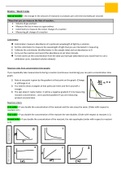
Reaction orders
Zero order = if you double the concentration of the reactant and the rate stays the same. (Order with respect to
reactant is 0.)
First order = if you double the concentration of the reactant the rate doubles. (Order with respect to reactant is 1).
Second order = if you double the concentration of the reactant, the rate quadruples (order with respect to reactant
is 2).
Concentration-time
Rate-concentration
, Monitoring the rate of reaction
• Continuous monitoring à taking step by step readings of the conc of “A” against time to form a rate-
concentration graph.
• Initial rates à used to find out how the initial rate changes as you vary the concentration of “A2
Experiment number [NO] (moldm-3) [CO] (moldm-3) [O2] (moldm-3) Initial rate
1 2.0 x 10⁻² 1.0 x 10⁻² 1.0 x 10⁻² 0.176
A A
2 4.0 x 10⁻² 1.0 x 10⁻² 1.0 x 10⁻² 0.704
3 2.0 x 10⁻² 2.0 x 10⁻² 1.0 x 10⁻² 0.176
B B
4 1.0 x 10⁻² 1.0 x 10⁻² 2.0 x 10⁻² 0.0440 C
A As concentration of NO doubles, the initial rate quadruples… so we can say that the rate of reaction is
second order in relation to the concentration of NO
B As the concentration of CO doubles, the rate of reaction stays the same… so the reaction is zero order in
relation to the concentration of CO.
C Concentration of NO has halved and the concentration of O2 has doubled… we know that the halve in
concentration of NO has halved the initial rate… so we can assume that the reaction is zero order in relation
to O2
Rate Constant à links reaction rates the reactant concentrations
• K = rate constant à the bigger it is the faster the reaction.
• M and N are the orders of the reaction in respect to reactant A and B.
Half-life = the time it takes for half of the reactant to be used up.
à if you know the half-life of a first order reaction you can use this equation:
Rate determining step = the slowest step in a multi-step reaction
à if a reactant appears in the rate equation… it must affect rate SO this reactant or something derived from it must
be in the rate determining step.
à if a reactant doesn’t appear in the rate equation, then it isn’t involved in the rate determining step.
• The rate determining step doesn’t have to be the first step in an equation.
• The reaction mechanism can’t usually be predicted from just the chemical equation.
•
à THE ORDER OF A REACTION WITH RESPECT TO A REACTANT SHOWS THE NUMBER OF MOLECULES OF THAT
REACTANT THAT ARE INVOLVED IN THE RATE DETERMINING STEP.
Rate of reaction = the change In the amount of reactants or products per unit time (normally per second)
Ways that you can measure the Rate of reaction…
• Volume of gas evolved
• Measure the loss in mass as a gas evolves
• Colorimetry to measure the colour change of a reaction
• Measuring pH change of a reaction
Colorimetry
è Colorimeters measure absorbance of a particular wavelength of light by a solution.
1) Set the colorimeter to measure the wavelength of light that you are interested in measuring
2) Calibrate the colorimeter (distilled water in the sample tube) and set absorbance to 0.
3) Carry out the reaction and record the absorbance at set time intervals.
è To then work out the concentration from the data you have got (absorbance) you would have to use a
calibration curve. (standard solution dataset)
Reaction rates from concentration-time graphs
If you repeatedly take measurements during a reaction (continuous monitoring) you can plot a concentration-time
graph.
1) Rate at any point is given by the gradient at that point on the graph. (Change
in y/Change in x)
2) You need to draw a tangent at that particular times and form yourself a
triangle.
3) The sign doesn’t really matter, it will be a negative gradient if it its measuring
reactant concentration… and a positive gradient if you are measuring
product concentration.
Reaction orders
Zero order = if you double the concentration of the reactant and the rate stays the same. (Order with respect to
reactant is 0.)
First order = if you double the concentration of the reactant the rate doubles. (Order with respect to reactant is 1).
Second order = if you double the concentration of the reactant, the rate quadruples (order with respect to reactant
is 2).
Concentration-time
Rate-concentration
, Monitoring the rate of reaction
• Continuous monitoring à taking step by step readings of the conc of “A” against time to form a rate-
concentration graph.
• Initial rates à used to find out how the initial rate changes as you vary the concentration of “A2
Experiment number [NO] (moldm-3) [CO] (moldm-3) [O2] (moldm-3) Initial rate
1 2.0 x 10⁻² 1.0 x 10⁻² 1.0 x 10⁻² 0.176
A A
2 4.0 x 10⁻² 1.0 x 10⁻² 1.0 x 10⁻² 0.704
3 2.0 x 10⁻² 2.0 x 10⁻² 1.0 x 10⁻² 0.176
B B
4 1.0 x 10⁻² 1.0 x 10⁻² 2.0 x 10⁻² 0.0440 C
A As concentration of NO doubles, the initial rate quadruples… so we can say that the rate of reaction is
second order in relation to the concentration of NO
B As the concentration of CO doubles, the rate of reaction stays the same… so the reaction is zero order in
relation to the concentration of CO.
C Concentration of NO has halved and the concentration of O2 has doubled… we know that the halve in
concentration of NO has halved the initial rate… so we can assume that the reaction is zero order in relation
to O2
Rate Constant à links reaction rates the reactant concentrations
• K = rate constant à the bigger it is the faster the reaction.
• M and N are the orders of the reaction in respect to reactant A and B.
Half-life = the time it takes for half of the reactant to be used up.
à if you know the half-life of a first order reaction you can use this equation:
Rate determining step = the slowest step in a multi-step reaction
à if a reactant appears in the rate equation… it must affect rate SO this reactant or something derived from it must
be in the rate determining step.
à if a reactant doesn’t appear in the rate equation, then it isn’t involved in the rate determining step.
• The rate determining step doesn’t have to be the first step in an equation.
• The reaction mechanism can’t usually be predicted from just the chemical equation.
•
à THE ORDER OF A REACTION WITH RESPECT TO A REACTANT SHOWS THE NUMBER OF MOLECULES OF THAT
REACTANT THAT ARE INVOLVED IN THE RATE DETERMINING STEP.

