Lecture 1
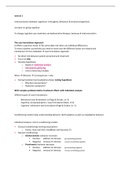
Interconnection between cognitions (=thoughts), Behaviors & emotions/cognitions
constant on-going cognition
To change cognition you could also use behavioral techniques, because of interconnection
The case formulation Approach
In DSM is a general cluster of the same label, but there are individual differences.
To treat a patient successfully you need to know how the different factors are related and
maintained for this individual → case formulation approach
➢ No direct link between patient presented and treatment
➢ Focus on why
➢ Develop hypothesis
o Based on individual analysis
o Information gathering
o Link to theoretical models
When → Behavior → Consequences + why
➢ During treatment and evaluation phase: testing hypothesis
o Effective interventions?
o Reduction symptoms?
With complex problems better treatment effects with individual analyses
Different types of case formulations:
- Behavioral case formulation vs (Page & Strizke, ch. 5)
- Cognitive conceptualization / case formulation (Beck, ch 3)
- Cognitive behavioral case formulation (Page & Strizke, ch. 5)
Conditioning models helps understanding behavior: Both adaptive as well as maladaptive behavior
Individual analyses: Link to conditioning models
➢ Classical conditioning: learning associations
o Pavlov, food, bell (UC), food&bell, bell becomes CS
➢ Operant conditioning:
o Reinforcement: behavior increases
▪ Positive: addition of stimulus get something positive
▪ Negative: removal of stimulus remove something negative
o Punishment: behavior decrease
▪ Positive: addition of stimulus get something negative
▪ Negative: removal of stimulus remove something positive
,Functional analyses: focus on the function of the problem / behavior → consequences of it
➔ Kijkt naar de functie van het gedrag: wat levert het op
Links to operant conditioning: a learning process through which the strength of a behavior (voluntary
behavior) is modified by reinforcement of punishment.
Focus on when it happens: always, or in certain situations? What defines the context where the
maladaptive behavior is present, vs absent? → antecedents = activating event, also called
discriminant stimulus = Sd
➢ 3 elements in functional analysis: Activating event – Behavior – Consequences (ABC).
(p. 63 Page & Strizke)
ANTECDENTS CAN BOTH BE EXTERNAL (comment from your boss) AND INTERNAL (depressed
feelings)
How to get input for a functional analysis:
➢ Ask the client, f.e. use topographical analyses (indirect assessment, Page Strizke, p. 65)
➢ Registration assignment for client
➢ Use your clinical knowledge and scientific knowledge of common antecedents (Sd) and
consequences of certain behavior.
Topographical analysis:
- Very detailed procedure where you talk about one event, go through it step by step.
- Preferably a recent event
- You can explain it to your patients as a procedure to really understand the problems. It is like
slowly playing a movie to see and understand every detail.
Get information on antecedents (Sd), behavior (B), and the consequences (C)
,Behavior:
➢ Verbal response, overt (yelling, complaining) or covert (worrying,counting)
➢ Psysiological response, heart rate, sweating
➢ Motor response, washing hands, hitting a person
Consequences, shortterm, midterm, longterm
, Lecture 2
Maladaptive behavior as a reaction will lead to a reinforcement of the core belief (+s-)
Only for short term it will be a positive consequence, f.e. less anxious feeling
Short term positive consequences: +S+, 0S-, -S-
Automatic thoughts are influenced by our (intermediate and core) beliefs.
Automatic thoughts Intermediate beliefs Core beliefs
Automatic thoughts
Words or images that come rapidly and spontaneously to mind to specific situations. It influences our
reactions [feelings and behaviors] to situations. Surface level thinking.
Presence of very strong emotions that are not logically related to the event in case.
Depression: Hopelessness low self esteem
Predictions of danger, harm, or incontrollability to manage threats.
Intermediate thoughts
Often unarticulated beliefs that guide our behavior, set our standards and establish rules for living.
“If…then…” or “
Core beliefs
Absolute fundamental convictions about yourself, the world and others, which are based on
experiences or onmet emotional core needs as we grow up. They are also grounded that they are
regarded as absolute underlying deeper truth and apply to situations in general.
Helpless, worthless, unlovable.
Clients benefit more from identifying general concept, schemas or core beliefs. They a strong
influence on selfbelief and behavior. Goal in CBT: identify maladaptive schemas and
Relationship schema and automatic thoughts: detailed in stress diathesis stress model.
Maladaptive schema may remain dormant until a stressful life events occurs that triggers core belief.
Maladaptive schema stimulates and drives the more automatic thoughts.
Identifying automatic thoughts:
Mood shifts
o Thought patterns that are linked to emotional expression offer rich opportunities for
drawing out some of the most important automatic thoughts and schemas
o Impact of emotional memory
With secondary emotions, always address the secondary emotion first, because it covers the first
emotions.
Interconnection between cognitions (=thoughts), Behaviors & emotions/cognitions
constant on-going cognition
To change cognition you could also use behavioral techniques, because of interconnection
The case formulation Approach
In DSM is a general cluster of the same label, but there are individual differences.
To treat a patient successfully you need to know how the different factors are related and
maintained for this individual → case formulation approach
➢ No direct link between patient presented and treatment
➢ Focus on why
➢ Develop hypothesis
o Based on individual analysis
o Information gathering
o Link to theoretical models
When → Behavior → Consequences + why
➢ During treatment and evaluation phase: testing hypothesis
o Effective interventions?
o Reduction symptoms?
With complex problems better treatment effects with individual analyses
Different types of case formulations:
- Behavioral case formulation vs (Page & Strizke, ch. 5)
- Cognitive conceptualization / case formulation (Beck, ch 3)
- Cognitive behavioral case formulation (Page & Strizke, ch. 5)
Conditioning models helps understanding behavior: Both adaptive as well as maladaptive behavior
Individual analyses: Link to conditioning models
➢ Classical conditioning: learning associations
o Pavlov, food, bell (UC), food&bell, bell becomes CS
➢ Operant conditioning:
o Reinforcement: behavior increases
▪ Positive: addition of stimulus get something positive
▪ Negative: removal of stimulus remove something negative
o Punishment: behavior decrease
▪ Positive: addition of stimulus get something negative
▪ Negative: removal of stimulus remove something positive
,Functional analyses: focus on the function of the problem / behavior → consequences of it
➔ Kijkt naar de functie van het gedrag: wat levert het op
Links to operant conditioning: a learning process through which the strength of a behavior (voluntary
behavior) is modified by reinforcement of punishment.
Focus on when it happens: always, or in certain situations? What defines the context where the
maladaptive behavior is present, vs absent? → antecedents = activating event, also called
discriminant stimulus = Sd
➢ 3 elements in functional analysis: Activating event – Behavior – Consequences (ABC).
(p. 63 Page & Strizke)
ANTECDENTS CAN BOTH BE EXTERNAL (comment from your boss) AND INTERNAL (depressed
feelings)
How to get input for a functional analysis:
➢ Ask the client, f.e. use topographical analyses (indirect assessment, Page Strizke, p. 65)
➢ Registration assignment for client
➢ Use your clinical knowledge and scientific knowledge of common antecedents (Sd) and
consequences of certain behavior.
Topographical analysis:
- Very detailed procedure where you talk about one event, go through it step by step.
- Preferably a recent event
- You can explain it to your patients as a procedure to really understand the problems. It is like
slowly playing a movie to see and understand every detail.
Get information on antecedents (Sd), behavior (B), and the consequences (C)
,Behavior:
➢ Verbal response, overt (yelling, complaining) or covert (worrying,counting)
➢ Psysiological response, heart rate, sweating
➢ Motor response, washing hands, hitting a person
Consequences, shortterm, midterm, longterm
, Lecture 2
Maladaptive behavior as a reaction will lead to a reinforcement of the core belief (+s-)
Only for short term it will be a positive consequence, f.e. less anxious feeling
Short term positive consequences: +S+, 0S-, -S-
Automatic thoughts are influenced by our (intermediate and core) beliefs.
Automatic thoughts Intermediate beliefs Core beliefs
Automatic thoughts
Words or images that come rapidly and spontaneously to mind to specific situations. It influences our
reactions [feelings and behaviors] to situations. Surface level thinking.
Presence of very strong emotions that are not logically related to the event in case.
Depression: Hopelessness low self esteem
Predictions of danger, harm, or incontrollability to manage threats.
Intermediate thoughts
Often unarticulated beliefs that guide our behavior, set our standards and establish rules for living.
“If…then…” or “
Core beliefs
Absolute fundamental convictions about yourself, the world and others, which are based on
experiences or onmet emotional core needs as we grow up. They are also grounded that they are
regarded as absolute underlying deeper truth and apply to situations in general.
Helpless, worthless, unlovable.
Clients benefit more from identifying general concept, schemas or core beliefs. They a strong
influence on selfbelief and behavior. Goal in CBT: identify maladaptive schemas and
Relationship schema and automatic thoughts: detailed in stress diathesis stress model.
Maladaptive schema may remain dormant until a stressful life events occurs that triggers core belief.
Maladaptive schema stimulates and drives the more automatic thoughts.
Identifying automatic thoughts:
Mood shifts
o Thought patterns that are linked to emotional expression offer rich opportunities for
drawing out some of the most important automatic thoughts and schemas
o Impact of emotional memory
With secondary emotions, always address the secondary emotion first, because it covers the first
emotions.