TDC – Meyers (lecture 2) 1
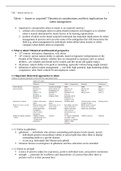
Talent — Innate or acquired? Theoretical considerations and their implications for
talent management
important to conceptualize talent as innate vs an acquired construct
1. scholars who investigate talent or talent-related constructs still disagree as to whether
talent is mainly determined by innate factors or by learning opportunities
2. position of talent on the innate-acquired continuum has important implications for talent
management in practice and can solve some of the ambiguities that still characterize the
field (e.g. talent management for individuals (when define talent innate) or whole
company (when define talent as acquired))
1. What is talent? Historical and theoretical perspective
13th century: inclination, disposition, will, desire
14th century: special natural ability or aptitude, based on figurative interpretations of the
Parable of the Talents (talents- whether they are interpreted as monetary units or natural
abilities—are valuable and should not be wasted, and this moral still applies today)
dictionary: natural ability to be good at something, especially without being taught (innate)
definition of talent in talent management → one field: high potential, high leadership ability,
competence; other field: cultural fit and employees values
1.1 Important theoretical approaches to talent
1.1.1 Talent as giftedness
giftedness → individuals who achieve outstanding performance levels (sports, music)
◦ individuals possess extraordinary talents or special gifts that allow them to display
outstanding skills in a specific domain
◦ is rare (e.g. individuals like Mozart truly gifted)
literature focuses on emergence of giftedness and how education can be amended
1.1.2 Talent as strength
science of positive subjective experience, positive individual traits, and positive institutions
strength → potentials for excellence and characteristic of a person that allow them to
perform well or at their personal best
, TDC – Meyers (lecture 2) 2
◦ partly innate but can be developed to some extent
◦ examples: creativity, kindness, prudence, gratitude, justice
every individual possesses certain strengths and that the use thereof is accompanied by
positive feelings such as invigoration, high energy, intrinsic motivation, authenticity, and
self-fulfillment → studied in diverse contexts
1.1.3 Talent as (meta-) competencies
competence: measurable human capability required for effective performance → behavioral
manifestation of talent
building blocks knowledge, skills, abilities, and personal or other characteristics →
knowledge and skills can be developed by most people; abilities and personal characteristics
rather stable
acquisition of competencies gets influenced by powerful, higher-level competencies,
referred to as meta-competencies → meta-competences construct that facilitates individual
learning, adaptability, and development
◦ examples: general and emotional intelligence
1.1.4 Talent as high potential
potential most common in context of talent development and strategic HRM
potential: possibility that individuals can become something more than what they currently
are → is latent and not visible (innate basis but has to be developed to become manifest in
outstanding performance)
scare individual feature
1.1.5 Talent as high performance
talent as construct that becomes manifest in present actions and behaviors (performance)
talent: realized outputs, and not, as in other approaches to talent, by the inputs that are
necessary to achieve a certain output (e.g., knowledge, skills, and abilities)
most agree that talent manifests in performance
2. Main arguments supporting different perspectives on the nature of talent
perspectives on a continuum
Talent — Innate or acquired? Theoretical considerations and their implications for
talent management
important to conceptualize talent as innate vs an acquired construct
1. scholars who investigate talent or talent-related constructs still disagree as to whether
talent is mainly determined by innate factors or by learning opportunities
2. position of talent on the innate-acquired continuum has important implications for talent
management in practice and can solve some of the ambiguities that still characterize the
field (e.g. talent management for individuals (when define talent innate) or whole
company (when define talent as acquired))
1. What is talent? Historical and theoretical perspective
13th century: inclination, disposition, will, desire
14th century: special natural ability or aptitude, based on figurative interpretations of the
Parable of the Talents (talents- whether they are interpreted as monetary units or natural
abilities—are valuable and should not be wasted, and this moral still applies today)
dictionary: natural ability to be good at something, especially without being taught (innate)
definition of talent in talent management → one field: high potential, high leadership ability,
competence; other field: cultural fit and employees values
1.1 Important theoretical approaches to talent
1.1.1 Talent as giftedness
giftedness → individuals who achieve outstanding performance levels (sports, music)
◦ individuals possess extraordinary talents or special gifts that allow them to display
outstanding skills in a specific domain
◦ is rare (e.g. individuals like Mozart truly gifted)
literature focuses on emergence of giftedness and how education can be amended
1.1.2 Talent as strength
science of positive subjective experience, positive individual traits, and positive institutions
strength → potentials for excellence and characteristic of a person that allow them to
perform well or at their personal best
, TDC – Meyers (lecture 2) 2
◦ partly innate but can be developed to some extent
◦ examples: creativity, kindness, prudence, gratitude, justice
every individual possesses certain strengths and that the use thereof is accompanied by
positive feelings such as invigoration, high energy, intrinsic motivation, authenticity, and
self-fulfillment → studied in diverse contexts
1.1.3 Talent as (meta-) competencies
competence: measurable human capability required for effective performance → behavioral
manifestation of talent
building blocks knowledge, skills, abilities, and personal or other characteristics →
knowledge and skills can be developed by most people; abilities and personal characteristics
rather stable
acquisition of competencies gets influenced by powerful, higher-level competencies,
referred to as meta-competencies → meta-competences construct that facilitates individual
learning, adaptability, and development
◦ examples: general and emotional intelligence
1.1.4 Talent as high potential
potential most common in context of talent development and strategic HRM
potential: possibility that individuals can become something more than what they currently
are → is latent and not visible (innate basis but has to be developed to become manifest in
outstanding performance)
scare individual feature
1.1.5 Talent as high performance
talent as construct that becomes manifest in present actions and behaviors (performance)
talent: realized outputs, and not, as in other approaches to talent, by the inputs that are
necessary to achieve a certain output (e.g., knowledge, skills, and abilities)
most agree that talent manifests in performance
2. Main arguments supporting different perspectives on the nature of talent
perspectives on a continuum