Healthy Psychology – Park (Lecture 4)
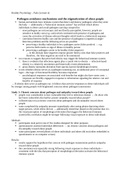
Pathogen-avoidance mechanisms and the stigmatization of obese people
human and animals have immune system that detect and destroy pathogens when they enter
the body → additionally a “behavioral immune system” has evolved which allows
individuals to detect and avoid pathogen-carrying conspecifics
◦ most pathogens are microscopic and not directly perceptible, however, people are
sensitive to bodily cues (e.g. rash) which correlated with presence of pathogens and
cause the activation of disease-relevant thoughts which leads to a behavioral response
◦ correlation between bodily cues and the presence of pathogens is imperfect (single-
detection problem) and the following errors are possible:
▪ perceiving a healthy individual to be a pathogen carrier (false positive) → e.g.
perceive birth marks as sign of illness in healthy person
▪ perceiving a pathogen carrier to be healthy (false negative)
→ in this domain false negatives impose greater fitness costs than false positives and
therefore, the false negatives are tried to be minimized
two reasons to suggest that perceived obesity may trigger the behavioral immune system:
1. there is evidence that infectious agents play a causal role in obesity → infection-based
obesity is a relatively uncommon and historically recent phenomenon
2. gross obesity represents deviation from species-typical morphological norms
to test whether obesity serves as a pathogen connoting cue, an additional piece of conceptual
logic—the logic of functional flexibility becomes important
◦ psychological responses are associated with benefits but might also have some costs →
responses are flexibly engaged in response to information signaling the relative cost and
benefits of response
→ If obesity does serve as pathogen cue, it follows that aversive responses to obese individuals will
be stronger among people with heightened concerns about pathogen transmission
Study 1: Chronic concerns about pathogen and antipathy toward obese people
people vary considerably in how vulnerable they feel to infectious disease → Do those who
feel more vulnerable also harbor greater antipathy toward obese people?
collected data on (a) chronic concerns about pathogens and (b) antipathy toward obese
people
some completed the antipathy measure immediately after seeing photos depicting obese
target persons, while others did not → additionally tested that (based on the premise that it is
the visual perception of morphological deviation that triggers the behavioral immune
system) this correlation might be stronger following visual exposure to obese individuals
Methods:
participants took part in one of five studies designed for other purposes
questionnaires assessed individual differences → (a) chronic concerns about pathogens and
(b) antipathy toward obese people
some participants viewed photos of obese individuals and others did not (either embedded in
questionnaire or on computer screen)
Results:
results support the hypothesis that concern with pathogen transmission predicts antipathy
toward obese people
the correlation was especially strong following visual exposure to obese individuals—
consistent with the idea that perception of morphological deviation activates the behavioral
immune system
Pathogen-avoidance mechanisms and the stigmatization of obese people
human and animals have immune system that detect and destroy pathogens when they enter
the body → additionally a “behavioral immune system” has evolved which allows
individuals to detect and avoid pathogen-carrying conspecifics
◦ most pathogens are microscopic and not directly perceptible, however, people are
sensitive to bodily cues (e.g. rash) which correlated with presence of pathogens and
cause the activation of disease-relevant thoughts which leads to a behavioral response
◦ correlation between bodily cues and the presence of pathogens is imperfect (single-
detection problem) and the following errors are possible:
▪ perceiving a healthy individual to be a pathogen carrier (false positive) → e.g.
perceive birth marks as sign of illness in healthy person
▪ perceiving a pathogen carrier to be healthy (false negative)
→ in this domain false negatives impose greater fitness costs than false positives and
therefore, the false negatives are tried to be minimized
two reasons to suggest that perceived obesity may trigger the behavioral immune system:
1. there is evidence that infectious agents play a causal role in obesity → infection-based
obesity is a relatively uncommon and historically recent phenomenon
2. gross obesity represents deviation from species-typical morphological norms
to test whether obesity serves as a pathogen connoting cue, an additional piece of conceptual
logic—the logic of functional flexibility becomes important
◦ psychological responses are associated with benefits but might also have some costs →
responses are flexibly engaged in response to information signaling the relative cost and
benefits of response
→ If obesity does serve as pathogen cue, it follows that aversive responses to obese individuals will
be stronger among people with heightened concerns about pathogen transmission
Study 1: Chronic concerns about pathogen and antipathy toward obese people
people vary considerably in how vulnerable they feel to infectious disease → Do those who
feel more vulnerable also harbor greater antipathy toward obese people?
collected data on (a) chronic concerns about pathogens and (b) antipathy toward obese
people
some completed the antipathy measure immediately after seeing photos depicting obese
target persons, while others did not → additionally tested that (based on the premise that it is
the visual perception of morphological deviation that triggers the behavioral immune
system) this correlation might be stronger following visual exposure to obese individuals
Methods:
participants took part in one of five studies designed for other purposes
questionnaires assessed individual differences → (a) chronic concerns about pathogens and
(b) antipathy toward obese people
some participants viewed photos of obese individuals and others did not (either embedded in
questionnaire or on computer screen)
Results:
results support the hypothesis that concern with pathogen transmission predicts antipathy
toward obese people
the correlation was especially strong following visual exposure to obese individuals—
consistent with the idea that perception of morphological deviation activates the behavioral
immune system