

Summary lectures Consumer Behaviour
Lecture 2
Properties of associations
- Reciprocal associations – category evokes brand; but does a brand evoke the
category?
- Interconnecting associations – used to improve consistency and brand image
Model of spreading activation
Knowledge accessibility depends on:
a) Frequency of concept activation
b) Recency of concept activation
c) Number of associations
Models of learning
Cognitive learning: Learning by engaging in mental processes:
- Repetition
- Mnemonics (ezelsbruggetjes)
- Elaboration
Classical conditioning – Learning by repeated pairing (Pavlov’s studies)
Evaluative conditioning (based on classical conditioning) – Repeated pairing of objects with
affective stimuli (f.e. celebrities), resulting in transfer of affect from stimulus to object
Operant conditioning (also instrumental learning or trial and error learning) – Learning
behavior by trial and error
Modeling – Learning by observing the actions of others (models), and the reward/punishment
they receive. Important factors in modeling:
- Attractiveness of the model (prestige, competence)
- Similarity of model to self
- Ability to reproduce observed behavior (may be increased by imagining being in
his/her shoes
Forgetting
Results from:
, - Decay – Pathway to the information fades over time when associations are not
renewed
- Interference – New information about the same topic may reduce the ability to
retrieve the original information
Reconstructive memory
When we retrieve information from memory, we may be reconstructing the memory instead
of recalling the factual information.
Reconstructive memory – The integration of different sources of information in remembering
(actual information, accessible cues).
Summary
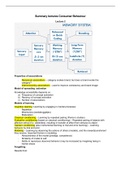
- Sensory memory has a very short duration, just long enough to organize stimuli, and
recognize the environment. Working (short term) memory has a slightly longer
duration, but a limited capacity. Long-term memory has an unlimited duration.
- Information is stored in long-term memory in associative networks.
- Secondary, reciprocal and interconnecting associations are desirable properties of
category (brand) associations.
- Learning involves transferring information from short term to long term memory.
- Memory is fluid not fixed: remembering involves reconstruction
Lecture 3
Where do goals and needs come from?
- Innate – We have been born with them
- Learned – See operant conditioning
Properties of goal systems
Equifinality – A single goal is associated with multiple means
Multifinality – Multiple goals are associated with a single means
Effect of multifinality on perceived value
Dilution effect – Decreased perception of instrumentality of the multifinal means with respect
to each goal
Multiple selves
Ideal self – A person’s conception of how he or she would like to be
Actual self – A person’s realistic appraisal of the qualities he or she does and does not
possess
Ought self – A person’ s conception of how he or she should be
Summary
- Needs involve a gap between actual and desired states. This gap is felt as discomfort
and creates tension. Tension in turn motivates individuals to behave in ways that can
reduce or eliminate the gap.
- Goals are represented in memory as knowledge structures and hence abide the
same principles that govern all cognitions.
- Goals can be chronically or temporarily activated and the consumer may or may not
consciously pursue them.
- The self-concept is a knowledge structure in memory that includes traits, values,
goals, social roles, etc.
- Consumers like to associate themselves with products whose image is congruent with
our actual or desired self-image.
- Consumers are motivated to maintain a positive self-evaluation. When their self-
evaluation is undermined, they are motivated to restore it. People use products to
Lecture 2
Properties of associations
- Reciprocal associations – category evokes brand; but does a brand evoke the
category?
- Interconnecting associations – used to improve consistency and brand image
Model of spreading activation
Knowledge accessibility depends on:
a) Frequency of concept activation
b) Recency of concept activation
c) Number of associations
Models of learning
Cognitive learning: Learning by engaging in mental processes:
- Repetition
- Mnemonics (ezelsbruggetjes)
- Elaboration
Classical conditioning – Learning by repeated pairing (Pavlov’s studies)
Evaluative conditioning (based on classical conditioning) – Repeated pairing of objects with
affective stimuli (f.e. celebrities), resulting in transfer of affect from stimulus to object
Operant conditioning (also instrumental learning or trial and error learning) – Learning
behavior by trial and error
Modeling – Learning by observing the actions of others (models), and the reward/punishment
they receive. Important factors in modeling:
- Attractiveness of the model (prestige, competence)
- Similarity of model to self
- Ability to reproduce observed behavior (may be increased by imagining being in
his/her shoes
Forgetting
Results from:
, - Decay – Pathway to the information fades over time when associations are not
renewed
- Interference – New information about the same topic may reduce the ability to
retrieve the original information
Reconstructive memory
When we retrieve information from memory, we may be reconstructing the memory instead
of recalling the factual information.
Reconstructive memory – The integration of different sources of information in remembering
(actual information, accessible cues).
Summary
- Sensory memory has a very short duration, just long enough to organize stimuli, and
recognize the environment. Working (short term) memory has a slightly longer
duration, but a limited capacity. Long-term memory has an unlimited duration.
- Information is stored in long-term memory in associative networks.
- Secondary, reciprocal and interconnecting associations are desirable properties of
category (brand) associations.
- Learning involves transferring information from short term to long term memory.
- Memory is fluid not fixed: remembering involves reconstruction
Lecture 3
Where do goals and needs come from?
- Innate – We have been born with them
- Learned – See operant conditioning
Properties of goal systems
Equifinality – A single goal is associated with multiple means
Multifinality – Multiple goals are associated with a single means
Effect of multifinality on perceived value
Dilution effect – Decreased perception of instrumentality of the multifinal means with respect
to each goal
Multiple selves
Ideal self – A person’s conception of how he or she would like to be
Actual self – A person’s realistic appraisal of the qualities he or she does and does not
possess
Ought self – A person’ s conception of how he or she should be
Summary
- Needs involve a gap between actual and desired states. This gap is felt as discomfort
and creates tension. Tension in turn motivates individuals to behave in ways that can
reduce or eliminate the gap.
- Goals are represented in memory as knowledge structures and hence abide the
same principles that govern all cognitions.
- Goals can be chronically or temporarily activated and the consumer may or may not
consciously pursue them.
- The self-concept is a knowledge structure in memory that includes traits, values,
goals, social roles, etc.
- Consumers like to associate themselves with products whose image is congruent with
our actual or desired self-image.
- Consumers are motivated to maintain a positive self-evaluation. When their self-
evaluation is undermined, they are motivated to restore it. People use products to

