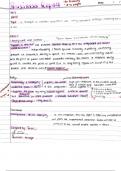
Loftus and Palmer’s study
Overall aim for both studies was to test whether the phrasing of a questions about
car accidents could alter participant’s memory of event
Study 1:
Aim was to see whether using different verbs to describe a car crash would affect the
estimation of the speed at which the cars were travelling
Method:
45 participants took part in this experiment
No details of age or gender were recorded
This was a lab experiment (controlled conditions) therefore lacked ecological validity
Procedure:
Seven car crash films were shown taken from training films used by Seattle PD and
Evergreen Safety Council.
In 4 videos, the speeds were known because crashes were staged for training
purpose (20,30,40 and 40 mph)
Participants were then asked to write down an account of the accident and answer
questions
Filler questions (irrelevant questions slide into a self report to disguise aim of
experiment ) were used.
Other question was a critical question (closely concerned with the aim of the study.
This question was ‘About how fast were the cars going when they hit each other?’
Independent variable was verb used: ‘hit’, ‘contacted’, ‘bumped’, ‘collided’,
‘smashed’.
Results:
Results were in form of quantitative data as participants estimated speed at which
car was going.
Results show that estimated speed was not affected by actual speed and estimation
was generally poor and not accurate
Order of words with highest estimated speeds were: smashed (40.1 mph), collided,
bumped, hit, contacted (31.8 mph)
Conclusions:
Response bias: When a participant is unclear what speed to estimate so verb give
them a clue whether to estimate high or low
Memory distortion: Verb used in question alters participants memory of crash
, Study 2:
Aim was to investigate whether speed estimates found in study 1 were a result of
distorted memory.
This was done by seeing whether participants who heard the words associated with
high speed would be more likely to incorrectly remember broken glass at crash site
compared with words associated with lower speeds.
Method:
150 students took part in experiment
No details of age or gender were recorded
This was a lab experiment
Procedure:
All participants watched a film of a car crash lasting less than a minute and accident
lasting 4 seconds
They were given a questionnaire that asked to describe accident and then answer
series of questions
The first 50 participants received critical question being: ‘About how fast was the car
going when they smashed into each other?’
Another 50 had: ‘About how fast was the car going when they hit each other?’
Final 50 were a control group that were not asked questions about speed of car
A week later, they returned and answered 10 questions, critical question being ‘Did
you see any broken glass?’
Results:
Participants who heard the word ‘smashed’ were more than twice more likely to
have answered yes than hearing the word ‘hit’
Smashed (16 answered yes), hit (7 answered yes) and control (6 answered yes)
Conclusions:
Wording of a question can distort memory
Remembrance of events isn’t just response bias but mainly memory distortion
Grant’s study
The aim was to test the effect of noise as a source of context on the studying and
retrieval of meaningful material
Overall aim for both studies was to test whether the phrasing of a questions about
car accidents could alter participant’s memory of event
Study 1:
Aim was to see whether using different verbs to describe a car crash would affect the
estimation of the speed at which the cars were travelling
Method:
45 participants took part in this experiment
No details of age or gender were recorded
This was a lab experiment (controlled conditions) therefore lacked ecological validity
Procedure:
Seven car crash films were shown taken from training films used by Seattle PD and
Evergreen Safety Council.
In 4 videos, the speeds were known because crashes were staged for training
purpose (20,30,40 and 40 mph)
Participants were then asked to write down an account of the accident and answer
questions
Filler questions (irrelevant questions slide into a self report to disguise aim of
experiment ) were used.
Other question was a critical question (closely concerned with the aim of the study.
This question was ‘About how fast were the cars going when they hit each other?’
Independent variable was verb used: ‘hit’, ‘contacted’, ‘bumped’, ‘collided’,
‘smashed’.
Results:
Results were in form of quantitative data as participants estimated speed at which
car was going.
Results show that estimated speed was not affected by actual speed and estimation
was generally poor and not accurate
Order of words with highest estimated speeds were: smashed (40.1 mph), collided,
bumped, hit, contacted (31.8 mph)
Conclusions:
Response bias: When a participant is unclear what speed to estimate so verb give
them a clue whether to estimate high or low
Memory distortion: Verb used in question alters participants memory of crash
, Study 2:
Aim was to investigate whether speed estimates found in study 1 were a result of
distorted memory.
This was done by seeing whether participants who heard the words associated with
high speed would be more likely to incorrectly remember broken glass at crash site
compared with words associated with lower speeds.
Method:
150 students took part in experiment
No details of age or gender were recorded
This was a lab experiment
Procedure:
All participants watched a film of a car crash lasting less than a minute and accident
lasting 4 seconds
They were given a questionnaire that asked to describe accident and then answer
series of questions
The first 50 participants received critical question being: ‘About how fast was the car
going when they smashed into each other?’
Another 50 had: ‘About how fast was the car going when they hit each other?’
Final 50 were a control group that were not asked questions about speed of car
A week later, they returned and answered 10 questions, critical question being ‘Did
you see any broken glass?’
Results:
Participants who heard the word ‘smashed’ were more than twice more likely to
have answered yes than hearing the word ‘hit’
Smashed (16 answered yes), hit (7 answered yes) and control (6 answered yes)
Conclusions:
Wording of a question can distort memory
Remembrance of events isn’t just response bias but mainly memory distortion
Grant’s study
The aim was to test the effect of noise as a source of context on the studying and
retrieval of meaningful material