Name: __________ Date_____________
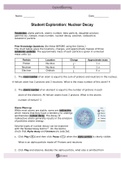
Student Exploration: Nuclear Decay
Vocabulary: alpha particle, atomic number, beta particle, daughter product,
gamma ray, isotope, mass number, nuclear decay, positron, radioactive,
subatomic particle
Prior Knowledge Questions (Do these BEFORE using the Gizmo.)
The chart below gives the locations, charges, and approximate masses of three
subatomic particles. The approximate mass of each particle is given in universal
mass units (u).
Particle Location Charge Approximate mass
Proton Nucleus 1+ 1u
Neutron Nucleus 0 1u
Electron Orbitals 1– 0u
1. The mass number of an atom is equal to the sum of protons and neutrons in the nucleus.
A helium atom has 2 protons and 2 neutrons. What is the mass number of this atom? 4
2. The atomic number of an element is equal to the number of protons in each
atom of the element. All helium atoms have 2 protons. What is the atomic
number of helium? 2
Gizmo Warm-up
While most atoms are stable, some are radioactive,
which means that they have a tendency to undergo
spontaneous nuclear decay. The decay of
radioactive atoms generally results in the emission
of particles and/or energy.
Several types of nuclear decay can be explored
with the Nuclear Decay Gizmo™. On the Gizmo,
check that Alpha decay and Uranium are selected.
1. Click Play ( ) and then click Pause ( ) when the alpha particle is clearly visible.
What is an alpha particle made of? Protons and neutrons
2. Click Play and observe. Besides the alpha particle, what else is emitted from
, the nucleus during alpha decay? Gamma rays
Gamma rays are energetic electromagnetic waves; they are often emitted in nuclear decay.
Student Exploration: Nuclear Decay
Vocabulary: alpha particle, atomic number, beta particle, daughter product,
gamma ray, isotope, mass number, nuclear decay, positron, radioactive,
subatomic particle
Prior Knowledge Questions (Do these BEFORE using the Gizmo.)
The chart below gives the locations, charges, and approximate masses of three
subatomic particles. The approximate mass of each particle is given in universal
mass units (u).
Particle Location Charge Approximate mass
Proton Nucleus 1+ 1u
Neutron Nucleus 0 1u
Electron Orbitals 1– 0u
1. The mass number of an atom is equal to the sum of protons and neutrons in the nucleus.
A helium atom has 2 protons and 2 neutrons. What is the mass number of this atom? 4
2. The atomic number of an element is equal to the number of protons in each
atom of the element. All helium atoms have 2 protons. What is the atomic
number of helium? 2
Gizmo Warm-up
While most atoms are stable, some are radioactive,
which means that they have a tendency to undergo
spontaneous nuclear decay. The decay of
radioactive atoms generally results in the emission
of particles and/or energy.
Several types of nuclear decay can be explored
with the Nuclear Decay Gizmo™. On the Gizmo,
check that Alpha decay and Uranium are selected.
1. Click Play ( ) and then click Pause ( ) when the alpha particle is clearly visible.
What is an alpha particle made of? Protons and neutrons
2. Click Play and observe. Besides the alpha particle, what else is emitted from
, the nucleus during alpha decay? Gamma rays
Gamma rays are energetic electromagnetic waves; they are often emitted in nuclear decay.