MST – 21306
Advanced Management and Marketing
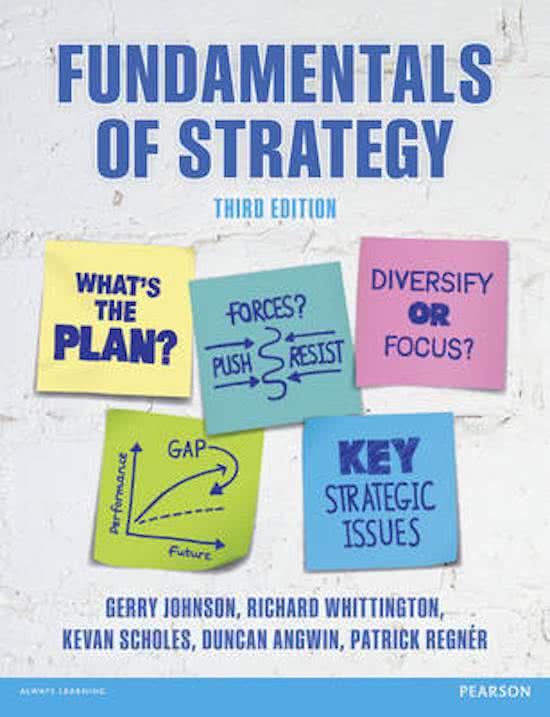
Fundamentals of Strategy (Management)
Chapter 1: Introducing Strategy
Strategy is the long-term direction of an organisation. It includes both deliberate, logical
strategy and more incremental, emergent patterns of strategy. It also includes both strategies
that emphasise difference and competition, and strategies that recognise the roles of
cooperation and even imitation.
1. Chandler: ‘the determination of the long-run goals and objectives of an enterprise
and the adoption of courses of action and the allocation of resource necessary for
carrying out these goals’
2. Porter: ‘competitive strategy is about being different. It means deliberately choosing a
different set of activities to deliver a unique mix of value’
3. Mintzberg: ‘a pattern in a stream of decisions’
Exploring strategy: the long term of an organisation.
The three elements of the strategy definition:
1. The long term: strategies are typically measured over years or more. The three-
horizons framework suggests organisations should think of themselves as
comprising three types of business or activity, defined by their horizons in terms of
years. Strategy involves pushing out horizon 1 as far as possible, at the same time as
looking to horizons 2 and 3.
Horizon 1: businesses are basically
the current core activities (extend
and defend the core business). In
the long term they will be flat or
declining in terms of profits.
Horizon 2: businesses are emerging
activities that should provide new
sources of profit (build emerging
businesses).
Horizon 3: nothing is sure (create
viable options).
2. Strategic direction: managers try to set the
direction of their strategy according to long-
term objectives, these are not always profit
related.
3. Organisation: organisations have always many internal (the people involved and
their different interests and views) and external (suppliers, customers, investors, etc.)
stakeholders, it is important to look at all those stakeholders.
Levels of strategy: each level need to be aligned with the others.
Corporate-level strategy is concerned with the overall scope of an organisation and
how value is added to the constituent businesses of the organisational whole. It
includes geographical scope, diversity of products or services, acquisitions of new
businesses and how resources are allocated between the different elements of the
organisation.
Business-level strategy is about how the individual business should compete in
their particular markets (competitive strategy). It concerns issues as innovation,
appropriate scale and response to competitors’ moves.
Operational strategies are concerned with how the components of an organisation
deliver effectively the corporate- and business-level strategies in terms of resources,
processes and people.
,Corporate strategy Operational strategy
Organisation-wide, holistic Routinized
Conceptualisation of issues Techniques and actions
Creating new directions Managing existing resources
Developing new resources Operating within existing strategy
Ambiguous/uncertain Operationally specific
Long term orientation Day to day issues
A strategy statement should have three main themes, it should not be no more than 35
words long:
1. The fundamental goals (mission, vision or objectives) that the organisation seeks.
Mission is the overriding purpose of the organisation, ‘What business are we in?’.
Vision refers to the desired future state of the organisation, ‘What do we want to
achieve?’. Objectives are more precise statements of the organisation’s goals overt
some period of time, ‘What do we have to achieve in the coming period?’
2. The scope or domain of the organisation’s activities. The internal activities of the
company. An organisation’s scope or domain refers to three dimensions: customers
or clients; geographical location; and extend of internal activities vertical
integration.
3. The particular advantages or capabilities it has to deliver all of these.
Advantages is a part of a strategy statement that describes how the organisation will
achieve the objectives it has set for itself in its chosen domain, and how it will be
better than their competitors. How the organisation will achieve the objectives set
regarding its chosen scope.
The exploring strategy model includes understanding the strategic position of an
organisation, assessing strategic choices for the future and managing strategy in action.
Position, choices and action should be seen as closely related, and in practice none has
priority over another.
The strategic position is concerned with the impact on strategy of the external
environment, the organisation’s strategic capability (resources (machines and
building) and competences (technical and managerial skills)), purpose and culture.
Strategic choices involve the options for strategy in terms of both the direction in
which strategy might move and the methods by which strategy might be pursued.
o Business strategy: strategic choices in terms of how the organisation seeks to
compete at the individual business level, ‘How should the business unit
compete?’
o Corporate strategy and diversification
o International strategy: ‘Where internationally should the organisation
compete?’
o Innovation strategy: most organisations have to innovate constantly to survive,
‘Is the organisation innovating and how should it respond to the innovations of
competitors?’
, oAcquisitions and alliances: ‘Whether to
buy another company, ally or to go it
alone?’
Strategy in action is concerned with how
chosen strategies are actually put into practice,
there are three key issues:
o Structuring an organisation to support
successful performance
o Systems are required to control the way
in which strategy is implemented
o Leading strategic change is an important
part of putting strategy into action
But strategies do not always develop in a logical
sequence of analysis, choice and action. Here are two
broad accounts of strategy development:
The rational-analytic view of strategy development is the conventional account. Strategies
are developed through rational and analytical processes, led by top managers, the processes
result in a strategic plan. The strategic plan begins with the statements of the overall strategy
and mission, vision and objectives. Then the environmental and capability analysis. Next a
range of strategic options will be evaluated. And finally the resources have to be put in place
and addressing the key change processes. The strategies are intended, the product of
deliberate choices, associated with Chandler and Porter.
The emergent strategy view is the alternative broad explanation of how strategies develop.
In this view, strategies often do not simply develop as intended or planned, but tend to
emerge in organisations over time as a result of ad hoc, incremental or even accidental
actions. This emergent view is associated with Mintzberg.
Strategic analyses: linear, rational-analytic view of strategy development VS non-linear,
emergent view of strategy development
Advanced Management and Marketing
Fundamentals of Strategy (Management)
Chapter 1: Introducing Strategy
Strategy is the long-term direction of an organisation. It includes both deliberate, logical
strategy and more incremental, emergent patterns of strategy. It also includes both strategies
that emphasise difference and competition, and strategies that recognise the roles of
cooperation and even imitation.
1. Chandler: ‘the determination of the long-run goals and objectives of an enterprise
and the adoption of courses of action and the allocation of resource necessary for
carrying out these goals’
2. Porter: ‘competitive strategy is about being different. It means deliberately choosing a
different set of activities to deliver a unique mix of value’
3. Mintzberg: ‘a pattern in a stream of decisions’
Exploring strategy: the long term of an organisation.
The three elements of the strategy definition:
1. The long term: strategies are typically measured over years or more. The three-
horizons framework suggests organisations should think of themselves as
comprising three types of business or activity, defined by their horizons in terms of
years. Strategy involves pushing out horizon 1 as far as possible, at the same time as
looking to horizons 2 and 3.
Horizon 1: businesses are basically
the current core activities (extend
and defend the core business). In
the long term they will be flat or
declining in terms of profits.
Horizon 2: businesses are emerging
activities that should provide new
sources of profit (build emerging
businesses).
Horizon 3: nothing is sure (create
viable options).
2. Strategic direction: managers try to set the
direction of their strategy according to long-
term objectives, these are not always profit
related.
3. Organisation: organisations have always many internal (the people involved and
their different interests and views) and external (suppliers, customers, investors, etc.)
stakeholders, it is important to look at all those stakeholders.
Levels of strategy: each level need to be aligned with the others.
Corporate-level strategy is concerned with the overall scope of an organisation and
how value is added to the constituent businesses of the organisational whole. It
includes geographical scope, diversity of products or services, acquisitions of new
businesses and how resources are allocated between the different elements of the
organisation.
Business-level strategy is about how the individual business should compete in
their particular markets (competitive strategy). It concerns issues as innovation,
appropriate scale and response to competitors’ moves.
Operational strategies are concerned with how the components of an organisation
deliver effectively the corporate- and business-level strategies in terms of resources,
processes and people.
,Corporate strategy Operational strategy
Organisation-wide, holistic Routinized
Conceptualisation of issues Techniques and actions
Creating new directions Managing existing resources
Developing new resources Operating within existing strategy
Ambiguous/uncertain Operationally specific
Long term orientation Day to day issues
A strategy statement should have three main themes, it should not be no more than 35
words long:
1. The fundamental goals (mission, vision or objectives) that the organisation seeks.
Mission is the overriding purpose of the organisation, ‘What business are we in?’.
Vision refers to the desired future state of the organisation, ‘What do we want to
achieve?’. Objectives are more precise statements of the organisation’s goals overt
some period of time, ‘What do we have to achieve in the coming period?’
2. The scope or domain of the organisation’s activities. The internal activities of the
company. An organisation’s scope or domain refers to three dimensions: customers
or clients; geographical location; and extend of internal activities vertical
integration.
3. The particular advantages or capabilities it has to deliver all of these.
Advantages is a part of a strategy statement that describes how the organisation will
achieve the objectives it has set for itself in its chosen domain, and how it will be
better than their competitors. How the organisation will achieve the objectives set
regarding its chosen scope.
The exploring strategy model includes understanding the strategic position of an
organisation, assessing strategic choices for the future and managing strategy in action.
Position, choices and action should be seen as closely related, and in practice none has
priority over another.
The strategic position is concerned with the impact on strategy of the external
environment, the organisation’s strategic capability (resources (machines and
building) and competences (technical and managerial skills)), purpose and culture.
Strategic choices involve the options for strategy in terms of both the direction in
which strategy might move and the methods by which strategy might be pursued.
o Business strategy: strategic choices in terms of how the organisation seeks to
compete at the individual business level, ‘How should the business unit
compete?’
o Corporate strategy and diversification
o International strategy: ‘Where internationally should the organisation
compete?’
o Innovation strategy: most organisations have to innovate constantly to survive,
‘Is the organisation innovating and how should it respond to the innovations of
competitors?’
, oAcquisitions and alliances: ‘Whether to
buy another company, ally or to go it
alone?’
Strategy in action is concerned with how
chosen strategies are actually put into practice,
there are three key issues:
o Structuring an organisation to support
successful performance
o Systems are required to control the way
in which strategy is implemented
o Leading strategic change is an important
part of putting strategy into action
But strategies do not always develop in a logical
sequence of analysis, choice and action. Here are two
broad accounts of strategy development:
The rational-analytic view of strategy development is the conventional account. Strategies
are developed through rational and analytical processes, led by top managers, the processes
result in a strategic plan. The strategic plan begins with the statements of the overall strategy
and mission, vision and objectives. Then the environmental and capability analysis. Next a
range of strategic options will be evaluated. And finally the resources have to be put in place
and addressing the key change processes. The strategies are intended, the product of
deliberate choices, associated with Chandler and Porter.
The emergent strategy view is the alternative broad explanation of how strategies develop.
In this view, strategies often do not simply develop as intended or planned, but tend to
emerge in organisations over time as a result of ad hoc, incremental or even accidental
actions. This emergent view is associated with Mintzberg.
Strategic analyses: linear, rational-analytic view of strategy development VS non-linear,
emergent view of strategy development