CHROMOSOMES AND MEIOSIS:
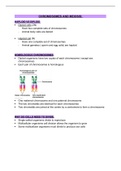
HAPLOID VS DIPLOID:
Diploid cells (2N)
- Have two complete sets of chromosomes
- Animal body cells are diploid
Haploid cell (N)
- Have one complete set of chromosomes
- Animal gametes ( sperm and egg cells) are haploid
HOMOLOGOUS CHROMOSOMES:
Diploid organisms have two copies of each chromosome ( except sex
chromosomes)
Each pair of chromosomes is homologous
One maternal chromosome and one paternal chromosome
The two chromatids are identical for each chromosomes
Two chromatids are joined at the centre by a centromere to form a chromosome
WHY DO CELLS NEED TO DIVIDE:
Single-celled organisms divide to reproduce
Multicellular organisms cell division allows the organism to grow
Some multicellular organisms must divide to produce sex cells
, CELL CYCLE:
2N
(Meiosis)
Egg cells Sperm cells
(N) (N)
(Fertilisation)
Zygote
(2N)
MITOSIS VS MEIOSIS:
Meiosis Mitosis
Homologous chromosomes pair up at single chromosomes line up at the
equator equator
Crossing over No crossing over
Two cell divisions One cell division
Four unidentical daughter cells Two identical daughter cells
Haploid daughter cells Diploid daughter cells
HAPLOID VS DIPLOID:
Diploid cells (2N)
- Have two complete sets of chromosomes
- Animal body cells are diploid
Haploid cell (N)
- Have one complete set of chromosomes
- Animal gametes ( sperm and egg cells) are haploid
HOMOLOGOUS CHROMOSOMES:
Diploid organisms have two copies of each chromosome ( except sex
chromosomes)
Each pair of chromosomes is homologous
One maternal chromosome and one paternal chromosome
The two chromatids are identical for each chromosomes
Two chromatids are joined at the centre by a centromere to form a chromosome
WHY DO CELLS NEED TO DIVIDE:
Single-celled organisms divide to reproduce
Multicellular organisms cell division allows the organism to grow
Some multicellular organisms must divide to produce sex cells
, CELL CYCLE:
2N
(Meiosis)
Egg cells Sperm cells
(N) (N)
(Fertilisation)
Zygote
(2N)
MITOSIS VS MEIOSIS:
Meiosis Mitosis
Homologous chromosomes pair up at single chromosomes line up at the
equator equator
Crossing over No crossing over
Two cell divisions One cell division
Four unidentical daughter cells Two identical daughter cells
Haploid daughter cells Diploid daughter cells