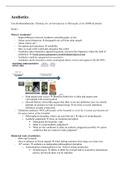
Aesthetics
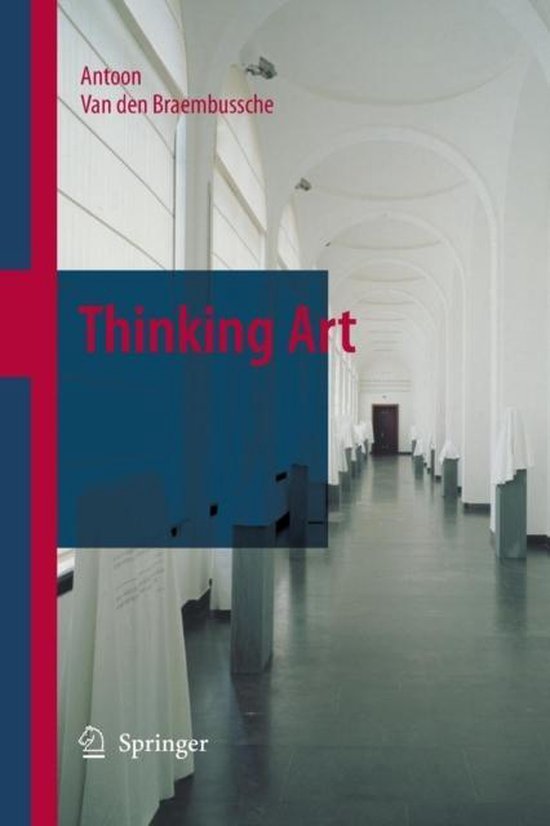
Van den Braembussche, Thinking Art, An Introduction to Philosophy of Art (2009) & articles
Week 1
What is Aesthetics?
- Slight difference between Aesthetics and philosophy of arts
- About social distinction à distinguish our self from other people
- About what is art?
- Perception and experience à sensibility
- How we look at the world and categorize this world
- Aesthetics takes humanities approach (general, universal developments within the field of
aesthetics) à Social science perspective (world behind object of art)
- Aesthetics could be categorized as essentialist
- Aesthetics slowly becomes a more sociological theory of art (convergence) (Wolff,1993)
o Kant argues taste is pure à Bourdieu thinks this is elitist and argues taste
corresponds with social position
o Howard Becker (Artworlds) argues that there is not one definition, how we classify
depends on position we take as human beings à art exists in social institution,
definition socially constructed
- Definition aesthetics àThe philosophy of the beautiful or of art & A system of principles for
the appreciation of the beautiful
o Philosophical discipline, what is art and what isn’t à object of art/production
o Aesthetic judgement à focus on reception perception
§ Distinguish the beautiful / ugly
§ What is a taste/aesthetic judgement?
§ What are the conditions to make an aesthetic judgement possible à a priori
conditions that are central to make judgment?
Historical roots of aesthetics
- Plato and Aristotle
- Idea of catharsis in Greek tragedy à when feeling emotions from stage you clean own
- 18th century à aesthetics as independent philosophical discipline
o Autonomation (emancipation) of art / field of artistic production
§ Enlightenment à ability to think for yourself and of yourself as autonomous
person, not forced upon you by authority
, § Conventions not decided by e.g. kingdom but by field itself
o Crisis of aesthetic norms
§ Reinvention of what is art
o Emergence of modern (natural) sciences
§ Birth of positivism
§ Understanding empirical rules of world à to change society to better place
§ Countermovement rationality à roots artistic knowledge not in our rational
cognitive abilities but in our feelings, sensibility
§ What are rules of art and its appreciation
o Growing out of and against enlightenment à emergence romanticism & bildung
§ Take science methods to study but study sensibility
§ Not only use science to change to world but also use arts (civilize people)
Difference aesthetics and philosophy of art
- Aisthesis à science of sense perception/sensation/sensibility
o Used in epistemological way
o Baumgarten
§ Aesthetica (1750 – 58) à Focus on distinction scientific and aesthetic
judgement
§ Reflection on Poetry (1735) à term aesthetics used in more modern way
“what is the definition of poetry/art?”
- Philosophy of art à critical reflection on the nature of art
- Used interchangeably in course
Philosophy of art vs. social science
- Distinction philosophical and empirical question
- What is the nature of art
Philosophy of art vs. sociology of culture/taste
- Distinction is determined formally and not materially à both are studying aesthetic judgment
but different question
- Philosophical cannot be answered with empirical research
- Aesthetic judgments are normative by nature, social scientist leave opinion out
Philosophy of art vs. art criticism
- Similarities
o Both normative by nature
o Aestheticians are influenced by own taste in formulating theory à similar premises
o Aesthetic judgments in art criticism often rely on aesthetics theory
- Distinction
o Criticism focus on particular vs. aesthetics focus on general
, 1. Imitation theory = Reality - Artwork
2. Expression theories = Artist - Artwork
3. Formalism = Artwork
4. Synthesis of form and expression = Artist - Artwork & Artwork
5. Aesthetic judgement = Artwork - Viewer
Aesthetics
Week 2
The Imitation Theory of Art
Introduction to the imitation theory of arts (Plato)
- Meaning Mimesis: imitation, image, copy
- Central to theory à art can imitate reality
- Reality à everything we can observe though the senses (empirical = trough experience)
- Plato refers to reality à world of ideas and/or form (something beyond empirical reality) à
idealist
- Plato (428/427 – 347 BC)
o Together with Aristotle one of most important founders of European philosophy
o Wealthy aristocratic family (Thirty Tyrants)
o Grew up in a turbulent time
§ Continuous wars Greek cities
§ Transition worldview mythos to logos à Not all decided by gods, but can
think and decided for themselves
§ Peloponnesian war
o 387 BC: Founding of Akademeia
o 407 BC: Meeting with Socrates (all we know of Socrates comes from work of Plato)
o Not systematic in work, wrote dialogues: Symposion (Love), Phaido (Socrates’ dying
day), Timaios (origins of cosmology), Politeia (justification), Nomoi (morality),
Gorgias (rhetorics)
o Politeia (380 BC)
§ Part 1: Ethics - what is the ideal society?
§ Part 2: Ontology – study of nature of being
§ Ontology = metaphysics à reality is behind or beyond what is empirically
observable
§ Distinction reality (the noumenal world) and appearances (the phenomenal
world) à metaphysical idealism
, • The noumenal world = Reality and created by god à unity between
the true, the beautiful and the good
§ Appearance = sensorily perceivable but in constant flux à never perceive the
same object in the same manner twice
§ How do we know the noumenal world exist?
• Logic: distinction the one cat and the word ‘cat’ à based on common
denominator humans able to formulate universal category
• Metaphysics: the one cat is a copy of the Cat (the idea/form created by
god)
§ Distinction knowledge (about reality by using ratio) and opinion (sensory
perception)
§ Human being also has an ultimate form à beauty, truth and the good
• Access beauty only through knowledge
§ Allegory of the cave à explanation ontology and ethics
• We are like the prisoners in the cave
• Merely see shadows produced by puppet showman
• Cave is phenomenal world
• Outside is noumenal
• By using ratio people can escape cave à way people should take
(ethics)
§ Ideal republic
• The idea of the Good exists and needs to be quested
• Philosopher (he/she who loves wisdom/to see the truth) only one to
‘see’ the Good
• King philosophers should be in power at age 50, trained by acidaemia
• Social hierarchy: philosophers (politics), soldiers (security), the people
(manual labour)
• Goal is to reach optimum ‘justice’
o Communal economy (no private ownership/property) à
competition brings chaos
o Ascetic lifestyle (self-control and moderation are important
values) à too much emotions bring chaos
o Eugenetics (king philosophers choose perfect partner for you)
Van den Braembussche, Thinking Art, An Introduction to Philosophy of Art (2009) & articles
Week 1
What is Aesthetics?
- Slight difference between Aesthetics and philosophy of arts
- About social distinction à distinguish our self from other people
- About what is art?
- Perception and experience à sensibility
- How we look at the world and categorize this world
- Aesthetics takes humanities approach (general, universal developments within the field of
aesthetics) à Social science perspective (world behind object of art)
- Aesthetics could be categorized as essentialist
- Aesthetics slowly becomes a more sociological theory of art (convergence) (Wolff,1993)
o Kant argues taste is pure à Bourdieu thinks this is elitist and argues taste
corresponds with social position
o Howard Becker (Artworlds) argues that there is not one definition, how we classify
depends on position we take as human beings à art exists in social institution,
definition socially constructed
- Definition aesthetics àThe philosophy of the beautiful or of art & A system of principles for
the appreciation of the beautiful
o Philosophical discipline, what is art and what isn’t à object of art/production
o Aesthetic judgement à focus on reception perception
§ Distinguish the beautiful / ugly
§ What is a taste/aesthetic judgement?
§ What are the conditions to make an aesthetic judgement possible à a priori
conditions that are central to make judgment?
Historical roots of aesthetics
- Plato and Aristotle
- Idea of catharsis in Greek tragedy à when feeling emotions from stage you clean own
- 18th century à aesthetics as independent philosophical discipline
o Autonomation (emancipation) of art / field of artistic production
§ Enlightenment à ability to think for yourself and of yourself as autonomous
person, not forced upon you by authority
, § Conventions not decided by e.g. kingdom but by field itself
o Crisis of aesthetic norms
§ Reinvention of what is art
o Emergence of modern (natural) sciences
§ Birth of positivism
§ Understanding empirical rules of world à to change society to better place
§ Countermovement rationality à roots artistic knowledge not in our rational
cognitive abilities but in our feelings, sensibility
§ What are rules of art and its appreciation
o Growing out of and against enlightenment à emergence romanticism & bildung
§ Take science methods to study but study sensibility
§ Not only use science to change to world but also use arts (civilize people)
Difference aesthetics and philosophy of art
- Aisthesis à science of sense perception/sensation/sensibility
o Used in epistemological way
o Baumgarten
§ Aesthetica (1750 – 58) à Focus on distinction scientific and aesthetic
judgement
§ Reflection on Poetry (1735) à term aesthetics used in more modern way
“what is the definition of poetry/art?”
- Philosophy of art à critical reflection on the nature of art
- Used interchangeably in course
Philosophy of art vs. social science
- Distinction philosophical and empirical question
- What is the nature of art
Philosophy of art vs. sociology of culture/taste
- Distinction is determined formally and not materially à both are studying aesthetic judgment
but different question
- Philosophical cannot be answered with empirical research
- Aesthetic judgments are normative by nature, social scientist leave opinion out
Philosophy of art vs. art criticism
- Similarities
o Both normative by nature
o Aestheticians are influenced by own taste in formulating theory à similar premises
o Aesthetic judgments in art criticism often rely on aesthetics theory
- Distinction
o Criticism focus on particular vs. aesthetics focus on general
, 1. Imitation theory = Reality - Artwork
2. Expression theories = Artist - Artwork
3. Formalism = Artwork
4. Synthesis of form and expression = Artist - Artwork & Artwork
5. Aesthetic judgement = Artwork - Viewer
Aesthetics
Week 2
The Imitation Theory of Art
Introduction to the imitation theory of arts (Plato)
- Meaning Mimesis: imitation, image, copy
- Central to theory à art can imitate reality
- Reality à everything we can observe though the senses (empirical = trough experience)
- Plato refers to reality à world of ideas and/or form (something beyond empirical reality) à
idealist
- Plato (428/427 – 347 BC)
o Together with Aristotle one of most important founders of European philosophy
o Wealthy aristocratic family (Thirty Tyrants)
o Grew up in a turbulent time
§ Continuous wars Greek cities
§ Transition worldview mythos to logos à Not all decided by gods, but can
think and decided for themselves
§ Peloponnesian war
o 387 BC: Founding of Akademeia
o 407 BC: Meeting with Socrates (all we know of Socrates comes from work of Plato)
o Not systematic in work, wrote dialogues: Symposion (Love), Phaido (Socrates’ dying
day), Timaios (origins of cosmology), Politeia (justification), Nomoi (morality),
Gorgias (rhetorics)
o Politeia (380 BC)
§ Part 1: Ethics - what is the ideal society?
§ Part 2: Ontology – study of nature of being
§ Ontology = metaphysics à reality is behind or beyond what is empirically
observable
§ Distinction reality (the noumenal world) and appearances (the phenomenal
world) à metaphysical idealism
, • The noumenal world = Reality and created by god à unity between
the true, the beautiful and the good
§ Appearance = sensorily perceivable but in constant flux à never perceive the
same object in the same manner twice
§ How do we know the noumenal world exist?
• Logic: distinction the one cat and the word ‘cat’ à based on common
denominator humans able to formulate universal category
• Metaphysics: the one cat is a copy of the Cat (the idea/form created by
god)
§ Distinction knowledge (about reality by using ratio) and opinion (sensory
perception)
§ Human being also has an ultimate form à beauty, truth and the good
• Access beauty only through knowledge
§ Allegory of the cave à explanation ontology and ethics
• We are like the prisoners in the cave
• Merely see shadows produced by puppet showman
• Cave is phenomenal world
• Outside is noumenal
• By using ratio people can escape cave à way people should take
(ethics)
§ Ideal republic
• The idea of the Good exists and needs to be quested
• Philosopher (he/she who loves wisdom/to see the truth) only one to
‘see’ the Good
• King philosophers should be in power at age 50, trained by acidaemia
• Social hierarchy: philosophers (politics), soldiers (security), the people
(manual labour)
• Goal is to reach optimum ‘justice’
o Communal economy (no private ownership/property) à
competition brings chaos
o Ascetic lifestyle (self-control and moderation are important
values) à too much emotions bring chaos
o Eugenetics (king philosophers choose perfect partner for you)