ORGANIZATION
THEORY
Summary 2020-2021
Chapter 1, 2, 5, 8, 9, 10, 11, 12, 13 & 14
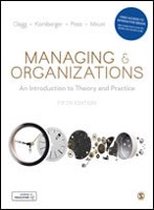
Source: Clegg, S.R., Kornberger, M., Pitsis, T.S. and Mount, M. (2019), Organization
Theory. London: SAGE
,Chapter 1
Contemporary managing and organizations in a changing world
Organizations are goal-oriented collectives. To be organized means being an element in a
systematic arrangement of parts, hopefully creating a unified, organic whole.
Management is the process of communicating, coordinating, and accomplishing action in the
pursuit of organizational objectives, while managing relationships with stakeholders,
technologies and other artefacts, both within as well as between organizations.
Organizations are tools: they are purposive, goal-oriented instruments designed to achieve a
specific objective.
Digitalization: the use of digital technologies and of data to manage organization processes.
Many of the jobs of the future are likely to be created and filled by digital nomads. These are
mobile workers armed with a laptop and Wi-Fi, connecting anywhere, and choosing mobility
rather than a fixed abode. They create problems for tax authorities: they can contrive not to
be anywhere long enough to be liable for taxation. Additionally, they tend to distort local
housing markets.
Even organizations, who are the clients of such workers, are changing, irrespective of their
mission, as a result of the possibilities afforded by digitalization.
Organizations in the digital age are switching from managing through ‘hard power’ in the
form of imperative commands to ‘soft power’ through indirect methods, such as induction
into an organizational culture, training and strategy workshops, or leadership courses.
New public management replaces public sector bureaucracy with public managers and
citizens with customers, managed by targets and audits.
Contemporary organizational changes
Principal agency theory has a fundamental premise that provision of capital by shareholders
is a risk-based endeavor in which the risks can be minimized if the agents that are managing
individuals’ capital at a distance are also themselves shareholders.
CEO compensation has grown far faster than that of other highly paid workers.
Digital organization
An increase in knowledge-intensive work means that organizations have to employ different
kind of employees. Technical and relational skills will be at a premium. Knowledge-intensive
work depends on much subtle tacit knowledge (enables you to speak grammatically or ride a
bike: you can do it but it would be hard to explain to a novice) as well as explicit mastery.
Knowledge workers, almost universally, are digital workers.
1
, Gig economy: participation in a labor market characterized by the prevalence of short-term
contracts or freelance work as opposed to permanent jobs.
New media can enable both discerning customers and ardent critics to become involved in
framing or even co-producing management’s strategic choices.
Managing as sensemaking
The predominant sense of what an organization should be has been modelled on lean and
efficient private-sector organizations that are profit-oriented. In organizations modelled as
thus, managing involves top management teams seeking to set a common frame within
which organization members, customers, suppliers, investors, and so on, can make common
sense of the organization – what it is and what it does. This is called sensemaking.
Considering the definition of sense-making, we can explore each of its terms in a little more
detail:
- Ongoing: We are always making sense – we never stop doing so, even when asleep.
- Retrospective: We make sense of something as it is elapsing and we are constantly
reviewing the sense we make in terms of additional sense data.
- Plausible: we never make perfect but rather provisional sense, sense that is good
enough for the matter and people at hand. It allows us to go on with what we are
trying to do.
- Images: we often work with representations of things – models, plans – as we
navigate our way around unfamiliar territory. We hear what the other is saying and
try to accommodate it to things we already know and carry round with us at our
stock of knowledge.
- Rationalize: we rationalize the meaning of things that are confusing to make them
clearer and justifiable.
- People: Although organizations contain many things that act which are not people –
such as computers – it is people who do the sensemaking.
- Doing: we do things through thinking and action, which define one another.
Managers create a frame, enabling things to be connected together to make coherent sense.
Framing occurs not only through sensemaking, but also through sensegiving and
sensebreaking. Sensegiving attempts to influence the sensemaking of others so that others
come to accept a preferred meaning. Sensebreaking occurs when organizational members
disrupt existing sense in order to make alternative sense.
Emotions matter in sensegiving.
Managerial rationality
When managers claim to be able to make decisions that deny legitimacy to other forms of
knowledge based on their generalized managerial competence, this is termed
managerialism. Managers that espouse the ideology of managerialism assume that
2
THEORY
Summary 2020-2021
Chapter 1, 2, 5, 8, 9, 10, 11, 12, 13 & 14
Source: Clegg, S.R., Kornberger, M., Pitsis, T.S. and Mount, M. (2019), Organization
Theory. London: SAGE
,Chapter 1
Contemporary managing and organizations in a changing world
Organizations are goal-oriented collectives. To be organized means being an element in a
systematic arrangement of parts, hopefully creating a unified, organic whole.
Management is the process of communicating, coordinating, and accomplishing action in the
pursuit of organizational objectives, while managing relationships with stakeholders,
technologies and other artefacts, both within as well as between organizations.
Organizations are tools: they are purposive, goal-oriented instruments designed to achieve a
specific objective.
Digitalization: the use of digital technologies and of data to manage organization processes.
Many of the jobs of the future are likely to be created and filled by digital nomads. These are
mobile workers armed with a laptop and Wi-Fi, connecting anywhere, and choosing mobility
rather than a fixed abode. They create problems for tax authorities: they can contrive not to
be anywhere long enough to be liable for taxation. Additionally, they tend to distort local
housing markets.
Even organizations, who are the clients of such workers, are changing, irrespective of their
mission, as a result of the possibilities afforded by digitalization.
Organizations in the digital age are switching from managing through ‘hard power’ in the
form of imperative commands to ‘soft power’ through indirect methods, such as induction
into an organizational culture, training and strategy workshops, or leadership courses.
New public management replaces public sector bureaucracy with public managers and
citizens with customers, managed by targets and audits.
Contemporary organizational changes
Principal agency theory has a fundamental premise that provision of capital by shareholders
is a risk-based endeavor in which the risks can be minimized if the agents that are managing
individuals’ capital at a distance are also themselves shareholders.
CEO compensation has grown far faster than that of other highly paid workers.
Digital organization
An increase in knowledge-intensive work means that organizations have to employ different
kind of employees. Technical and relational skills will be at a premium. Knowledge-intensive
work depends on much subtle tacit knowledge (enables you to speak grammatically or ride a
bike: you can do it but it would be hard to explain to a novice) as well as explicit mastery.
Knowledge workers, almost universally, are digital workers.
1
, Gig economy: participation in a labor market characterized by the prevalence of short-term
contracts or freelance work as opposed to permanent jobs.
New media can enable both discerning customers and ardent critics to become involved in
framing or even co-producing management’s strategic choices.
Managing as sensemaking
The predominant sense of what an organization should be has been modelled on lean and
efficient private-sector organizations that are profit-oriented. In organizations modelled as
thus, managing involves top management teams seeking to set a common frame within
which organization members, customers, suppliers, investors, and so on, can make common
sense of the organization – what it is and what it does. This is called sensemaking.
Considering the definition of sense-making, we can explore each of its terms in a little more
detail:
- Ongoing: We are always making sense – we never stop doing so, even when asleep.
- Retrospective: We make sense of something as it is elapsing and we are constantly
reviewing the sense we make in terms of additional sense data.
- Plausible: we never make perfect but rather provisional sense, sense that is good
enough for the matter and people at hand. It allows us to go on with what we are
trying to do.
- Images: we often work with representations of things – models, plans – as we
navigate our way around unfamiliar territory. We hear what the other is saying and
try to accommodate it to things we already know and carry round with us at our
stock of knowledge.
- Rationalize: we rationalize the meaning of things that are confusing to make them
clearer and justifiable.
- People: Although organizations contain many things that act which are not people –
such as computers – it is people who do the sensemaking.
- Doing: we do things through thinking and action, which define one another.
Managers create a frame, enabling things to be connected together to make coherent sense.
Framing occurs not only through sensemaking, but also through sensegiving and
sensebreaking. Sensegiving attempts to influence the sensemaking of others so that others
come to accept a preferred meaning. Sensebreaking occurs when organizational members
disrupt existing sense in order to make alternative sense.
Emotions matter in sensegiving.
Managerial rationality
When managers claim to be able to make decisions that deny legitimacy to other forms of
knowledge based on their generalized managerial competence, this is termed
managerialism. Managers that espouse the ideology of managerialism assume that
2