lOMoARcPSD|6552690
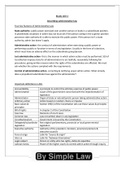
Study Unit 1
Describing administra4ve law
Four key features of Administra2ve Law
State authority- public power exercised over another person or body in a subordinate posi2on.
In problema2c situa2ons in admin law, we must ask if the person ac2ng in the superior posi2on
possesses state authority & is able to exercise this public power. If the person isn’t a state
authority, admin law doesn’t apply.
Administra4ve ac4on- the conduct of administrators when exercising a public power or
performing a public or func2on in terms of any legisla2on. Usually in the form of a decision,
which must have an adverse eDect on the subordinate group/person.
Just administra4ve ac4on- this is the manner in which admin ac2on must be performed. S33 of
Cons2tu2on imposes duty for all administrators to act lawfully, reasonably, following fair
procedures, giving wriIen reasons when the rights of the subordinates are aDected. We must
ask whether the ac2ons complied with the requirements.
Control of administra4ve ac4on- correc2ng & rec2fying unjust admin ac2on. What remedy
does a prejudiced subordinate have against the administrator?
Important deNni2ons in ADL
Accountability A principle to control the arbitrary exercise of public power
Administra2on A part of the government concerned with the implementa2on of
legisla2on
Administrator Organ of state or natural/juris2c person taking administra2ve ac2on
Arbitrary ac2on Ac2on based on random choice or impulse
Basic values & Sec2on 195(1) of the Cons2tu2on sets out these values & principles
principles
Bill of rights In chapter 2 of the Cons2tu2on
Case law Decisions of court cases
Common law Law not wriIen down in any legisla2on
Cons2tu2onalism Government is bound by the Cons2tu2on
Delegated/subordinate Not original parliamentary, provincial or local governmental
legisla2on legisla2on
Execu2ve authority Authority of the president, ministers, provincial premiers &
execu2ve councils
Fons et origo La2n for “source & origin”
Inter se La2n for “between themselves”
Legal subject Person or en2ty who has rights, du2es & capaci2es
Judicial review Power of the higher courts to control admin ac2on through inquiry
1
Downloaded by Wynand Roodman ()
, lOMoARcPSD|6552690
Legality The lawfulness of state ac2on
Legislature The body of people who have been elected to make laws
Limita2on clause Sec2on 36 of Cons2tu2on- the limita2on of rights
Ne bis in idem The rule that the same maIer may not be heard twice
Organ of state DeNned in Sec2on 239 of the Cons2tu2on
Public administra2on The ac2ons of all organs of state & administra2ons in all spheres of
government & public enterprises
Public service DeNned in Sec2on 197 of the Cons2tu2on
Res indicata A maIer that’s been dealt with can’t be reconsidered by the same
body, only a higher-ranking body
Statutory bodies Bodies created by law to perform certain func2ons for the state
Tes2ng of legisla2on Done through the process of cons2tu2onal review or judicial review
Confusing administra2ve ac2on with execu2ve ac2on
Cabinet ministers can perform administra2ve ac2on, even though S1 of the PAJA excludes
execu2ve powers & func2ons in the na2onal sphere. Administra2ve law deals with
administra2ve ac2on taken by organs of state. Execu2ve ac2on IS excluded, but these are
instances where ministers take ac2on at the highest level, eg- formula2ng a policy. Forming a
policy does not classify as administra2ve ac2on, but execu2ve ac2on, since this is a poli2cal
decision. But when a minister executes that policy or acts in terms of legisla2on, he acts in an
administra2ve capacity.
Just administra2ve ac2on
Must be…. Lawful, reasonable & procedurally fair
Lawful Must comply with the requirements of the law
Reasonable Must have a reasonable eDect or result
Procedurally Correct procedure must be used to take a decision
fair
WriIen reasons When a decision results in someone’s rights being adversely aDected,
wriIen reasons for the decision must be given
DeNning administra2ve law
-part of public law
-regulates ac2vi2es of organs of state & persons exercising public power or performing public
func2ons
Study unit 2
2
Downloaded by Wynand Roodman ()
, lOMoARcPSD|6552690
The administra4ve-law rela4onship
Administra2ve-law rela2onship
- A legal rela2onship with 2 or more subjects, governed by the law
- One of the subjects exercises state authority/power over the other
- Ver2cal rela2onship
Any decision, even by an administrator, MUST contain the superior & subordinate posi2ons to
qualify as falling into administra2ve law. They must also be authorized to exercise that state
power.
Within the administra2ve law rela2onship, we dis2nguish between…
1- The general/objec2ve rela2onship
2- The individual/subjec2ve rela2onship
General/objec2ve The legal rules governing the rela2onship between par2es apply to all
subjects within a par2cular group. This rela2onship is created, changed
or ended by legisla2on. The group cannot be “the public”, but rather a
class of persons, like refugees.
Individual/subjec2ve The rules governing this rela2onship apply personally & speciNcally
between par2es. Individua administra2ve rela2onships are created by
individual administra2ve decisions. These rela2onships are not aDected
by legisla2on.
Study unit 3
3
Downloaded by Wynand Roodman ()
, lOMoARcPSD|6552690
The legal subjects of the administra4ve-law rela4onship
Sec2on 239 of the Cons2tu2on deNnes an organ of state…
a) Any department of state or administra2on in the na2onal, provincial or local sphere of
government; or
b) Any other func2onary or ins2tu2on….
1- Exercising a power or performing a func2on in terms of the Cons2tu2on or a provincial
cons2tu2on
2- Exercising a public power or performing a public func2on in terms of any legisla2on,
BUT not including a court or a judicial ohcer
Any department of state or administra4on
In na2onal sphere- departments of state or governmental departments
Eg- Department of Arts & Culture, Health, Finance etc
This could refer to the whole dept or to its administrators
The President & Deputy are organs of state in this sphere aswell, but it is VITAL to dis2nguish
between their execu2ve & administra2ve func2ons
In provincial sphere- organs of state include the provincial departments of state, provincial
public service, Premiers of the 9 provinces & other Members or Execu2ve Councils (MECs),
but it is VITAL to dis2nguish between their execu2ve & administra2ve func2ons
In local sphere- organs of state include municipali2es & various municipal councils vested
with execu2ve authority
Any other func4onary or ins4tu4on….
1- Exercising a power or performing a func4on in terms of the Cons4tu4on or a
provincial cons4tu4on
2- Exercising a public power or performing a public func4on in terms of any
legisla4on
It may be dihcult to decide whether the func2onary or ins2tu2on is ac2ng in a public or
private capacity, & whether they are performing a public or private func2on
In each case we must determine whether …
1- The func2onary exercises public powers/func2ons
2- The func2onary is doing so in terms of legisla2on
Associa2ons, clubs & other private organisa2ons
4
Downloaded by Wynand Roodman ()
Study Unit 1
Describing administra4ve law
Four key features of Administra2ve Law
State authority- public power exercised over another person or body in a subordinate posi2on.
In problema2c situa2ons in admin law, we must ask if the person ac2ng in the superior posi2on
possesses state authority & is able to exercise this public power. If the person isn’t a state
authority, admin law doesn’t apply.
Administra4ve ac4on- the conduct of administrators when exercising a public power or
performing a public or func2on in terms of any legisla2on. Usually in the form of a decision,
which must have an adverse eDect on the subordinate group/person.
Just administra4ve ac4on- this is the manner in which admin ac2on must be performed. S33 of
Cons2tu2on imposes duty for all administrators to act lawfully, reasonably, following fair
procedures, giving wriIen reasons when the rights of the subordinates are aDected. We must
ask whether the ac2ons complied with the requirements.
Control of administra4ve ac4on- correc2ng & rec2fying unjust admin ac2on. What remedy
does a prejudiced subordinate have against the administrator?
Important deNni2ons in ADL
Accountability A principle to control the arbitrary exercise of public power
Administra2on A part of the government concerned with the implementa2on of
legisla2on
Administrator Organ of state or natural/juris2c person taking administra2ve ac2on
Arbitrary ac2on Ac2on based on random choice or impulse
Basic values & Sec2on 195(1) of the Cons2tu2on sets out these values & principles
principles
Bill of rights In chapter 2 of the Cons2tu2on
Case law Decisions of court cases
Common law Law not wriIen down in any legisla2on
Cons2tu2onalism Government is bound by the Cons2tu2on
Delegated/subordinate Not original parliamentary, provincial or local governmental
legisla2on legisla2on
Execu2ve authority Authority of the president, ministers, provincial premiers &
execu2ve councils
Fons et origo La2n for “source & origin”
Inter se La2n for “between themselves”
Legal subject Person or en2ty who has rights, du2es & capaci2es
Judicial review Power of the higher courts to control admin ac2on through inquiry
1
Downloaded by Wynand Roodman ()
, lOMoARcPSD|6552690
Legality The lawfulness of state ac2on
Legislature The body of people who have been elected to make laws
Limita2on clause Sec2on 36 of Cons2tu2on- the limita2on of rights
Ne bis in idem The rule that the same maIer may not be heard twice
Organ of state DeNned in Sec2on 239 of the Cons2tu2on
Public administra2on The ac2ons of all organs of state & administra2ons in all spheres of
government & public enterprises
Public service DeNned in Sec2on 197 of the Cons2tu2on
Res indicata A maIer that’s been dealt with can’t be reconsidered by the same
body, only a higher-ranking body
Statutory bodies Bodies created by law to perform certain func2ons for the state
Tes2ng of legisla2on Done through the process of cons2tu2onal review or judicial review
Confusing administra2ve ac2on with execu2ve ac2on
Cabinet ministers can perform administra2ve ac2on, even though S1 of the PAJA excludes
execu2ve powers & func2ons in the na2onal sphere. Administra2ve law deals with
administra2ve ac2on taken by organs of state. Execu2ve ac2on IS excluded, but these are
instances where ministers take ac2on at the highest level, eg- formula2ng a policy. Forming a
policy does not classify as administra2ve ac2on, but execu2ve ac2on, since this is a poli2cal
decision. But when a minister executes that policy or acts in terms of legisla2on, he acts in an
administra2ve capacity.
Just administra2ve ac2on
Must be…. Lawful, reasonable & procedurally fair
Lawful Must comply with the requirements of the law
Reasonable Must have a reasonable eDect or result
Procedurally Correct procedure must be used to take a decision
fair
WriIen reasons When a decision results in someone’s rights being adversely aDected,
wriIen reasons for the decision must be given
DeNning administra2ve law
-part of public law
-regulates ac2vi2es of organs of state & persons exercising public power or performing public
func2ons
Study unit 2
2
Downloaded by Wynand Roodman ()
, lOMoARcPSD|6552690
The administra4ve-law rela4onship
Administra2ve-law rela2onship
- A legal rela2onship with 2 or more subjects, governed by the law
- One of the subjects exercises state authority/power over the other
- Ver2cal rela2onship
Any decision, even by an administrator, MUST contain the superior & subordinate posi2ons to
qualify as falling into administra2ve law. They must also be authorized to exercise that state
power.
Within the administra2ve law rela2onship, we dis2nguish between…
1- The general/objec2ve rela2onship
2- The individual/subjec2ve rela2onship
General/objec2ve The legal rules governing the rela2onship between par2es apply to all
subjects within a par2cular group. This rela2onship is created, changed
or ended by legisla2on. The group cannot be “the public”, but rather a
class of persons, like refugees.
Individual/subjec2ve The rules governing this rela2onship apply personally & speciNcally
between par2es. Individua administra2ve rela2onships are created by
individual administra2ve decisions. These rela2onships are not aDected
by legisla2on.
Study unit 3
3
Downloaded by Wynand Roodman ()
, lOMoARcPSD|6552690
The legal subjects of the administra4ve-law rela4onship
Sec2on 239 of the Cons2tu2on deNnes an organ of state…
a) Any department of state or administra2on in the na2onal, provincial or local sphere of
government; or
b) Any other func2onary or ins2tu2on….
1- Exercising a power or performing a func2on in terms of the Cons2tu2on or a provincial
cons2tu2on
2- Exercising a public power or performing a public func2on in terms of any legisla2on,
BUT not including a court or a judicial ohcer
Any department of state or administra4on
In na2onal sphere- departments of state or governmental departments
Eg- Department of Arts & Culture, Health, Finance etc
This could refer to the whole dept or to its administrators
The President & Deputy are organs of state in this sphere aswell, but it is VITAL to dis2nguish
between their execu2ve & administra2ve func2ons
In provincial sphere- organs of state include the provincial departments of state, provincial
public service, Premiers of the 9 provinces & other Members or Execu2ve Councils (MECs),
but it is VITAL to dis2nguish between their execu2ve & administra2ve func2ons
In local sphere- organs of state include municipali2es & various municipal councils vested
with execu2ve authority
Any other func4onary or ins4tu4on….
1- Exercising a power or performing a func4on in terms of the Cons4tu4on or a
provincial cons4tu4on
2- Exercising a public power or performing a public func4on in terms of any
legisla4on
It may be dihcult to decide whether the func2onary or ins2tu2on is ac2ng in a public or
private capacity, & whether they are performing a public or private func2on
In each case we must determine whether …
1- The func2onary exercises public powers/func2ons
2- The func2onary is doing so in terms of legisla2on
Associa2ons, clubs & other private organisa2ons
4
Downloaded by Wynand Roodman ()