

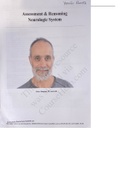
Assessment & Reasoning
Neurologic System
- -- ----
ce
er ia ur
s o r
se red re
m
ur ha y
v
Co s s tud
co
o.
s
w is
Peter Simpson, 55 years old
Th
H
a
0 2019 Keith Rischer/wWW.KeithRN.com
This study source was downloaded by 100000819951441 from CourseHero.com on 06-09-2021 01:34:33 GMT -05:00
https://www.coursehero.com/file/96569529/Neuro-clinical-homeworkpdf/
, SuvPested Neuroloeic Nursine Assessment Skills to Be Demonstrated:
Assessment: General
• Mental status: assess speech, orientation, memory, and level of consciousness• Posture, position
• Assess behavior, mood, and affect
• Assess dress, grooming, hygiene
Inspection: Neurological
• Level of consciousness, orientation
• Cranial nerves
• Gait, balance, coordination Head:
• Tongue-midline?
• Symmetry in facial features
• Grimace-big smile to assess facial droop
• Sensation each side face
• Pupils
• Eyes: conjugate vs. disconjugate/extra ocular eye movements/visual fields •uAssess cranial nerve II (Optic)
- Check PERRLA and visual fields
• Evaluate posture, gait, balance, involuntary movements.
• Assess light touch (to face and extremities), pain to extremities.
• Fine motor coordination UPPER: finger to nose w/eyes closed (sobriety test)
•••finger to nose then touch nurse's finger
•••fingers to thumb same hand in sequence
• Fine motor coordination LOWER: Rub heel on opposite shin/calf downwards
• Gross motor UPPER: bilateral hand grasp/pronator drift
• Gross motor LOWER: dorsi/plantar flexion, bilateral leg lift, Babinski
Inspection: Musculoskeletal
Observe posture - standing with feet together
Observe gait-weight-bearing, foot position, stride and length (and equality of stride), arm swing symmetry, and
posture
• Palpate muscles and joints for edema, heat, tenderness or crepitus
• Assess muscle strength (0 to 5 scale) and joint range of motion
FOCUSED/Frequent Neuro Assessment:
Signs/symptoms:
se are rce y
Pupil changes of any kind (sluggish/change in size-EARLY ICP)
o. a s
r
Assess LOC, orientation/new confusion, seizures, lethargic/unresponsive (LA TE ICP)
sh ou tud
• Headache, nausea, vomiting
er vi a
m u
VS changes: increased blood pressure, decreased HR, RR.
w
co Co
s
Role play or go through the interview/body assessment process - student to student or as a group.
• Review the case study as an application exercise in small groups or together as a class.
re is
• Depending on your program, some content in the case study may not have been taught. Do not let that
prevent you from utilizing this case study! Use II lo promote learning by having students Identity what
Ibey do not yet know and guide where they can find the information in the textbook or on the internet to
Th
address knowledge gaps. This is educational best practice aud another way to scaffold knowledge!
H d
s
102019 Keith Rischer/Www.KeithRN.com
This study source was downloaded by 100000819951441 from CourseHero.com on
06-09-2021 01:34:33 GMT -05:00
https://www.coursehero.com/file/96569529/Neuro-clinical-homeworkpdf/
Neurologic System
- -- ----
ce
er ia ur
s o r
se red re
m
ur ha y
v
Co s s tud
co
o.
s
w is
Peter Simpson, 55 years old
Th
H
a
0 2019 Keith Rischer/wWW.KeithRN.com
This study source was downloaded by 100000819951441 from CourseHero.com on 06-09-2021 01:34:33 GMT -05:00
https://www.coursehero.com/file/96569529/Neuro-clinical-homeworkpdf/
, SuvPested Neuroloeic Nursine Assessment Skills to Be Demonstrated:
Assessment: General
• Mental status: assess speech, orientation, memory, and level of consciousness• Posture, position
• Assess behavior, mood, and affect
• Assess dress, grooming, hygiene
Inspection: Neurological
• Level of consciousness, orientation
• Cranial nerves
• Gait, balance, coordination Head:
• Tongue-midline?
• Symmetry in facial features
• Grimace-big smile to assess facial droop
• Sensation each side face
• Pupils
• Eyes: conjugate vs. disconjugate/extra ocular eye movements/visual fields •uAssess cranial nerve II (Optic)
- Check PERRLA and visual fields
• Evaluate posture, gait, balance, involuntary movements.
• Assess light touch (to face and extremities), pain to extremities.
• Fine motor coordination UPPER: finger to nose w/eyes closed (sobriety test)
•••finger to nose then touch nurse's finger
•••fingers to thumb same hand in sequence
• Fine motor coordination LOWER: Rub heel on opposite shin/calf downwards
• Gross motor UPPER: bilateral hand grasp/pronator drift
• Gross motor LOWER: dorsi/plantar flexion, bilateral leg lift, Babinski
Inspection: Musculoskeletal
Observe posture - standing with feet together
Observe gait-weight-bearing, foot position, stride and length (and equality of stride), arm swing symmetry, and
posture
• Palpate muscles and joints for edema, heat, tenderness or crepitus
• Assess muscle strength (0 to 5 scale) and joint range of motion
FOCUSED/Frequent Neuro Assessment:
Signs/symptoms:
se are rce y
Pupil changes of any kind (sluggish/change in size-EARLY ICP)
o. a s
r
Assess LOC, orientation/new confusion, seizures, lethargic/unresponsive (LA TE ICP)
sh ou tud
• Headache, nausea, vomiting
er vi a
m u
VS changes: increased blood pressure, decreased HR, RR.
w
co Co
s
Role play or go through the interview/body assessment process - student to student or as a group.
• Review the case study as an application exercise in small groups or together as a class.
re is
• Depending on your program, some content in the case study may not have been taught. Do not let that
prevent you from utilizing this case study! Use II lo promote learning by having students Identity what
Ibey do not yet know and guide where they can find the information in the textbook or on the internet to
Th
address knowledge gaps. This is educational best practice aud another way to scaffold knowledge!
H d
s
102019 Keith Rischer/Www.KeithRN.com
This study source was downloaded by 100000819951441 from CourseHero.com on
06-09-2021 01:34:33 GMT -05:00
https://www.coursehero.com/file/96569529/Neuro-clinical-homeworkpdf/

