OPMT 1197
Business Statistics
Lecture 15: Confidence Intervals for the Mean and Finding the Sample
Size (when the Standard Deviation of a Population is Unknown)
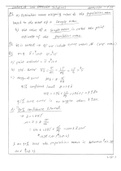
If the sample size is small, the sample standard deviation is not a good (close) estimate of
the population standard deviation, σ. An adjustment is needed so we use the t-tables.
t-distribution
1. Bell-shaped and symmetrical about the mean.
2. Flatter in the middle and has longer tails compared to the standard normal distribution.
3. A family of curves based on the degrees of freedom = n – 1.
4. As the sample size increases, the t-curve becomes more like the standard normal curve.
You just got a job offer to work at a downtown accounting firm. You wonder if you can afford to
rent an apartment downtown, so you call 9 randomly selected apartment buildings and ask how
much the monthly rent is for a one-bedroom apartment. The data (in order) is:
1,900 1,925 1,975 1,975 2,000 2,025 2,275 2,300 2,750
(a) Construct a 95% confidence interval estimate for the true mean rental cost for a one-
bedroom apartment downtown.
(b) What is the margin of error on the estimate of the true mean rental cost?
(c) What assumption must you make before you construct the confidence interval? Is this a
valid assumption? Does the mean = median?
You need to take a much larger sample. You randomly select 150 apartment buildings and
obtain a mean rent of $1,980/month and a standard deviation of $275/month.
(d) Construct a 95% confidence interval estimate for the true mean rental cost for a one-
bedroom apartment downtown.
(e) If you budget $1,900/month would it be enough for an average one-bedroom apartment? You
decide to budget $1,950. Is this enough? Should you budget $2,050 instead?
We want to be 95% sure that your estimate of the average monthly rent for a one-bedroom
apartment is within $30 of the true average (µ). Assume that the sample standard deviation of
$275 is a reasonably close estimate of the population standard deviation.
(f) How many apartment buildings would you need to sample so that you are 95% confident
that the estimated (sample) mean is within $30 of the true population mean rental cost for a
one-bedroom apartment downtown? (to reduce the maximum error on your estimate to $30)
(g) Suppose we take a sample of 323 apartments, and obtain a sample mean of $1,980 and a
standard deviation of $275. We can be 95% confident (sure) that the true average rental cost
for a one-bedroom apartment is between and
(h) You want to cut the margin of error in half. How large of a sample would you need?
Business Statistics
Lecture 15: Confidence Intervals for the Mean and Finding the Sample
Size (when the Standard Deviation of a Population is Unknown)
If the sample size is small, the sample standard deviation is not a good (close) estimate of
the population standard deviation, σ. An adjustment is needed so we use the t-tables.
t-distribution
1. Bell-shaped and symmetrical about the mean.
2. Flatter in the middle and has longer tails compared to the standard normal distribution.
3. A family of curves based on the degrees of freedom = n – 1.
4. As the sample size increases, the t-curve becomes more like the standard normal curve.
You just got a job offer to work at a downtown accounting firm. You wonder if you can afford to
rent an apartment downtown, so you call 9 randomly selected apartment buildings and ask how
much the monthly rent is for a one-bedroom apartment. The data (in order) is:
1,900 1,925 1,975 1,975 2,000 2,025 2,275 2,300 2,750
(a) Construct a 95% confidence interval estimate for the true mean rental cost for a one-
bedroom apartment downtown.
(b) What is the margin of error on the estimate of the true mean rental cost?
(c) What assumption must you make before you construct the confidence interval? Is this a
valid assumption? Does the mean = median?
You need to take a much larger sample. You randomly select 150 apartment buildings and
obtain a mean rent of $1,980/month and a standard deviation of $275/month.
(d) Construct a 95% confidence interval estimate for the true mean rental cost for a one-
bedroom apartment downtown.
(e) If you budget $1,900/month would it be enough for an average one-bedroom apartment? You
decide to budget $1,950. Is this enough? Should you budget $2,050 instead?
We want to be 95% sure that your estimate of the average monthly rent for a one-bedroom
apartment is within $30 of the true average (µ). Assume that the sample standard deviation of
$275 is a reasonably close estimate of the population standard deviation.
(f) How many apartment buildings would you need to sample so that you are 95% confident
that the estimated (sample) mean is within $30 of the true population mean rental cost for a
one-bedroom apartment downtown? (to reduce the maximum error on your estimate to $30)
(g) Suppose we take a sample of 323 apartments, and obtain a sample mean of $1,980 and a
standard deviation of $275. We can be 95% confident (sure) that the true average rental cost
for a one-bedroom apartment is between and
(h) You want to cut the margin of error in half. How large of a sample would you need?