Nutriti on Portage Online Summer 2018
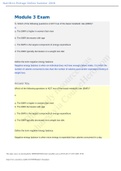
Module 3 Exam
1. Which of the following questions is NOT true of the basal metabolic rate (BMR)?
a
a. The BMR is higher in women than men
b. The BMR decreases with age
c. The BMR is the largest component of energy expenditure
d. The BMR typically decreases on a weight loss diet
m
er as
Define the term negative energy balance.
co
Negative energy balance is when an individual does not have enough calorie intake. It is when the
eH w
number of calories consumed is less than the number of calories used and/or expended resulting in
o.
weight loss.
rs e
ou urc
Answer Key
o
aC s
Which of the following questions is NOT true of the basal metabolic rate (BMR)?
vi y re
a
ed d
a. The BMR is higher in women than men
ar stu
b. The BMR decreases with age
c. The BMR is the largest component of energy expenditure
is
Th
d. The BMR typically decreases on a weight loss diet
sh
Define the term negative energy balance.
Negative energy balance is when more energy is expended than calories consumed in a day.
This study source was downloaded by 100000828872084 from CourseHero.com on 09-03-2021 17:45:51 GMT -05:00
https://www.coursehero.com/file/32235498/Module-3-Examdocx/
, Nutriti on Portage Online Summer 2018
2. Using the guidelines for Body Mass Index someone with a body mass index of 25 to 29.9 would
be considered Overweight
Skin fold measures estimates a person’s percentage of fat by using calipers.
Instructor Comments
I will take "skin fold measures" but remember that these are a part of the overall anthropometrics
that assess a person's health and nutritional status.
Answer Key
Using the guidelines for Body Mass Index someone with a body mass index of 25 to 29.9 would be
considered
m
er as
overweight
co
eH w
Anthropometrics
o.
rs e
estimates a person’s percentage of fat by using calipers.
ou urc
3. Calculate the EER for a female who is 33 years old, 5 feet 9 inches tall, 145 pounds with a low
o
activity lifestyle.
aC s
vi y re
Activity Level PA Men PA Women
Sedentary - No exercise 1.00 1.00
Low Activity - exercises the equivalent of walking 2 miles per day at 3-4
1.11 1.12
mph
ed d
Active - exercises the equivalent of walking 7 miles per day 1.25 1.27
ar stu
Very Active - exercises the equivalent of walking 17 miles per day 1.48 1.45
is
Th
sh
Males: EER = 662 - (9.53 x AGE) + PA x (15.91 x WT + 539.6 x HT)
Females: EER = 354 - (6.91 x AGE) + PA * (9.36 x WT + 726 x HT)
This study source was downloaded by 100000828872084 from CourseHero.com on 09-03-2021 17:45:51 GMT -05:00
https://www.coursehero.com/file/32235498/Module-3-Examdocx/
Module 3 Exam
1. Which of the following questions is NOT true of the basal metabolic rate (BMR)?
a
a. The BMR is higher in women than men
b. The BMR decreases with age
c. The BMR is the largest component of energy expenditure
d. The BMR typically decreases on a weight loss diet
m
er as
Define the term negative energy balance.
co
Negative energy balance is when an individual does not have enough calorie intake. It is when the
eH w
number of calories consumed is less than the number of calories used and/or expended resulting in
o.
weight loss.
rs e
ou urc
Answer Key
o
aC s
Which of the following questions is NOT true of the basal metabolic rate (BMR)?
vi y re
a
ed d
a. The BMR is higher in women than men
ar stu
b. The BMR decreases with age
c. The BMR is the largest component of energy expenditure
is
Th
d. The BMR typically decreases on a weight loss diet
sh
Define the term negative energy balance.
Negative energy balance is when more energy is expended than calories consumed in a day.
This study source was downloaded by 100000828872084 from CourseHero.com on 09-03-2021 17:45:51 GMT -05:00
https://www.coursehero.com/file/32235498/Module-3-Examdocx/
, Nutriti on Portage Online Summer 2018
2. Using the guidelines for Body Mass Index someone with a body mass index of 25 to 29.9 would
be considered Overweight
Skin fold measures estimates a person’s percentage of fat by using calipers.
Instructor Comments
I will take "skin fold measures" but remember that these are a part of the overall anthropometrics
that assess a person's health and nutritional status.
Answer Key
Using the guidelines for Body Mass Index someone with a body mass index of 25 to 29.9 would be
considered
m
er as
overweight
co
eH w
Anthropometrics
o.
rs e
estimates a person’s percentage of fat by using calipers.
ou urc
3. Calculate the EER for a female who is 33 years old, 5 feet 9 inches tall, 145 pounds with a low
o
activity lifestyle.
aC s
vi y re
Activity Level PA Men PA Women
Sedentary - No exercise 1.00 1.00
Low Activity - exercises the equivalent of walking 2 miles per day at 3-4
1.11 1.12
mph
ed d
Active - exercises the equivalent of walking 7 miles per day 1.25 1.27
ar stu
Very Active - exercises the equivalent of walking 17 miles per day 1.48 1.45
is
Th
sh
Males: EER = 662 - (9.53 x AGE) + PA x (15.91 x WT + 539.6 x HT)
Females: EER = 354 - (6.91 x AGE) + PA * (9.36 x WT + 726 x HT)
This study source was downloaded by 100000828872084 from CourseHero.com on 09-03-2021 17:45:51 GMT -05:00
https://www.coursehero.com/file/32235498/Module-3-Examdocx/